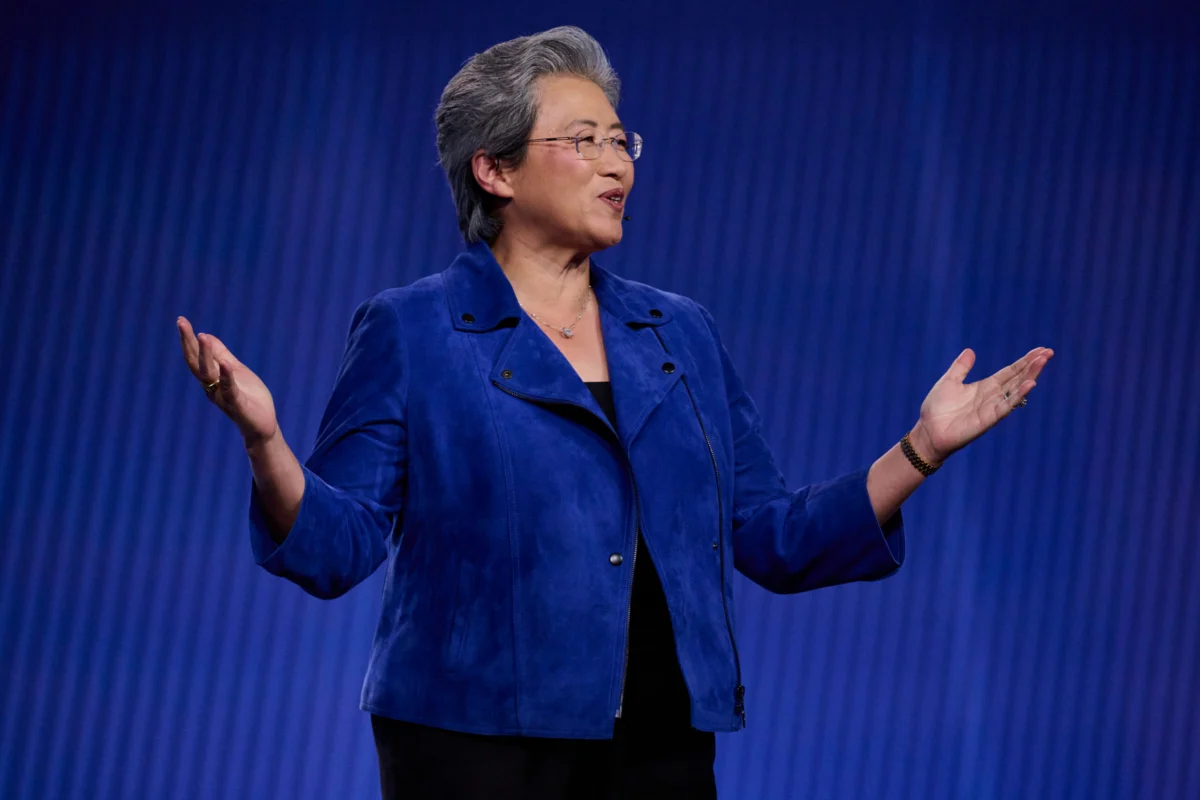
In a bold move to capture a significant share of the burgeoning artificial intelligence hardware market, chipmaker Advanced Micro Devices (AMD) has unveiled its latest offering: Helios, a comprehensive rack-scale system meticulously engineered to meet the colossal computing demands of the world’s leading AI laboratories. The announcement, made at AMD’s sold-out Advancing AI conference in San Francisco, signals a direct confrontation with incumbent market leader Nvidia and underscores AMD’s strategic ambition to become a central player in the AI revolution.
The Advancing AI conference, held on Thursday, served as the grand stage for AMD Chair and CEO Dr. Lisa Su to not only introduce Helios but also to highlight the growing ecosystem of clients eager to deploy this new hardware. Among the prominent early adopters is Microsoft, a titan in cloud computing and AI development, which has committed to integrating Helios into its infrastructure. The company also showcased its latest generation of AI-focused chips, designed to fuel the insatiable computational appetite of the artificial intelligence industry.
Understanding Rack-Scale AI Systems
Rack-scale systems represent a paradigm shift in high-performance computing, particularly for AI workloads. These integrated units consolidate numerous high-powered processors—often GPUs (Graphics Processing Units) and CPUs (Central Processing Units)—into a single, cohesive, and massively powerful unit. They are purpose-built for the demanding environment of data centers, where they are instrumental in both the training of complex AI models, a process that can require exabytes of data and trillions of computations, and the subsequent inference, where these trained models are deployed to make predictions or generate content. The ability to scale these systems horizontally by adding more racks allows organizations to tackle increasingly complex AI challenges and manage vast datasets efficiently.
Helios: AMD’s Bid for AI Supremacy
Dr. Su proudly declared Helios to be the tech industry’s "highest-performance AI rack," emphasizing its design for "training and running the most demanding frontier models in the world at massive scale." The company revealed that Helios will be deployed by leading AI companies at "gigawatt-scale," a testament to the sheer power and volume of these deployments. This ambitious claim positions Helios as a direct challenger to Nvidia’s established dominance in this critical market segment.
Historically, Nvidia has been the undisputed leader in the AI rack system arena, boasting successful products such as its Vera Rubin and Grace Blackwell platforms. AMD’s introduction of Helios is a clear strategic maneuver to disrupt this established order. Early indications suggest that Helios may indeed possess the performance capabilities to compete effectively. Reports, such as those from The Register, suggest that Helios benchmarks favorably against Nvidia’s Vera Rubin system across several key metrics, indicating a genuine potential for AMD to carve out a substantial market share.
A Growing Clientele and Strategic Partnerships
The momentum behind Helios is further amplified by its already impressive roster of early customers. The system, which was initially revealed in 2025 and publicly demonstrated on stage at CES 2026 in January, has garnered commitments from some of the most influential names in AI research and development. These include OpenAI, the pioneering AI research lab behind models like ChatGPT; Meta, the parent company of Facebook and Instagram, which is heavily invested in AI for its metaverse ambitions; Oracle, a major enterprise cloud provider; Anthropic, another prominent AI safety and research company; and Microsoft, a foundational player in both cloud infrastructure and AI development.
Microsoft’s commitment to expanding its Azure cloud infrastructure with Helios, as announced by CEO Satya Nadella on Monday, is a significant endorsement. This move signifies that Azure, a platform hosting numerous AI workloads for businesses globally, will offer AMD’s cutting-edge AI hardware.
Furthermore, AMD and Anthropic have forged a strategic partnership, announced on Wednesday, to deploy an astounding two gigawatts of AMD Instinct MI450 series GPUs through the new Helios rack system. This substantial commitment underscores the confidence these leading AI organizations have in AMD’s technological prowess and its ability to deliver at a massive scale. This partnership alone represents a significant step towards realizing the gigawatt-scale deployments AMD envisions.
The Evolving AI Hardware Landscape
The rapid advancements in artificial intelligence are creating an unprecedented surge in demand for specialized computing hardware. AI models, particularly the large language models (LLMs) and generative AI systems that have captured public imagination, require immense computational power for both training and inference. This demand is driving innovation and competition among hardware manufacturers.
AMD’s strategy extends beyond just rack systems. During the Advancing AI conference, the company also unveiled its Venice-X CPU, a processor specifically designed for data centers and engineered to handle the most demanding high-computing workloads. The Venice-X is slated for a 2027 launch, indicating AMD’s long-term commitment to building a comprehensive portfolio of AI-centric hardware.
The Future of AI Compute: A Trillion-Dollar Market
Dr. Lisa Su articulated a compelling vision for the future of the chip industry during her keynote address. She projected that chips powering AI will constitute a massive segment of the overall computing market by the year 2030. This projection is underpinned by what she described as a "step change in compute demand," largely fueled by the rise of agentic AI.
"When you ask the agent to do something, it actually has dozens of steps, and it has to reason, and it has to call tools, and it has to access data, and it has to keep doing it over and over until it solves the problem, and so you need lots of GPUs to do all that," Dr. Su explained, illustrating the complex computational processes involved in modern AI agents. This inherent complexity necessitates a significant increase in processing power.
AMD’s market analysis is particularly striking. "We’re now expecting that by 2030, the AI accelerator market is going to reach about $1.4 trillion," Dr. Su stated. "What that means is, by the end of the decade, the AI accelerator market is going to approach the size of the entire semiconductor market today." This forecast positions the AI accelerator market as one of the most significant growth engines in the technology sector.
Dr. Su further elaborated on the projected market composition, noting, "We do expect that GPUs are going to make up the vast majority of that market because the algorithms are still very much in their infancy, and we’re still continuing to see the workloads change, and that favors programmability in the overall silicon ecosystem." This highlights the ongoing evolution of AI algorithms and the critical role of programmable hardware like GPUs in adapting to these changes.
Implications and Analysis
AMD’s aggressive push into the AI hardware market with Helios signifies a pivotal moment for the semiconductor industry. For years, Nvidia has enjoyed a near-monopoly in high-performance AI computing, a position that has fueled its meteoric rise. AMD’s introduction of a competitive, high-performance rack-scale system, backed by significant customer commitments, introduces genuine competition and could lead to greater innovation and potentially more competitive pricing for AI infrastructure.
The success of Helios will depend on several factors, including its ability to deliver on its performance promises in real-world deployments, the ongoing development of its software ecosystem to support its hardware, and its capacity to scale manufacturing to meet the anticipated demand. The strategic partnerships with giants like Microsoft and Anthropic provide a strong foundation, offering immediate avenues for deployment and validation.
The projected $1.4 trillion AI accelerator market by 2030 underscores the immense economic opportunity. AMD’s ambition with Helios and its broader AI hardware strategy positions it as a key contender in this lucrative and rapidly expanding market. As AI continues to permeate various industries, the demand for powerful and efficient computing infrastructure will only intensify, making the competitive landscape for companies like AMD and Nvidia even more dynamic. The race to build the future of AI is on, and AMD’s Helios is a significant new contender in the arena.