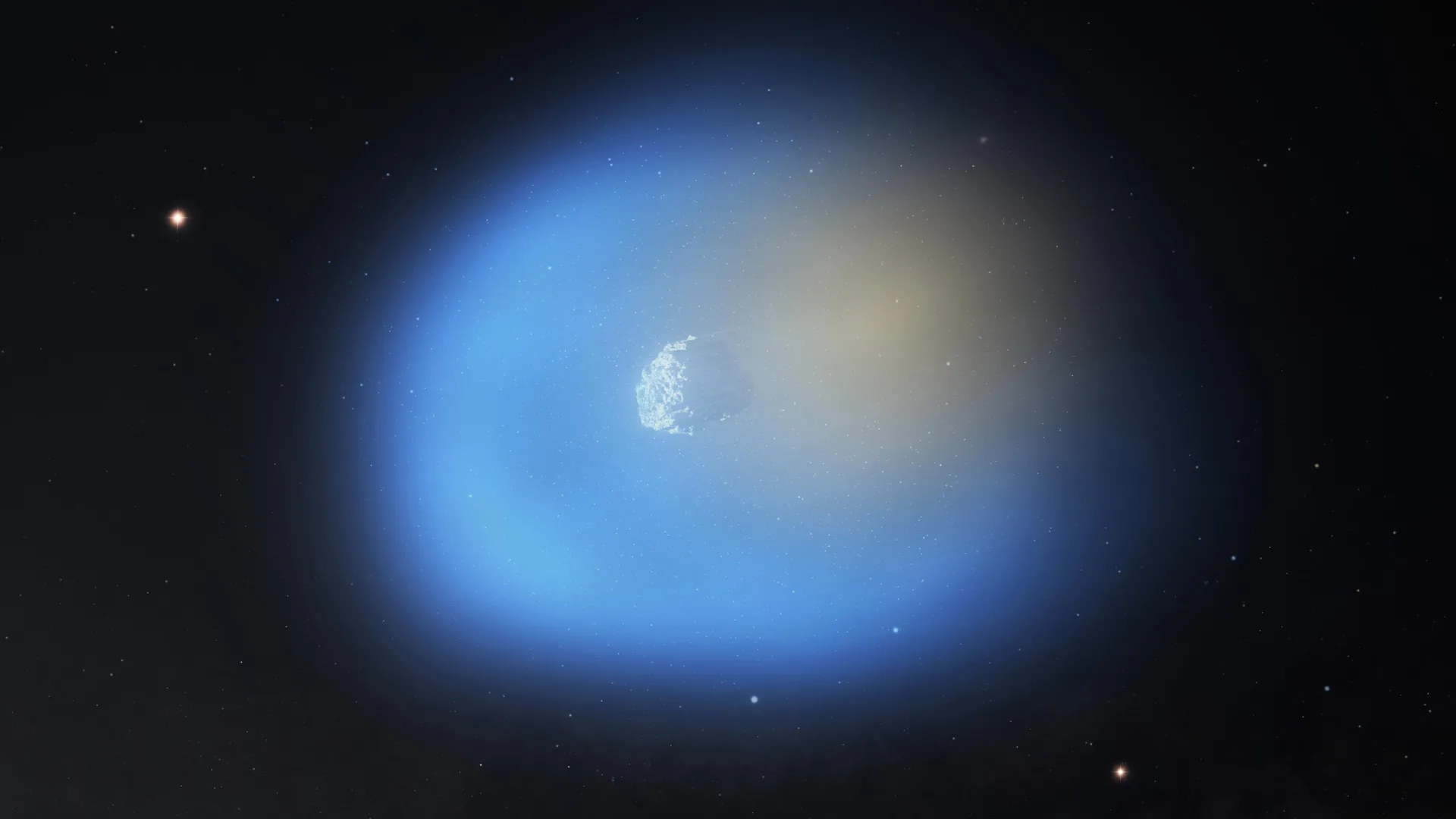
The arrival of an interstellar visitor within our solar system offers a rare, fleeting glimpse into the chemical architecture of distant, alien planetary nurseries. Comet 3I/ATLAS, the third confirmed interstellar object to traverse our neighborhood, has provided astronomers with a wealth of data that challenges current models of comet formation. Recent high-resolution observations conducted by the Atacama Large Millimeter/submillimeter Array (ALMA)—a premier astronomical facility co-managed by the U.S. National Science Foundation’s National Radio Astronomy Observatory (NRAO)—have unveiled that this visitor possesses a chemical signature markedly distinct from those found in our own solar system, most notably an extraordinarily high concentration of methanol.
A Rare Cosmic Fingerprint
As the comet navigated its trajectory toward the Sun in late 2025, it began to shed its frozen mantle, releasing a cloud of gas and dust known as a coma. By utilizing the Atacama Compact Array in Chile, an international team of researchers was able to conduct a sophisticated spectroscopic analysis of this coma. The primary objective was to deconstruct the chemical fingerprint of the comet, effectively treating 3I/ATLAS as a time capsule from a distant star system.
"Observing 3I/ATLAS is like taking a fingerprint from another solar system," explained Nathan Roth, the study’s lead author and a professor at American University. "The details reveal what it’s made of, and it’s bursting with methanol in a way we just don’t usually see in comets in our own solar system."
The implications of this discovery are profound. By analyzing the molecular ratios within the coma, scientists can infer the thermal and chemical conditions that existed at the time of the comet’s birth, millions or even billions of miles away from our Sun.
Chronology of the 2025 Observation Campaign
The scientific campaign to study 3I/ATLAS was a coordinated effort that spanned several months. As the object approached perihelion—its closest point to the Sun—the increasing solar radiation triggered intense sublimation. This process, where solid ice transitions directly into gas, provided the necessary material for the researchers to analyze.
Throughout late 2025, ALMA’s antennas were trained on the comet on multiple dates. This timeline allowed the team to track the evolution of the comet’s outgassing as it grew warmer. The initial data sets confirmed the presence of hydrogen cyanide (HCN), a standard nitrogen-bearing organic molecule typical of comets. However, as the data was processed, the methanol (CH₃OH) readings began to exceed all prior expectations. On two specific observation dates, the team recorded methanol-to-HCN ratios of approximately 70 and 120. These figures place 3I/ATLAS in a unique, highly enriched category of icy bodies, far surpassing the methanol abundance of virtually every native solar system comet ever surveyed.
Decoding the Chemical Divergence
The disparity in chemical makeup between 3I/ATLAS and local comets suggests that the environments in which these objects coalesce vary significantly across the galaxy. In the local solar system, comets are generally composed of a specific mixture of volatiles, formed in the cold, primordial protoplanetary disk. The excessive methanol detected in 3I/ATLAS points toward a formation history characterized by unique volatile-trapping processes or subsequent exposure to high-energy environments, such as those found near young, volatile-rich stars.
This finding builds upon earlier investigations conducted by the James Webb Space Telescope (JWST). While JWST observed the comet at a greater distance from the Sun, it noted a coma dominated by carbon dioxide. The transition from a carbon dioxide-rich coma to a methanol-rich environment as the comet approached the Sun indicates a complex, multi-layered internal structure. This stratification suggests that the comet experienced different thermal regimes during its formation, likely migrating through different zones of its parent star’s protoplanetary disk before being ejected into interstellar space.
The Dynamics of Micro-Comets
One of the most striking aspects of the ALMA data was the spatial distribution of the molecules. By utilizing ALMA’s high-resolution imaging capabilities, astronomers observed a clear divergence in how methanol and hydrogen cyanide were released from the object.
Hydrogen cyanide appeared to be emitted primarily from the comet’s central nucleus, a standard behavior consistent with the sublimation of ice directly from the core. In contrast, methanol demonstrated a more diffuse emission pattern. It originated not only from the nucleus but also from icy dust grains floating within the coma. These tiny grains, effectively functioning as "mini-comets," continued to sublime as they moved further away from the main body, releasing a secondary, lingering plume of methanol into the surrounding environment. While this phenomenon has been theorized in local comets, this study marks the first time such granular physics has been documented in an object of interstellar origin.
Contextualizing Interstellar Visitors
To date, humanity has confirmed only three interstellar visitors: 1I/‘Oumuamua, 2I/Borisov, and now 3I/ATLAS. Each discovery has fundamentally altered our understanding of the galaxy. 1I/‘Oumuamua, discovered in 2017, was notable for its anomalous trajectory and lack of a visible coma, sparking intense debate regarding its composition. 2I/Borisov, the first confirmed interstellar comet, displayed more conventional cometary behavior, yet still carried a distinct isotopic signature that set it apart from local bodies.
3I/ATLAS serves as the next logical step in this comparative research. By having three distinct data sets, scientists are moving from anecdotal observation to comparative exoplanetary science. The ability to compare the chemical "flavors" of these visitors—carbon dioxide dominance, organic molecule ratios, and isotopic signatures—allows astronomers to begin mapping the diversity of planetary systems throughout the Milky Way.
Scientific Implications and Future Directions
The high methanol content of 3I/ATLAS raises critical questions about the prevalence of complex organic molecules in the early stages of planetary formation. Methanol is a vital precursor for more complex organic compounds, potentially including the building blocks of life. If interstellar comets are commonly as rich in methanol as 3I/ATLAS appears to be, it implies that the "chemical seeds" for life are distributed far more ubiquitously across the galaxy than previously theorized.
Furthermore, the study highlights the necessity of multi-wavelength observation. By combining the wide-field, infrared capabilities of the James Webb Space Telescope with the high-resolution, submillimeter precision of ALMA, scientists can create a holistic view of an object’s composition. This multi-messenger approach is essential for identifying the subtle nuances in gas release and dust distribution that reveal the inner life of these frozen wanderers.
As the scientific community continues to analyze the 3I/ATLAS data, the focus will likely shift toward reconciling the chemical abundances found here with known models of planetary migration. If the comet’s chemistry is indeed indicative of its home system, then 3I/ATLAS is not merely a transient visitor, but a piece of evidence suggesting that our own solar system’s chemical composition may be one of many variations rather than a universal standard.
Looking ahead, the development of more sensitive wide-field survey telescopes—such as the Vera C. Rubin Observatory—is expected to increase the frequency with which we detect these interstellar travelers. With each new discovery, the "fingerprints" collected by astronomers like Nathan Roth and his colleagues provide a more detailed map of the galaxy’s composition. The study of 3I/ATLAS is a testament to the fact that while we remain bound to our own solar system, the icy, methanol-rich debris of other stars is constantly drifting through our backyard, waiting to be read like a ledger of the universe’s history.
The successful analysis of 3I/ATLAS is not just a triumph of instrument sensitivity; it is a profound step forward in our understanding of how the fundamental materials of life are synthesized and transported across the interstellar medium. As we refine our ability to study these objects, we move ever closer to answering the foundational question of whether our solar system is a typical example of planetary evolution or an outlier in a vast, chemically diverse cosmos.