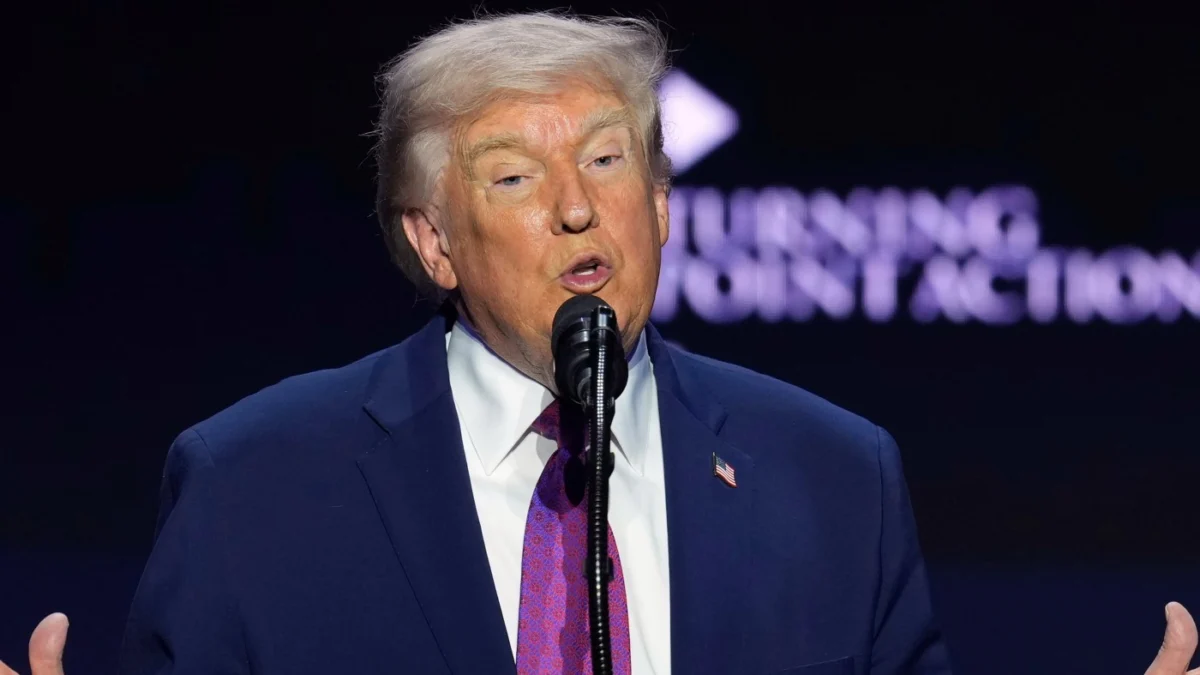
President Trump’s address at a Turning Point USA event in Arizona on Friday, where he detailed his administration’s stringent policies towards Iran, was met with enthusiastic applause from a predominantly young conservative audience, even as contradictory statements from Iranian officials regarding the vital Strait of Hormuz sparked confusion and market volatility globally. The event, dubbed "Build the Red Wall," served as a platform for the President to galvanize his base ahead of upcoming midterm elections, touching on a range of familiar campaign themes including immigration, tax cuts, and his vision for the 2024 election, alongside a hawkish stance on Tehran’s nuclear ambitions and regional influence.
Trump’s Assertive Stance on Iran’s Nuclear Program
Speaking to a receptive crowd, President Trump directly engaged the audience on the topic of Iran, asking, "Would anybody like to hear about Iran a little bit?" The question elicited a roaring ovation, underscoring the resonance of his hardline foreign policy among his supporters. He reiterated his administration’s unwavering commitment to preventing Iran from developing nuclear weapons, stating, "We’ll remain in full force and effect as it pertains to Iran until such time as our transaction with Iran is 100 percent complete and fully signed." While acknowledging an ongoing process, he expressed cautious optimism, adding, "this process should go very quickly and that most of the points are already negotiated and agreed to. You’ll be very happy."
Central to his remarks was the pledge to ensure Iran "will never have a nuclear weapon." He specifically mentioned the objective of retrieving what he termed "nuclear dust" — a non-technical reference to enriched uranium — and bringing it back, signifying a complete disarmament or stringent control over Iran’s nuclear material. This stance is a continuation of the "maximum pressure" campaign initiated during his previous term, aiming to compel Iran into renegotiating a more comprehensive nuclear agreement that addresses not only its nuclear program but also its ballistic missile development and regional proxy activities.
The "Build the Red Wall" event itself was designed to energize conservative voters, particularly the youth demographic that Turning Point USA targets. Beyond Iran, the President revisited key talking points such as "blowing up Iran’s nuclear facilities" (a rhetorical flourish often used to convey a decisive approach), securing victories in all seven swing states in the 2024 election, advocating for further tax cuts, and reinforcing strict immigration policies. These themes collectively form the bedrock of his political platform, aiming to rally his base and project an image of strength and unwavering commitment to his campaign promises.
A Day of Contradictions: The Strait of Hormuz Controversy
The President’s confident pronouncements on Iran, however, unfolded against a backdrop of escalating confusion regarding the Strait of Hormuz, a critical maritime chokepoint through which approximately 20% of the world’s total petroleum consumption and a significant portion of global liquefied natural gas (LNG) transits daily. The day’s events saw a rapid succession of conflicting statements from both U.S. and Iranian officials, leaving international markets and the global shipping community in a state of uncertainty.
Earlier on Friday, Iran’s Foreign Minister Abbas Araghchi announced that the Strait of Hormuz was "open for all commercial vessels… for the remaining period of ceasefire." This statement, conveyed via diplomatic channels, initially suggested a potential de-escalation of tensions and a commitment to maintaining open international shipping lanes, perhaps in the context of an unstated or ongoing ceasefire arrangement.
However, President Trump quickly countered this, asserting that while Iran had reportedly declared the Strait "open for business," the U.S. blockade on ships going to and from Iranian ports would unequivocally remain in effect. This created an immediate dissonance, highlighting a fundamental disagreement on the operational status of the strait under U.S. sanctions. The U.S. blockade, a key component of its "maximum pressure" campaign, aims to restrict Iran’s oil exports and other maritime trade, thereby cutting off its primary revenue streams.
Hours later, Mohammad-Bagher Qalibaf, Iran’s parliamentary speaker and a prominent hardliner, further complicated the narrative. In a post on X (formerly Twitter), Qalibaf issued a stern warning: "With the continuation of the blockade, the Strait of Hormuz will not remain open." He emphasized that passage through the strait would be "conducted based on the ‘designated route’ and with Iranian authorization," a clear assertion of Iranian sovereignty and control over the waterway. Qalibaf also dismissed the notion of policy being dictated by social media, stating, "Whether the strait is open or closed and the regulations governing it will be determined by the field, not by social media." This statement appeared to implicitly criticize Araghchi’s earlier diplomatic announcement, suggesting a lack of internal consensus or a deliberate effort to project a more defiant posture from Tehran’s hardline faction.
The confusion deepened with the Fars News Agency, an Iranian state news outlet known for its alignment with conservative elements within the government, questioning Araghchi’s initial tweet. Fars characterized it as an "unexpected tweet about the liberation of the Strait of Hormuz, and following Trump’s subsequent nervous saber-rattling, Iranian society has been plunged into an atmosphere of confusion." This public questioning of a senior diplomat’s statement by a state-affiliated media outlet underscored the internal divisions and potential power struggles within Iran regarding its foreign policy and approach to the U.S.
Historical Context: A Decades-Long Rivalry
The recent exchanges regarding the Strait of Hormuz and Iran’s nuclear program are deeply rooted in a complex and often adversarial history between the United States and Iran, spanning decades. The 2015 Joint Comprehensive Plan of Action (JCPOA), commonly known as the Iran nuclear deal, represented a landmark agreement between Iran and the P5+1 world powers (the United States, United Kingdom, France, China, Russia, and Germany). Under the JCPOA, Iran agreed to significantly curtail its nuclear program in exchange for relief from international sanctions. This deal was predicated on extensive monitoring and verification by the International Atomic Energy Agency (IAEA).
However, in 2018, the Trump administration withdrew the U.S. from the JCPOA, arguing that it was fundamentally flawed and did not adequately address Iran’s ballistic missile program or its destabilizing regional activities. Following the withdrawal, the U.S. reimposed and expanded sanctions, initiating the "maximum pressure" campaign aimed at crippling Iran’s economy and forcing it to negotiate a new, more comprehensive agreement.
In response to the U.S. withdrawal and sanctions, Iran gradually began to scale back its commitments under the JCPOA, increasing its uranium enrichment levels and accumulating larger stockpiles of enriched uranium. "Enriched uranium," the "nuclear dust" President Trump referred to, is a critical component for both nuclear power generation and, at higher enrichment levels, nuclear weapons. The process involves increasing the concentration of the fissile isotope uranium-235. While enrichment up to 3.67% is permitted for peaceful energy purposes under the original JCPOA, enriching to 20% or even 60% significantly shortens the time required to reach weapons-grade levels (around 90%), raising serious proliferation concerns. The IAEA regularly reports on Iran’s enrichment activities, which have consistently exceeded the limits set by the original deal since the U.S. withdrawal.
The Strait of Hormuz has historically been a flashpoint in this rivalry. Its strategic importance as a narrow passage connecting the Persian Gulf to the open Arabian Sea and beyond makes it incredibly vulnerable to disruptions. Any closure or significant restriction of passage through the strait could have catastrophic implications for global energy markets, leading to soaring oil prices and severe economic repercussions worldwide. Over the years, incidents involving tankers, drones, and naval confrontations have periodically heightened tensions in the strait, underscoring its volatility.
Geopolitical and Economic Repercussions
The conflicting statements on Friday immediately sent ripples through global financial markets. In a telling reaction to the initial news, likely spurred by Foreign Minister Araghchi’s statement suggesting a de-escalation, the stock market rallied. Investors often perceive reduced geopolitical risk, especially concerning vital energy transit routes, as positive for global economic stability and growth.
Conversely, oil prices experienced a sharp decline, dropping by 12 percent following the news. This significant drop indicates that market participants initially interpreted the "opening" of the Strait of Hormuz as a signal of increased crude supply flow and diminished risk of supply disruptions. However, the subsequent contradictory statements from President Trump and particularly from Speaker Qalibaf, which reasserted the threat of closure and Iranian control, introduced fresh uncertainty. The fact that the Iranian leaders’ posts came well after global markets closed for the weekend meant that the full impact of this renewed ambiguity would only become clear with the opening of markets in the following week. This volatility underscores the hypersensitivity of energy markets to any perceived shifts in the geopolitical landscape of the Middle East.
The implications extend beyond market fluctuations. A prolonged period of uncertainty or actual disruption in the Strait of Hormuz would significantly impact global supply chains, increase shipping insurance premiums, and potentially lead to a global energy crisis. For the international shipping community, clarity on transit rules and security assurances are paramount. The conflicting messages emanating from Tehran, particularly the public questioning of a senior diplomat by a state news agency, project an image of internal disarray, making it difficult for international actors to assess the true intentions or operational policies of the Iranian government.
The Domestic Political Landscape and Future Outlook
From a domestic political perspective, President Trump’s strong rhetoric on Iran at the Turning Point USA event serves a clear purpose: to energize his conservative base. A hawkish foreign policy, particularly one perceived as standing up to adversaries like Iran, resonates strongly with many of his supporters. The "Build the Red Wall" event itself is part of a broader strategy to mobilize voters ahead of critical midterm elections, where control of Congress and key state offices will be fiercely contested. By linking his Iran policy to broader campaign themes, President Trump reinforces his image as a decisive leader committed to American strength and national interests.
However, the rapid succession of conflicting statements regarding the Strait of Hormuz highlights the immense challenges inherent in U.S.-Iran relations. The communication breakdown, both between the U.S. and Iran, and seemingly within the Iranian leadership itself, creates a dangerous environment ripe for miscalculation. Diplomatic channels, often strained, become even more crucial in such volatile situations, yet the public nature of these contradictions, particularly via social media, complicates efforts to achieve clarity and de-escalation.
As the situation unfolds, the international community will be closely watching for further clarification from all parties. The stability of global energy markets, the security of international shipping lanes, and the broader prospects for peace and security in the Middle East hinge on a clearer understanding of the operational status of the Strait of Hormuz and the true intentions behind the diplomatic and rhetorical exchanges between Washington and Tehran. The events of Friday underscore the fragile nature of regional stability and the profound impact that political rhetoric and policy decisions can have on global affairs.