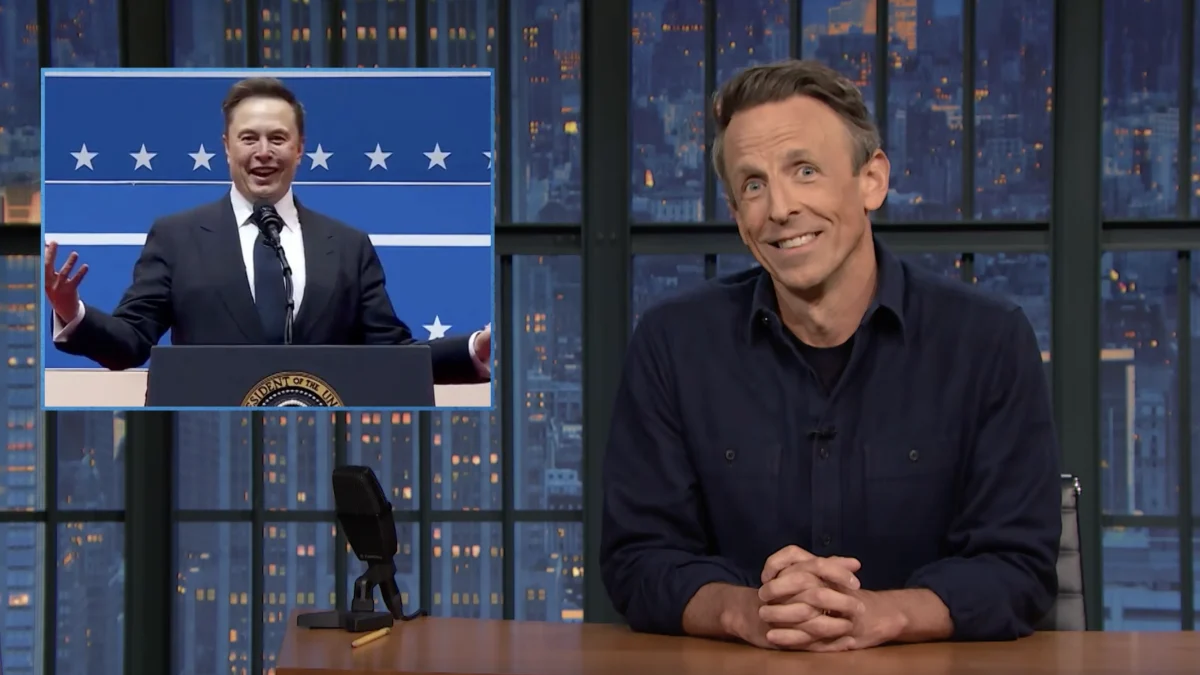
The ambitious, and some might say audacious, endeavor by Elon Musk to leverage artificial intelligence to create a "historically accurate" rendition of Homer’s epic poem, "The Odyssey," has sparked a wave of commentary, with late-night television being a particularly fertile ground for dissection and satire. Seth Meyers, host of NBC’s "Late Night with Seth Meyers," recently joined the chorus, offering a scathing yet humorous critique of the project on his program. The comedian’s segment, which aired on July 24, 2026, highlighted the inherent absurdities and potential pitfalls of using AI to reimagine a foundational work of Western literature, particularly when imbued with Musk’s distinctive vision.
The genesis of this particular commentary stems from a recent announcement that Elon Musk, through his AI ventures, is reportedly exploring the creation of a new version of "The Odyssey." This project aims to utilize AI to generate a cinematic experience that is not only faithful to the original narrative but also, according to the purported vision, historically accurate. This claim of historical accuracy, when applied to a mythologized ancient Greek epic, immediately raised eyebrows and became a focal point for Meyers’s comedic deconstruction.
Meyers opened his segment with a blunt assessment, quoted from the original report as stating, "Wow, I can’t wait for that to suck." This sentiment, delivered with characteristic deadpan, immediately set the tone for his analysis. He then proceeded to articulate the layered ironies of Musk’s proposed undertaking. "Elon Musk is going to use fake actors stolen from real actors to make a fake movie that’s a real version of a fake story," Meyers quipped, encapsulating the perceived contradiction at the heart of the project. The notion of "fake actors stolen from real actors" likely refers to concerns surrounding AI-generated performances and deepfake technology, which raise ethical questions about intellectual property and the very definition of performance.
The comedian’s critique extended to the projected quality of AI-generated dialogue, drawing a parallel to the often stilted and predictable output of large language models like ChatGPT. "I’m so excited for the AI dialogue," Meyers stated sarcastically. "I hope it’s like ChatGPT. ‘Odysseus, you must return home.’ ‘You got it, I can’t wait to embark on this journey with you! Let’s keep it light and fun! And I’m here for whatever you need.’" This imagined dialogue serves to underscore the fear that AI, in its current state, may struggle to capture the nuanced emotional depth and poetic grandeur of Homer’s original work, potentially reducing complex characters and dramatic situations to superficial exchanges.
A significant portion of Meyers’s humor was directed at the concept of "historical accuracy" in the context of "The Odyssey." He posed a rhetorical question that resonated with many: "Also, what do you mean historically accurate? It’s a myth! Are you also making a historically accurate version of The Santa Clause?" This line effectively highlights the logical inconsistency of applying a historical lens to a work rooted in mythology, fantasy, and divine intervention. "The Odyssey" is replete with gods, goddesses, mythical creatures like the Cyclops and Sirens, and supernatural events. To pursue a strictly "historically accurate" interpretation would necessitate either the wholesale removal of these elements or a radical reinterpretation that would fundamentally alter the narrative’s essence.
Background and Context: The Allure of AI in Creative Industries
Elon Musk’s interest in AI-generated content is not an isolated phenomenon. The burgeoning field of artificial intelligence has seen rapid advancements in recent years, particularly in generative AI, which has the capability to create text, images, music, and even video. This has led to widespread discussions and debates across various industries, including entertainment, about the potential of AI to revolutionize creative processes, democratize content creation, and even replace human artists.
Musk himself has been a prominent figure in the AI landscape, co-founding OpenAI before parting ways and later launching xAI, an artificial intelligence company focused on understanding the universe. His ventures have consistently pushed the boundaries of technological innovation, and his foray into AI-driven storytelling is consistent with his broader ambitions. The concept of "historically accurate" AI-generated content, while seemingly contradictory for a myth, might reflect a desire to ground fantastical elements in a more plausible, perhaps even scientifically explained, reality, or to present the narrative through a lens that eschews perceived anachronisms or biases in older interpretations.
However, the application of AI in creative fields is fraught with challenges and ethical considerations. Concerns about copyright, intellectual property, the devaluation of human artistry, and the potential for AI to perpetuate biases embedded in its training data are all part of an ongoing global conversation. The idea of an AI generating a version of "The Odyssey" also touches upon questions of authorship and the very definition of art. Can a piece generated by an algorithm, however sophisticated, be considered art in the same way as a human-created work?
The Original Announcement and Early Reactions
While specific details regarding the exact timeline and technological underpinnings of Musk’s "Odyssey" project remain somewhat opaque, the initial reports, which surfaced prior to Meyers’s commentary, were enough to capture the public imagination and, in some cases, stir apprehension. The concept of an AI-driven, historically accurate "Odyssey" conjured images of a potentially soulless, overly literal, or even nonsensical interpretation of a beloved classic.

Colman Domingo, a highly respected actor, had previously offered his perspective on the project during an appearance as a guest host on "Jimmy Kimmel Live!" Domingo, known for his profound ability to inhabit complex characters, expressed a similar bewilderment and skepticism, albeit with a different tone. His reaction, as reported, further amplified the nascent public discourse surrounding Musk’s initiative, setting the stage for Meyers’s more pointed comedic take.
Chronology of Commentary
The timeline of public commentary on this specific Elon Musk AI project can be broadly outlined as follows:
- Early to Mid-2026: Initial reports and speculation emerge regarding Elon Musk’s interest and potential plans to utilize AI for a "historically accurate" adaptation of Homer’s "The Odyssey." These reports likely stem from interviews, leaked information, or announcements related to his AI ventures, such as xAI.
- Mid-July 2026: Actor Colman Domingo, guest-hosting "Jimmy Kimmel Live!," addresses the Musk "Odyssey" project, offering his initial reactions and critiques. This public acknowledgment from a prominent figure in the arts helps to bring the story into the mainstream entertainment news cycle.
- July 24, 2026: Seth Meyers dedicates a segment of "Late Night with Seth Meyers" to dissecting and satirizing the proposed AI "Odyssey." His commentary, published by Mashable, provides a detailed breakdown of the perceived absurdities and potential shortcomings of the project, leveraging humor to critique the technological and artistic implications.
- Post-July 2026: It is reasonable to assume that the commentary on this project will continue to evolve as more details emerge or as Musk’s AI ventures progress. Public discourse will likely remain divided between those who see AI as a powerful tool for creative innovation and those who harbor concerns about its impact on art, culture, and human creativity.
Data and Supporting Information
While precise data on the specific technological capabilities being employed for Musk’s "Odyssey" project are not publicly available, general advancements in AI-powered content generation provide a framework for understanding the potential.
- Large Language Models (LLMs): Models like OpenAI’s GPT series, Google’s Gemini, and Meta’s Llama have demonstrated remarkable abilities in generating coherent and contextually relevant text. They can be trained on vast datasets of literature, history, and cultural information, theoretically enabling them to mimic various writing styles and incorporate factual elements. However, their output can sometimes be repetitive, lack genuine emotional depth, or exhibit factual inaccuracies when not carefully guided.
- Generative Adversarial Networks (GANs) and Diffusion Models: These AI architectures are at the forefront of image and video generation. They can create highly realistic visual content, including photorealistic images and synthetic video. Concerns surrounding deepfakes and the ethical implications of using AI to generate likenesses of actors or create entirely new, synthetic performers are directly relevant to any AI-driven film project.
- AI in Scriptwriting: Some AI tools are already being used to assist human screenwriters by generating plot ideas, dialogue suggestions, or character descriptions. However, the consensus among many creative professionals is that AI currently serves as a supplementary tool rather than a replacement for human creativity, vision, and emotional intelligence in storytelling.
The challenge for an AI tasked with creating a "historically accurate" "Odyssey" would be immense. It would need to reconcile the mythological elements with any purported historical context, generate compelling dialogue that moves beyond simple information exchange, and create visual representations that are both aesthetically pleasing and narratively significant. The very definition of "historically accurate" in this context is ambiguous and open to interpretation, which is precisely what makes it a target for satire.
Broader Impact and Implications
The commentary by Seth Meyers, and the broader public reaction to Elon Musk’s AI "Odyssey" project, speaks to several significant implications for the future of creative industries and technology.
Firstly, it underscores the ongoing tension between technological innovation and artistic integrity. As AI becomes more sophisticated, the lines between human and machine creativity will continue to blur, prompting essential conversations about authorship, originality, and the value of human expression. The fear of AI producing derivative, uninspired, or even harmful content is a legitimate concern that necessitates careful consideration and ethical guidelines.
Secondly, the project highlights the public’s skepticism regarding the application of AI in areas traditionally considered the domain of human artistry and cultural heritage. "The Odyssey" is a cornerstone of Western literature, revered for its poetic language, complex characters, and enduring themes. The prospect of it being reinterpreted by an algorithm, particularly under the banner of "historical accuracy," raises questions about how we preserve and engage with our cultural legacy in the digital age.
Thirdly, it reflects a growing public awareness and, in some cases, apprehension, about the immense power and potential influence of figures like Elon Musk. His ventures often attract significant attention, and his pronouncements on technology and its future invariably spark debate. In this instance, his purported AI "Odyssey" serves as a proxy for larger discussions about the direction of AI development and its impact on society.
Finally, the humor employed by Meyers serves a crucial function. By satirizing the project, he provides a relatable and accessible critique of complex technological and artistic issues. Late-night comedy, in this regard, acts as a vital mechanism for public discourse, allowing audiences to engage with potentially daunting subjects through laughter and shared observation, thereby fostering a more informed and critical public. The implications extend beyond entertainment, touching upon how we perceive authenticity, narrative, and the very essence of human storytelling in an increasingly AI-influenced world. The success or failure of such ambitious AI-driven creative projects will undoubtedly shape future discussions and technological trajectories in the arts.