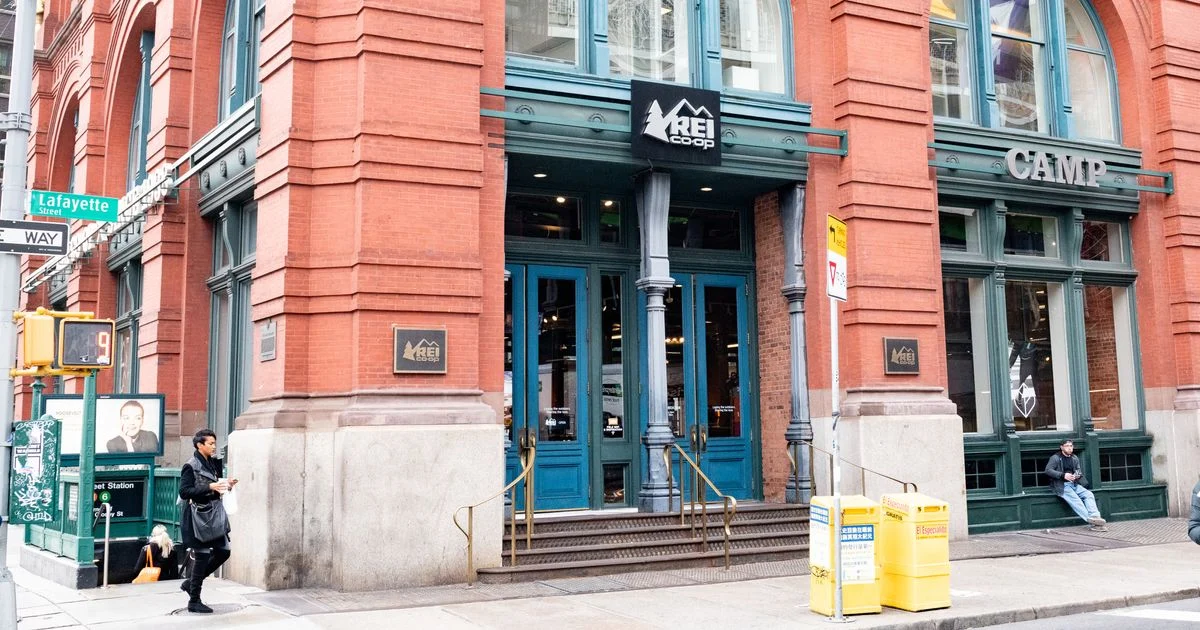
The corner of East Houston and Lafayette Streets, a bustling intersection at the gateway to Manhattan’s Soho district, marked the end of a retail era on July 23, 2026. After nearly 15 years of serving as a primary hub for New York City’s outdoor enthusiasts, the REI flagship store inside the historic Puck Building has officially shuttered its doors. The closure represents more than just the loss of a prominent brick-and-mortar retailer; it signifies a shifting tide in the landscape of Manhattan real estate, where traditional experiential retail is increasingly being displaced by high-tech office expansions and evolving consumer habits.
For a decade and a half, the 35,000-square-foot store acted as a base camp for hikers, climbers, and urban commuters. On its final day of operation, the atmosphere was one of somber reflection rather than celebratory clearance. Long-time customers, some of whom had been members of the Seattle-based co-op for half a century, gathered to bid farewell to a space that many considered a community center as much as a retail outlet. Among them was Glen Nison, a retired Sanitation Department worker and a member of the co-op since 1975. Nison, known to the staff for bringing homemade banana bread to the store, exemplified the deep-rooted loyalty the brand managed to cultivate in a city often characterized by its transient nature.
A Legacy of Urban Adventure
When REI first announced its intention to move into the Puck Building in 2011, industry analysts were skeptical. At the time, the idea of a massive outdoor gear emporium in the heart of one of the world’s most densely populated urban centers was viewed as a high-stakes gamble. The New York Times noted during the 2011 opening that the retailer was attempting to "win over high-rise-living, taxi-riding, restaurant-eating and forever-in-a-hurry New Yorkers."
The gamble appeared to pay off. REI did not merely sell tents and sleeping bags; it sold a lifestyle of escapism. The store became famous for its educational programming, hosting lectures from world-class mountaineers and organizing rock-climbing lessons in local parks. It tapped into a burgeoning "Gorpcore" trend, where technical outdoor apparel became a staple of urban fashion. Furthermore, the store’s timing coincided with the Bloomberg administration’s push to make New York City more bicycle-friendly. REI responded by installing a full-service bike shop in its cellar, providing a critical resource for the city’s growing legion of cyclists.
The physical space itself was a marvel of adaptive reuse. Working with the architecture firm Callison, REI meticulously restored the interior of the Puck Building, which was originally constructed in the late 19th century to house the J. Ottmann Lithographing Company. The design team exposed original brick walls, restored ornate chandeliers, and integrated two massive steam flywheels—remnants of the building’s printing press history—into the store’s decor. This blend of West Coast outdoor culture and East Coast industrial heritage created a shopping environment that felt uniquely "New York."
The Chronology of a Flagship
The lifecycle of the Soho REI flagship serves as a mirror for the broader trends in Manhattan’s commercial evolution:
- 2011: REI signs a long-term lease for 35,000 square feet in the Puck Building, owned by Kushner Companies. The store opens in November to massive crowds and critical acclaim for its historic restoration.
- 2012–2019: The store thrives as a destination for the "urban outdoorsman." It survives the rise of e-commerce by focusing on high-touch services like gear rentals, bike repairs, and expert-led workshops.
- 2020–2021: The COVID-19 pandemic temporarily halts operations, but a subsequent surge in outdoor recreation interest leads to a brief post-lockdown boom in gear sales.
- 2022: Labor tensions begin to surface. Employees at the Soho location vote overwhelmingly to unionize with the Retail, Wholesale and Department Store Union (RWDSU), making it the first unionized REI store in the country.
- 2023–2024: Rumors of the store’s closure begin to circulate as the lease expiration nears. Reports emerge that Kushner Companies is looking to reposition the building’s upper floors for high-tech tenants.
- 2025: OpenAI, the artificial intelligence research laboratory, secures a massive 90,000-square-foot lease in the Puck Building, signaling a transition from retail-focused occupancy to tech-heavy office use.
- 2026: REI officially announces its departure. The final day of business is set for July 23, 2026.
Market Forces and Real Estate Dynamics
The closure of the Soho flagship was not the result of a single factor but rather a confluence of economic pressures. Primary among these was the real estate strategy of the landlord, Kushner Companies. As the Soho and Nolita neighborhoods continued to gentrify and evolve into a hub for tech and venture capital, the value of large-format retail space began to pale in comparison to the potential returns of high-end office suites.
The arrival of OpenAI in the upper floors of the Puck Building underscored this shift. For the landlord, transitioning the building into a tech fortress provided a more stable and lucrative long-term revenue stream than a retail lease. Customers browsing the final sales in July 2026 often looked upward at the windows of the tech giant’s new headquarters, lamenting the "siliconification" of the neighborhood.
Beyond real estate, REI faced internal challenges. The company, which operates as a member-owned co-op, has grappled with declining margins and the complexities of managing a unionized workforce in an increasingly competitive market. While the Soho store remained popular, the cost of operating a 35,000-square-foot flagship in one of the most expensive zip codes in the world became difficult to justify, especially as consumer preferences shifted toward online shopping and smaller, specialized boutique experiences.
Community Impact and the Loss of Public Space
The departure of REI leaves a significant void in the Lower Manhattan community. For many, the store was more than a place to purchase a North Face parka; it was one of the few places in Soho that offered reliable public amenities. "You learn a lot about a culture from how they treat public bathrooms," noted Juan Pablo Baene, an artist and frequent visitor. "It’s sad to lose a space that felt accessible to everyone, not just those buying luxury goods."
The store’s "ReSupply" section—a corner dedicated to discounted, gently used gear—was a favorite among budget-conscious hikers and students. In the final days, this section was picked clean by bargain hunters, leaving behind only empty shelves and cordoned-off aisles. The loss of the "quick-fix" bike shop is also expected to impact the local commuting population, which has few alternatives for immediate repairs in the immediate vicinity.

As the store prepared to lock its doors for the last time, a small "funerary shrine" appeared on Lafayette Street, where locals left flowers and notes of gratitude. The sentiment was clear: while REI is a national corporation, this specific location had become a neighborhood institution.
Broader Implications for NYC Retail
The shuttering of the Soho REI is a cautionary tale for the future of large-scale "destination retail" in New York City. While brands like Apple and Nike continue to maintain massive flagships, the middle-market outdoor sector is seeing a retreat to the suburbs. New Yorkers looking for the REI experience will now have to travel to Huntington Station on Long Island or East Hanover in New Jersey.
Industry experts suggest that the future of outdoor retail in Manhattan may lie in smaller, curated "guide posts" rather than sprawling flagships. Competitors like Paragon Sports in Union Square remain, but they lack the national co-op model that REI utilized to build its membership base.
The transition of the Puck Building from a printing house to a retail giant and finally to an AI headquarters reflects the broader economic history of New York City. As the city continues to recover and redefine itself in the mid-2020s, the priority appears to be shifting toward the digital economy, often at the expense of the physical spaces that once defined the streetscape.
For Glen Nison and the thousands of other members who frequented the Soho REI, the closure is a personal loss. "I might have to get a job just to have something to do," Nison joked as he carried his final haul of gear toward the exit. But behind the humor was a palpable sense of displacement. As the "Area Closed" signs were moved into place, the city lost a bit of its rugged edge, replaced by the quiet, climate-controlled hum of the tech industry upstairs.