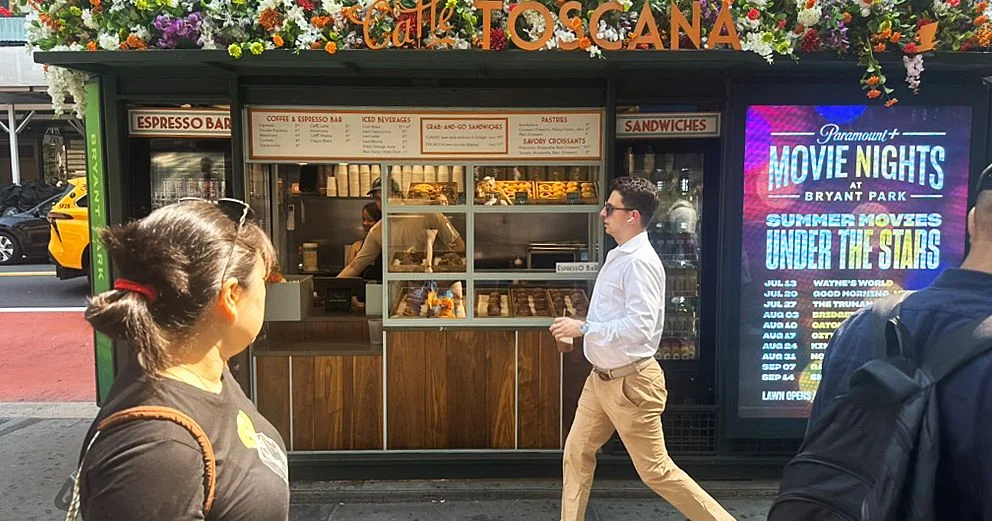
The Vanguard of Change: Caffé Toscana and the High-End Kiosk
At the corner of Fifth Avenue and 42nd Street, a location traditionally defined by the heavy foot traffic of commuters and tourists visiting the New York Public Library, the standard newsstand aesthetic has been replaced by the polished veneer of Caffé Toscana. Operated by Luca Meacci, a 43-year-old native of Tuscany, the stand represents a significant financial and conceptual investment in the future of street-level retail. Meacci invested approximately $150,000 to gut the original structure, replacing rusted newspaper racks and linoleum counters with custom-made display cases, high-end beverage coolers, and a professional-grade espresso machine.
The menu at Caffé Toscana serves as a stark departure from the typical street-cart fare. Instead of lukewarm pretzels or generic hot dogs, Meacci offers pistachio bomboloni, prosciutto-mozzarella croissants, and cortados. The conversion required more than just cosmetic upgrades; it necessitated structural integration, including the installation of a sink with a dedicated water hookup and an air conditioning unit to protect sensitive pastry inventory and equipment from the city’s summer heat.
Meacci’s experience highlights the unique challenges of "micro-retail." Unlike his previous kiosk in Bryant Park, the sidewalk newsstand requires a hyper-accelerated service model. According to Meacci, the attention span of a sidewalk pedestrian is roughly ten seconds. To thrive, he has had to simplify his menu, transitioning from made-to-order sandwiches to high-quality premade options and swapping boutique water brands for the more recognizable Acqua Panna. Since the conversion, Meacci reports that daily sales have grown fivefold, suggesting that the "newsstand-to-café" model is not only viable but potentially more lucrative than the traditional retail format.
The Regulatory Framework: JCDecaux and the $1.4 Billion Deal
The evolution of these stands is occurring within a complex web of city contracts and legislative restrictions. Most of New York’s approximately 300 sidewalk newsstands are part of a massive coordinated street furniture franchise. In 2006, the City of New York entered into a 20-year, $1.4 billion agreement with JCDecaux, the French outdoor-advertising giant. Under this contract, JCDecaux is responsible for the installation and maintenance of newsstands, bus shelters, and automated public toilets in exchange for the rights to sell the lucrative advertising space on their exteriors.
While JCDecaux manages the physical structures, the operations inside are governed by the New York City Department of Consumer and Worker Protection (DCWP). For years, these regulations have acted as a bottleneck for innovation. Current city laws still technically require newsstands to carry periodicals, despite the collapse of the print industry. Furthermore, a 2013 update to the regulations prohibits newsstand operators from selling items priced over $10 and forbids the sale of clothing, jewelry, and fashion accessories.
Max Bookman, counsel to the New York City Newsstand Operators Association, notes that these rules have left many operators in a state of stagnation. As traditional candy and soda wholesalers have consolidated—dwindling from seven major vendors twenty years ago to just two today—most newsstands have become carbon copies of one another, selling the same inventory to a shrinking customer base.
A Chronology of the New York City Newsstand
To understand the current shift, one must look at the historical trajectory of these sidewalk fixtures:
- 19th Century – Early 20th Century: Newsstands began as informal wooden stalls, often operated by "newsies" or individuals with disabilities who were granted special licenses by the city.
- The Golden Age (1920s–1970s): The newsstand became a vital community hub. At its peak, New York City boasted over 1,500 stands, serving as the primary source for daily newspapers, literary journals, and international magazines.
- The Convenience Pivot (1980s–2000s): As television and early internet adoption began to impact print sales, operators shifted their focus toward "convenience items"—tobacco, lottery tickets, and sugary snacks.
- The Infrastructure Era (2006): The JCDecaux contract standardized the look of the stands, replacing eclectic older structures with uniform, modern steel-and-glass kiosks.
- The Specialization Era (2020–Present): Post-pandemic economic pressures and the rise of "grab-and-go" gourmet culture have led to the current wave of specialized conversions, ranging from electronics boutiques to health-focused Caribbean stands.
The "Parks Department Exception" and Underground Innovation
The most successful conversions often occur outside the standard DCWP jurisdiction. Newsstands located within city parks are managed by the Parks Department, which operates under a different set of concession rules. This "Parks Department Exception" is what allows Luca Meacci to sell an $11 sandwich, bypassing the $10 price cap that binds his counterparts on standard city sidewalks.
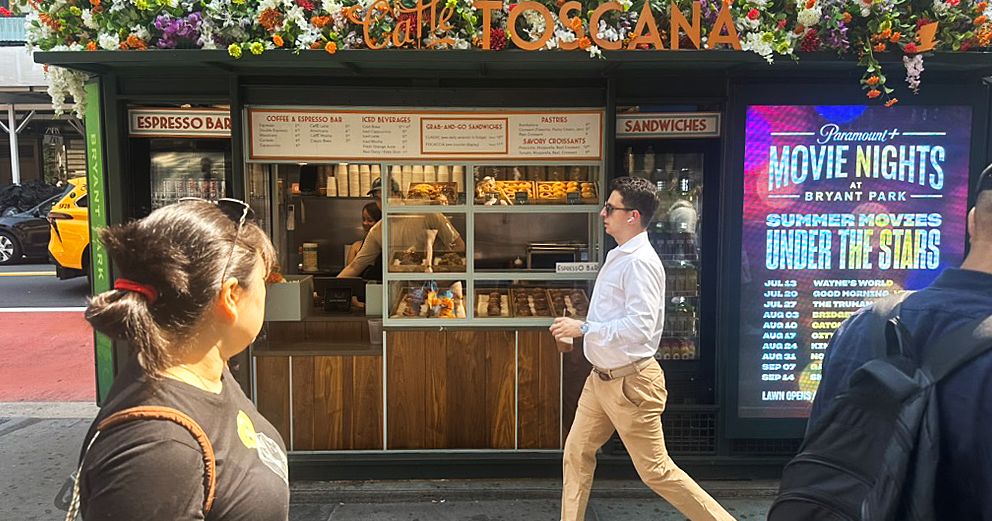
The Bryant Park Corporation (BPC), a non-profit that manages Bryant Park, has been particularly aggressive in seeking higher-quality tenants. Dan Pisark, BPC’s Vice President of Retail Services, notes that the park deliberately moved away from "candy-and-soda" operators in favor of local businesses like Little Biggs Sandwich Shop. Similarly, Alexander Han, the Parks Department’s Chief of Concessions, has confirmed plans to convert newsstands in Verdi Square, Union Square, and near West 4th Street into food-and-beverage hubs, explicitly stating a lack of interest in using these spaces for cigarette sales.
Innovation is also flourishing underground. The Metropolitan Transportation Authority (MTA) has been more flexible with its vacant newsstand spaces within the subway system. This has paved the way for creative installations such as Rex’s Dino Store at Grand Army Plaza and the Data Vandals art space at 51st Street and Lexington. These underground projects serve as a proof-of-concept for how small, non-traditional retail can enhance the commuter experience.
Shifting Consumer Habits: The Ozempic and Protein Era
The decline of the traditional newsstand is not merely a result of the death of print; it is also a reflection of changing American dietary habits. Max Bookman points out that the "Coke and Snickers" model of 2005 is no longer a guaranteed revenue generator. The rise of GLP-1 medications like Ozempic, combined with a broader societal shift toward "protein-maxxing" and sugar reduction, has significantly impacted the sale of traditional convenience store snacks.
In response, some operators are pivoting toward health-focused inventory. Express Essentials on Broadway and 94th Street, owned by an entrepreneur named Rodney, focuses on Caribbean health aids. Instead of a wall of chocolate bars, the stand offers $4 Jamaican patties (including lentil and salmon options), ginger shots, sorrel juice, and turmeric gummy chews. While the stand still carries some traditional items like lottery tickets to maintain cash flow, the core identity is built around wellness and culturally specific snacks.
Economic Implications and Future Outlook
The cost of operating a newsstand remains a significant barrier. While the physical structure is provided via the JCDecaux contract, the licensing fees, insurance, and electricity costs can be substantial. For an operator like Meacci, the $150,000 renovation cost is a gamble that high-margin coffee and pastries will provide a faster return on investment than low-margin newspapers.
There is growing political pressure to modernize the rules governing these spaces. A bill recently introduced in the New York City Council aims to lift the $10 price cap and allow for the sale of a wider variety of accessories, such as handbags and hair ornaments. However, the bill does not yet address the restriction on selling fresh, non-prepackaged food—a change that advocates say is essential for the survival of the 300 remaining stands.
Industry experts argue that allowing newsstands to evolve into "micro-cafés" or "boutique kiosks" would benefit the city in multiple ways. It would provide entrepreneurs with a lower-cost entry point into the NYC real estate market compared to traditional storefronts, while also increasing tax revenue and improving the aesthetic and safety of the streetscape by ensuring these stands remain occupied and well-lit.
As New York continues to navigate its post-pandemic recovery, the rise of the specialized newsstand serves as a microcosm of the city’s broader resilience. By transforming these relics of the print era into vibrant nodes of modern commerce, operators are ensuring that the sidewalk newsstand remains a vital, albeit different, part of the New York City experience. Whether it is a $20 electronic speaker on the Upper West Side or a zine-and-ceramics kiosk in Midtown, the future of the newsstand appears to be defined by everything except the news.