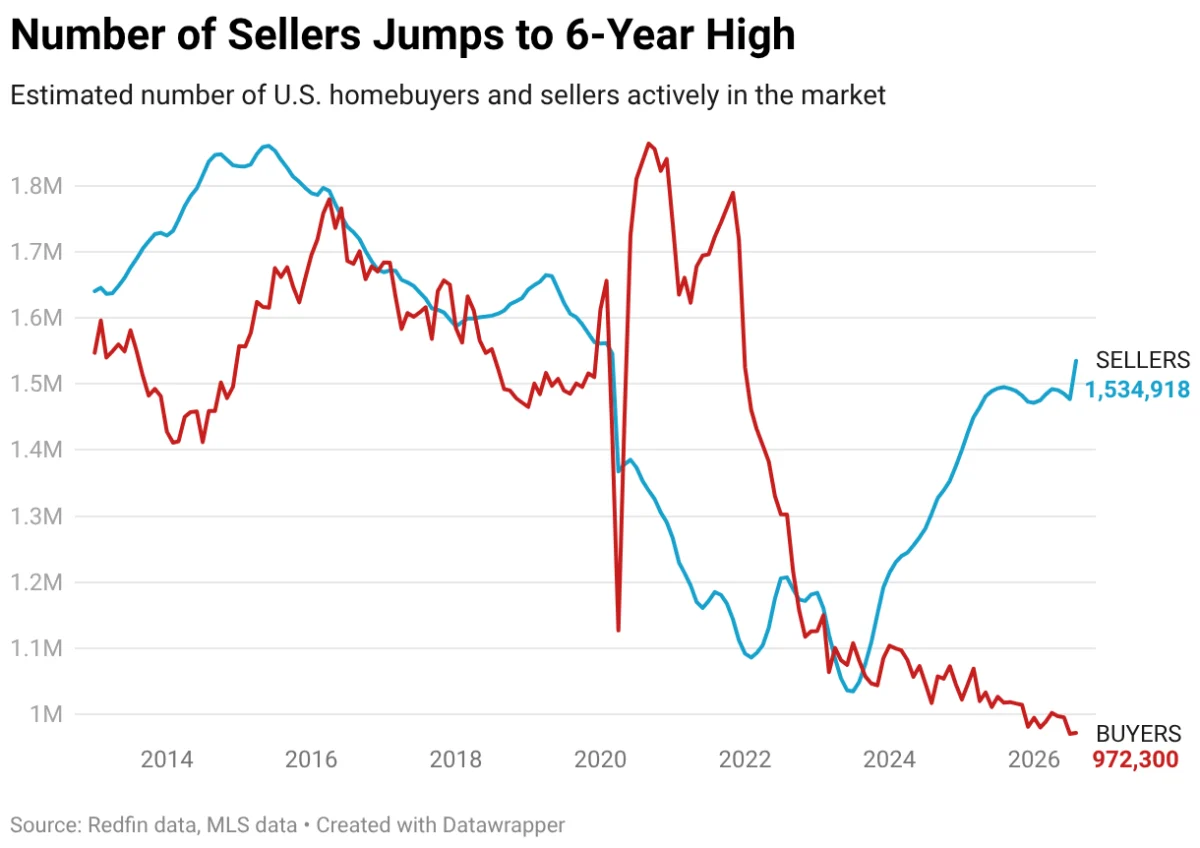
In August, the American residential real estate landscape underwent a profound shift, reaching its most pronounced buyer’s market conditions since records began in 2013. Across the nation, the imbalance between supply and demand widened significantly, with an estimated 57.9% more home sellers than active buyers. This figure represents a sharp escalation from July’s 52.1%, marking the second-consecutive month of record-setting volatility. The surge in inventory, coupled with stagnant demand, has fundamentally altered the power dynamic of the typical home transaction, shifting leverage away from those holding the deeds and toward those seeking to purchase.
The Geography of a Buyer’s Market
The phenomenon is not distributed equally across the United States. The Sun Belt region has emerged as the epicenter of this shift, with all ten of the nation’s strongest buyer’s markets located in states characterized by historically high population growth and robust construction pipelines.
Nashville, Tennessee, currently sits at the top of this list, reporting a staggering 139.3% surplus of sellers over buyers. This represents the widest gap in the city’s recorded history. Following closely behind are Miami, Florida, with a 138.3% surplus, and Houston, Texas, at 130.9%. The concentration of these conditions in cities like Orlando, Las Vegas, San Antonio, Austin, and Dallas suggests that the rapid expansion of housing stock in these metropolitan areas—often driven by aggressive new-home construction—has finally outpaced the absorption rate of prospective buyers.
The implications for these specific markets are significant. As inventory levels swell, the "time on market" for listings is expanding, providing house hunters with a rare opportunity to conduct due diligence, compare multiple properties, and exercise patience. In markets where sellers outnumber buyers by such wide margins, the standard urgency that defined the post-pandemic housing boom has largely evaporated.
Understanding the Shift: The Mechanics of Supply and Demand
To categorize the state of the market, analysts at Redfin define a "buyer’s market" as any region where sellers exceed the number of buyers by more than 10%. Conversely, a "seller’s market" occurs when buyers exceed sellers by more than 10%. Anything falling within a 10% variance is considered a balanced, or neutral, market.
By this metric, the national housing market is firmly in the camp of the buyer. The data, which tracks the typical duration from a buyer’s first property tour to the final close of purchase alongside Multiple Listing Service (MLS) data for active listings, paints a picture of a sector struggling to find equilibrium.
In August, the national tally of home sellers reached approximately 1,534,918, the highest volume observed since early 2020. This 3.9% month-over-month increase in inventory occurred simultaneously with a virtual stagnation in buyer interest, which rose by a negligible 0.1%. For many potential buyers, the barrier to entry remains high. Despite the abundance of inventory, elevated mortgage interest rates and persistent economic uncertainty have kept a large cohort of prospective buyers on the sidelines, waiting for a more favorable financial environment.
The Motivations Behind the Seller Surge
The sudden influx of homes onto the market is driven by a complex interplay of personal and economic factors. For years, many homeowners held back from listing their properties, hoping for a decline in mortgage rates or a resurgence in demand. However, as interest rates have remained stubbornly high, the "wait-and-see" approach has become untenable for many.
Life events remain a primary driver of real estate turnover. Retirement, family expansion, and career-related relocations are forcing homeowners to list their properties regardless of the market’s cooling temperature. Furthermore, many long-term homeowners have accumulated substantial home equity over the last decade. Even in a market where prices may be softening or stagnating, these sellers find themselves in a position where they can afford to negotiate on price while still realizing a significant profit.
There is also a psychological component to this trend. Some homeowners, fearing that a continued surplus of inventory could lead to a future decline in home values, are opting to sell now to capture current equity levels. This "exit strategy" behavior has contributed to the mounting pile of active listings, further fueling the buyer-friendly nature of the current cycle.
Economic Implications for Buyers and Sellers
Asad Khan, a senior economist at Redfin, suggests that the current market environment offers a unique, albeit challenging, window for participants. "With sellers piling into the market and demand falling flat, today’s house hunters can afford to be choosy," Khan noted.
For the prospective buyer, the current environment is objectively beneficial. In most metropolitan areas, the ability to negotiate on price, request repairs, or ask for seller-funded closing cost concessions has become a standard feature of the transaction process. However, economists warn against assuming that every seller is desperate. Homes that are priced competitively and situated in desirable neighborhoods continue to attract attention. The advice for buyers is to leverage the current surplus to ensure the deal aligns with their financial needs, rather than feeling compelled to rush into a contract.
For sellers, the reality is more demanding. The era of "list and wait for a bidding war" has largely concluded. Sellers must now engage in aggressive staging, professional marketing, and realistic pricing strategies. To move a property quickly in a high-inventory environment, sellers are increasingly expected to make their homes "turn-key" ready, as buyers are no longer willing to overlook major repairs or maintenance issues when there are several other options available on the block.
The Few Remaining Seller’s Markets
While the vast majority of the 49 analyzed metropolitan areas are currently favoring buyers, a handful of exceptions persist. Only five regions—Nassau County, New York; Newark, New Jersey; Montgomery County, Pennsylvania; Milwaukee, Wisconsin; and San Francisco, California—remain firmly in "seller’s market" territory.
The common denominator among these regions is a long-standing, structural constraint on housing supply. In the New York City suburbs and the Mid-Atlantic regions, strict zoning, geographic limitations, and a lack of new construction have kept supply perpetually low. In San Francisco, the dynamic is different; the recent surge in the Artificial Intelligence sector has created a localized wealth effect, stimulating demand that outweighs the available inventory.
The disparity in pricing power is evident in the data: home-sale prices in these five seller’s markets rose by an average of 5.5% year-over-year in August. In contrast, the buyer’s markets saw an average price increase of just 1.6%. This delta illustrates clearly how competition among buyers remains the primary engine for price appreciation, even in a national economy characterized by cooling demand.
The Road Ahead: A Period of Adjustment
The structural imbalance of the current market highlights the sensitivity of the real estate sector to broader macroeconomic indicators. The Sun Belt’s current position as a buyer’s market is not merely a product of lower demand, but also of a sustained, high-volume construction effort that has finally succeeded in building enough homes to meet, and now exceed, the needs of the population.
As the market enters the final quarter of the year, several factors remain in flux. The potential for future changes in interest rate policy from the Federal Reserve, the ongoing stability of the labor market, and the continued migration of the workforce will dictate whether this buyer’s market continues to intensify or begins to revert toward a more balanced state.
For now, the message to the public is clear: the U.S. housing market has undergone a fundamental pivot. Buyers have reclaimed their seat at the negotiating table, while sellers must adapt to a landscape where standing out requires more than just an address. Whether this shift represents a temporary correction or a long-term change in the nature of American real estate remains to be seen, but for the millions of Americans navigating this landscape in the coming months, the reality is one of choice, negotiation, and a much-needed cooling of the frenetic pace that defined the last several years.