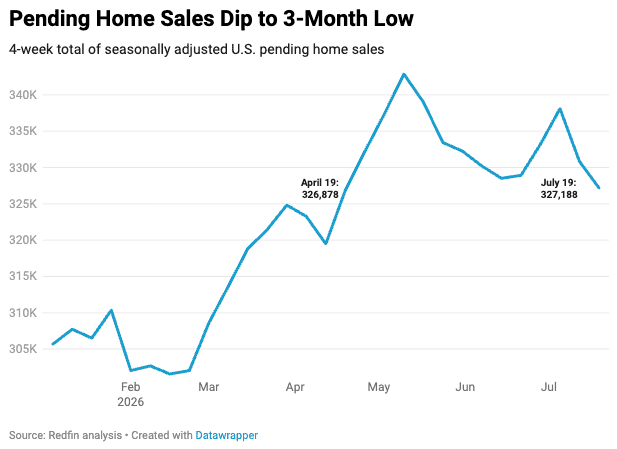
The United States housing market is experiencing a notable cooling phase as pending home sales fell 1.3% week over week during the four-week period ending July 19, 2026. This decline marks the lowest level of sales activity in three months, signaling a cautious retreat by prospective homebuyers. The slowdown is attributed to a combination of persistent economic pressures, including mortgage rates reaching an 11-month high, and a volatile global landscape marked by renewed geopolitical conflict. Despite the drop in demand, home prices remain near record highs, creating a complex environment where buyers hold more negotiating power on older listings while still facing stiff competition for turnkey properties.
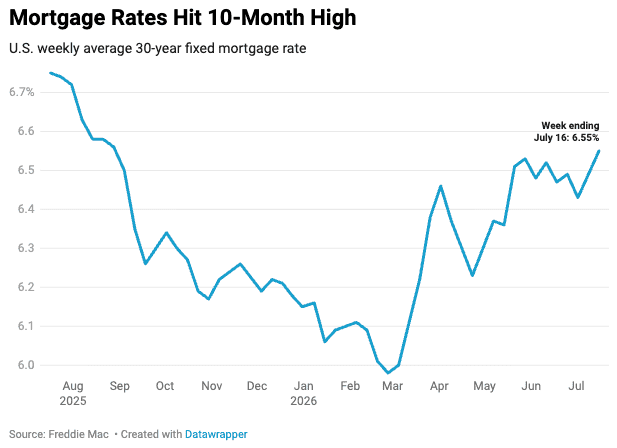
The average 30-year fixed mortgage rate climbed to 6.55% during the week ending July 16, according to Freddie Mac data. This upward trajectory in borrowing costs has significantly impacted affordability, especially as the median sale price of a U.S. home sits at $408,795—just $900 below the all-time peak. The convergence of high interest rates and high entry prices has effectively sidelined a large segment of the population, leaving only the most determined or well-capitalized buyers in the hunt.
The Macroeconomic Context: Geopolitics and Energy Costs
Beyond the immediate mechanics of the real estate market, the broader U.S. economy is navigating a period of significant uncertainty. The resurgence of the Iran war has sent ripples through global financial markets, leading to increased volatility and a defensive posture among American consumers. This geopolitical instability has directly impacted domestic costs, most notably through rising oil prices. With gasoline prices hitting the $4 mark in many regions due to renewed Iran-Russia tensions, the cost of living has surged, further depleting the discretionary income of potential homeowners.
Economic analysts suggest that the "wait-and-see" approach adopted by many consumers is a rational response to these external shocks. When energy costs rise and international conflict dominates the headlines, long-term financial commitments like 30-year mortgages are often deferred. This sentiment is reflected in Google search data, where searches for "homes for sale" have plummeted by 15% compared to the same period last year.
Buyer Leverage and the Tale of Two Markets
While the overall volume of sales is down, the current environment has created a unique window of opportunity for those who remain in the market. Real estate professionals are reporting a shift in the balance of power between buyers and sellers. In many cases, buyers now possess the most significant leverage they have seen in several years.
Vanessa Leimback, a Redfin Premier agent based in Seattle, notes that the market has become increasingly bifurcated. Properties that have been on the market for more than a few weeks are frequently seeing price reductions and seller concessions. These concessions often include sellers covering closing costs or providing credits for interest rate buy-downs. However, this leverage does not apply across the board.
"Desirable, move-in ready homes can still be competitive because many people don’t want to take on renovation costs while mortgage payments are high," Leimback explained. "That’s why the biggest bargains are often on fixer-uppers."
This trend highlights a growing aversion to risk and additional expenditure among buyers. With monthly mortgage payments averaging $2,618—a 0.7% increase year over year—homeowners are looking for properties that require zero immediate investment. Consequently, the "fixer-upper" segment of the market is seeing the most significant stagnation, providing a fertile ground for investors or buyers willing to trade sweat equity for a lower purchase price.
Chronology of Market Indicators in July 2026
The trajectory of the housing market through July 2026 has been defined by a steady tightening of conditions.
- Early July: Mortgage rates began their ascent, breaking past the 6.4% barrier as inflation concerns resurfaced.
- Mid-July: The resurgence of military activity in the Middle East caused a spike in oil prices, leading to a 5% drop in home-search activity within a single month.
- July 16-19: Pending sales reached their three-month trough, and the weekly average mortgage rate hit 6.55%.
- July 22: The daily average 30-year fixed mortgage rate reached 6.77%, the highest level in a full year, suggesting that the cooling trend may persist into August.
Despite the drop in sales, the supply side of the equation remains constrained. New listings ticked up a marginal 0.4% week over week, yet they remain at their second-lowest level since the beginning of 2026. Many potential sellers are "locked in" to lower mortgage rates from previous years and are unwilling to trade those for a 6.5% rate, a phenomenon that continues to keep inventory levels below historic norms.
Detailed Statistical Breakdown
The data for the four weeks ending July 19, 2026, provides a comprehensive look at the cooling trend. The median asking price is currently $400,257, representing a 2.3% year-over-year increase. While the median sale price of $408,795 is high, the "share of home listings with price drops" stands at 20.2%. This indicates that one in five sellers is being forced to adjust their expectations to meet the reality of lower demand.
Inventory levels are currently at 3.4 months of supply. In traditional real estate economics, 4 to 5 months of supply is considered a "balanced" market. A level of 3.4 months still technically favors sellers, but the trend is moving toward balance as active listings remain stagnant and pending sales drop.
Touring activity, a leading indicator of future sales, was up 18% from the start of the year as of July 20. However, this is a sharp decline from the same period in 2025, when touring activity was up 36% from the start of the year. This 50% reduction in the growth of touring interest underscores the impact of the current economic climate on consumer behavior.
Regional Variations: Winners and Losers
The national cooling trend masks significant disparities between different metropolitan areas. Some regions continue to see price appreciation and high demand, while others are seeing significant corrections.
Top Performing Metros (Year-over-Year Sale Price Increase):
- West Palm Beach, FL: 11%
- Pittsburgh, PA: 7.2%
- Virginia Beach, VA: 6.9%
- Detroit, MI: 6.7%
- Philadelphia, PA: 6.5%
Florida continues to be a magnet for buyers, with West Palm Beach leading the nation in both price increases and pending sales growth (13.2%). The Rust Belt and Mid-Atlantic regions are also showing resilience, likely due to their relatively lower price points compared to West Coast tech hubs.
Metros Seeing the Largest Price Decreases:
- San Jose, CA: -3.3%
- Seattle, WA: -3.2%
- Nashville, TN: -0.9%
- Los Angeles, CA: -0.8%
- Boston, MA: -0.8%
The West Coast market, particularly Seattle and San Jose, is feeling the brunt of the slowdown. Seattle saw a staggering 14.5% drop in pending sales year over year. These high-cost markets are the most sensitive to mortgage rate fluctuations, as the total interest paid on multi-million dollar loans increases exponentially with every basis point hike.
Analysis of Implications and Future Outlook
The current data suggests a "holding pattern" for the U.S. housing market. Economists point to the 3.1% year-over-year increase in pending sales as a sign that the market is not in a freefall, but rather a state of recalibration. The slight increase in mortgage-purchase applications (up 6% in the latest weekly survey) suggests that some buyers are attempting to lock in rates before they climb even higher.
However, the broader impact of the 2026 geopolitical situation cannot be overstated. If oil prices continue to climb and the conflict in the Middle East escalates, the Federal Reserve may be forced to keep interest rates higher for longer to combat energy-driven inflation. This would maintain the pressure on mortgage rates, potentially pushing them toward the 7% mark.
For sellers, the current environment demands patience and flexibility. The era of "bidding wars" on every property has largely transitioned into a market where "move-in ready" is the primary currency. For buyers, the market offers a rare chance to negotiate on price and terms, provided they can navigate the high cost of financing.
As we move into the latter half of 2026, the housing market will likely remain tethered to the headlines coming out of Washington and the Middle East. Until there is a stabilization in energy prices and a clear direction for interest rates, the "topsy-turvy" nature of the market is expected to persist, keeping both buyers and sellers on their toes.