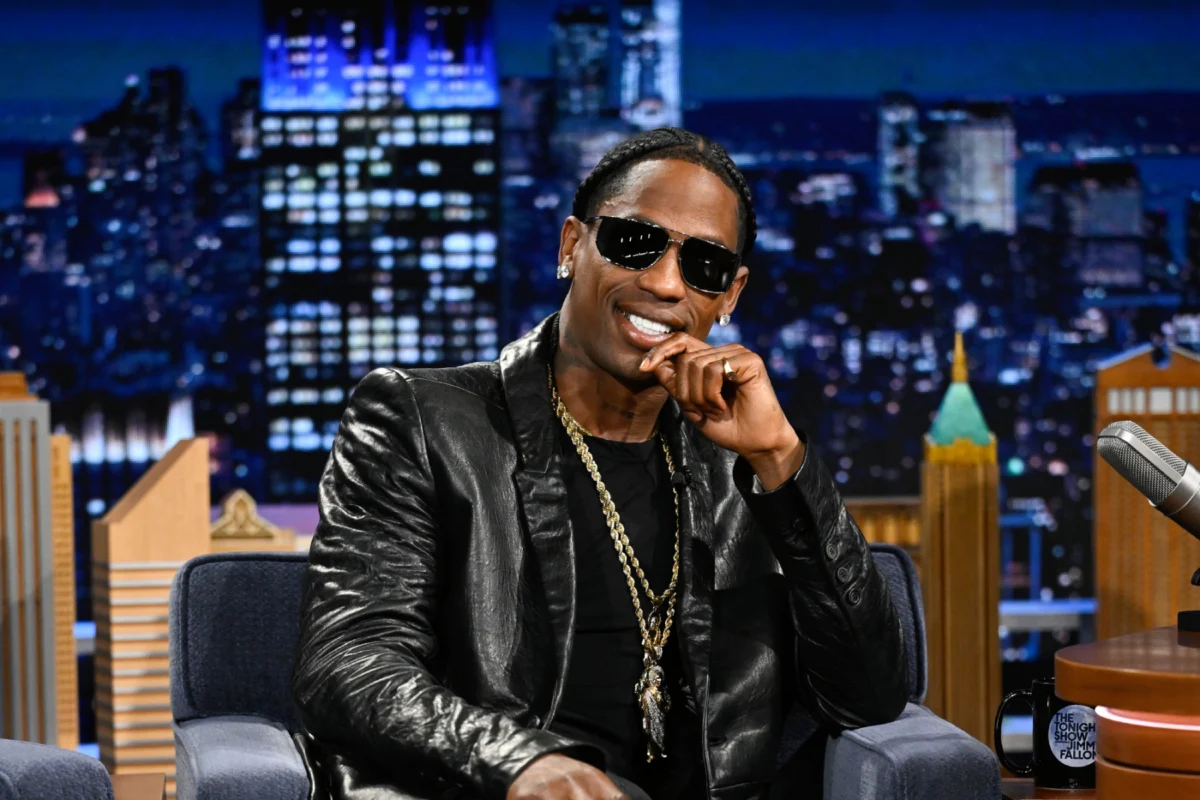
In a significant cross-industry moment that bridges the worlds of contemporary hip-hop and prestige cinema, multi-platinum recording artist Travis Scott appeared on The Tonight Show Starring Jimmy Fallon to discuss his pivotal role in Christopher Nolan’s latest cinematic achievement, The Odyssey. The appearance served as a deep dive into Scott’s transition from the recording studio to the high-stakes environment of a major motion picture set, marking his first appearance in a film that has secured the No. 1 spot at the global box office. During the interview, Scott provided insight into his collaborative relationship with Nolan, the challenges of portraying a mythological figure, and the creative process behind the film’s end-credits anthem, "When I’m Home."
A New Stratosphere of Greatness
The conversation opened with host Jimmy Fallon highlighting the commercial and critical success of The Odyssey, which has solidified Christopher Nolan’s reputation as a titan of the modern blockbuster. For Scott, the experience of being part of a top-tier film production brought a different level of validation compared to his chart-topping musical career. The rapper reflected on the personal impact of this achievement, noting that the recognition extended back to his formative years. Scott shared that his high school theater teacher reached out to his mother to express pride in his performance, a gesture that Scott interpreted as a sign of reaching a new level of professional maturity.
"It feels way different," Scott told Fallon, emphasizing the weight of the film’s reception. He noted that the approval of those who mentored him during his youth felt like a final stamp of legitimacy. "This is like another stratosphere of greatness. All the people [who] were scolding you when you were in school, trying to make you a great human, are like, ‘You finally did something good.’" This sentiment underscores a broader narrative in Scott’s career—the pursuit of multidisciplinary artistic respect that transcends the boundaries of the music industry.
From Tenet to The Odyssey: The Evolution of a Partnership
The collaboration between Travis Scott and Christopher Nolan did not begin with The Odyssey. The foundation was laid during the production of Nolan’s 2020 sci-fi thriller, Tenet. For that project, Scott contributed the lead single "The Plan," a track produced by Ludwig Göransson that mirrored the film’s complex, pulsating rhythmic structure. However, the transition from a musical contributor to a cast member was an unexpected development for the artist.
Scott recounted the moment he received the call from Nolan, admitting that he initially misunderstood the director’s intentions. "My phone went off and it just said ‘Chris,’ and I was thinking, ‘Okay, I don’t know what this is about. Maybe he wants to go to a show,’" Scott recalled. When Nolan asked if he would be interested in acting, Scott’s first instinct was that Nolan was producing a project for another director. The realization that he was being recruited for a Nolan-directed epic was both a shock and a career-defining opportunity.
Scott described Nolan as a "real mentor," expressing a profound level of trust in the filmmaker’s vision. This relationship allowed Scott to step outside his comfort zone, moving from the controlled environment of a recording booth to the sprawling, often intimidating sets characteristic of a Nolan production.
The Role of the Greek Bard: Connecting Hip-Hop to Oral Tradition
In The Odyssey, Scott portrays a Greek bard, a character whose function is to sing of the victories and tribulations of Odysseus during the Trojan War. This casting choice was intentional and deeply rooted in Nolan’s thematic goals for the film. In previous statements, Nolan explained that he viewed the ancient tradition of oral poetry as the historical predecessor to modern rap. By casting Scott, Nolan aimed to create a bridge between the Homeric epics of antiquity and the rhythmic storytelling of today.
"I cast [Scott] because I wanted to nod towards the idea that this story has been handed down as oral poetry, which is analogous to rap," Nolan stated in a prior interview. This conceptual link provided Scott with a unique entry point into the character. While he was playing a figure from thousands of years ago, the core of the role—using voice and rhythm to preserve history and celebrate heroism—was something inherently familiar to him as a lyricist.
Despite this connection, Scott admitted to being "nervous as F" throughout the process. The gravity of the production became apparent when he realized the caliber of the ensemble cast he would be joining. Working alongside Academy Award winner Anne Hathaway, Marvel star Tom Holland, and frequent Nolan collaborator Robert Pattinson presented a daunting challenge for a first-time actor. "I didn’t know that it was going to be Anne Hathaway, Tom [Holland], and Robert Pattinson," Scott said. "A bunch of amazing people. And I don’t know what the fuck I’m doing."
However, Scott credited the welcoming environment fostered by Nolan and the veteran actors for helping him navigate his insecurities. He noted that the director’s hands-on approach and the professionalism of his co-stars made him feel comfortable enough to observe and learn the nuances of the craft.
The Sonic Architecture of "When I’m Home"
While Scott’s primary contribution to The Odyssey was his acting, his musical roots remained a vital part of the project. As the film moved into post-production, Nolan approached Scott to create a song for the end credits. This resulted in "When I’m Home," a collaborative effort involving Scott, Academy Award-winning composer Ludwig Göransson, and acclaimed musician James Blake.
The track serves as a thematic bookend to the film, blending Göransson’s orchestral score with the atmospheric electronic textures of James Blake and Scott’s signature melodic trap influence. The collaboration represents a meeting of three distinct musical minds, all of whom have a history of pushing the boundaries of their respective genres. Scott revealed that a music video for the track, which he directed himself, is scheduled for release next week. This directorial turn further signals Scott’s intent to establish himself as a visual storyteller in addition to his roles as a musician and actor.
Historical Context: Musicians in the Nolan Cinematic Universe
Travis Scott joins a select group of musicians who have successfully transitioned into the "Nolanverse." Christopher Nolan has a documented history of identifying the cinematic potential in iconic musical figures, often casting them in roles that utilize their public personas in unexpected ways.
- David Bowie in The Prestige (2006): In one of the most celebrated examples of musician casting, Nolan tapped David Bowie to play the enigmatic inventor Nikola Tesla. Bowie’s innate sense of mystery and gravitas was perfectly suited for the role, providing a pivotal performance that remains a highlight of the film.
- Harry Styles in Dunkirk (2017): Nolan surprised many by casting former One Direction member Harry Styles in his harrowing World War II epic. Styles’ performance as Alex, a young soldier struggling for survival, was widely praised for its grit and lack of vanity, proving that the singer possessed legitimate acting range.
By casting Travis Scott in The Odyssey, Nolan continues this tradition of integrating contemporary cultural icons into his meticulously crafted worlds. These casting choices often serve to broaden the demographic appeal of his films while adding a layer of meta-commentary on the nature of celebrity and performance.
Implications for the Future of Epic Cinema
The success of The Odyssey and the inclusion of figures like Travis Scott suggest a shift in how Hollywood approaches the "Epic" genre. By blending classical source material with modern cultural influencers and cutting-edge production techniques, Nolan is attempting to keep the tradition of the "Big Screen Experience" alive in an era dominated by streaming services.
Industry analysts suggest that Scott’s involvement may have played a role in the film’s strong performance among younger demographics, a group that is increasingly difficult for traditional prestige dramas to reach. Furthermore, Scott’s successful foray into acting opens the door for other artists in the hip-hop community to be considered for roles in high-concept, auteur-driven cinema, rather than being relegated to genre-specific projects.
For Travis Scott, the journey from the "Astroworld" stage to the shores of Ithaca represents a significant evolution. He has moved from being a curator of sound and energy to a participant in the enduring tradition of storytelling. As The Odyssey continues its dominant run in theaters, the conversation around Scott’s performance serves as a testament to the power of cross-disciplinary collaboration and the visionary direction of Christopher Nolan. With a new music video on the horizon and the film’s soundtrack gaining momentum, the "stratosphere of greatness" Scott described appears to be his new permanent residence.