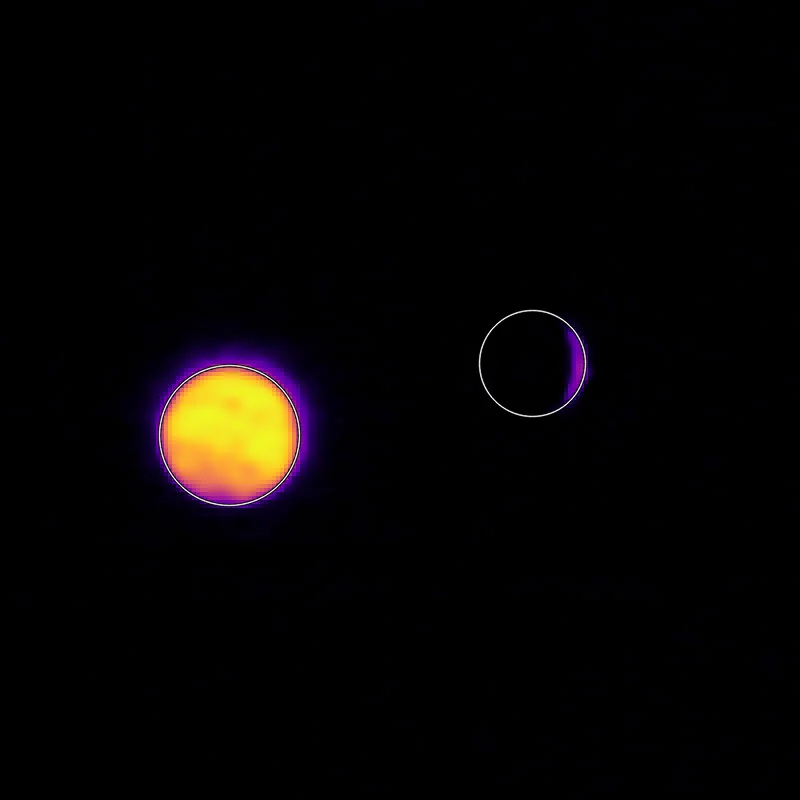
NASA’s ESCAPADE (Escape and Plasma Acceleration and Dynamics Explorers) mission, a vital component of the agency’s exploration of Mars, has recently captured striking images of Earth and the Moon from a remarkable vantage point. These photographs, taken on July 3rd, showcase our home planet and its natural satellite in both visible and thermal infrared light, serving a crucial purpose beyond mere celestial photography: calibrating the advanced instruments that will soon embark on a journey to the Red Planet. The mission, funded by NASA’s Heliophysics Division and part of the Small Innovative Missions for Planetary Exploration program, is poised to provide groundbreaking insights into how solar wind interacts with Mars’ atmosphere, potentially unlocking secrets about the planet’s past habitability and ongoing atmospheric loss.
The ESCAPADE spacecraft, a pair of identical probes built by Rocket Lab, were positioned approximately 363,250 miles (584,600 kilometers) from Earth and 115,600 miles (186,100 kilometers) from the Moon when the images were acquired. This significant distance, while vast, allowed for the Moon to appear relatively large in the frame, offering a detailed view of both celestial bodies. The visible light image, captured with the Sun partially illuminating Earth and the Moon, presents both as delicate crescents, with only about 8% of each face bathed in sunlight. This stark illumination highlights the challenges and nuances of observing celestial bodies under varying light conditions.
However, it is the thermal infrared image that offers a truly unique perspective. In this spectrum, the shadowed hemisphere of Earth, devoid of direct sunlight, is illuminated by its own internal heat. This thermal radiation emanates from both the atmosphere and the surface, causing the planet to glow within a temperature range of minus 10 to minus 44 degrees Fahrenheit (250 to 280 kelvins). This phenomenon underscores the insulating properties of Earth’s oceans and atmosphere, which retain and radiate heat. In contrast, the Moon, lacking such protective layers, presents a starkly different thermal profile. Its far side, also in shadow, registers a significantly cooler temperature of minus 280 degrees Fahrenheit (100 kelvins). This dramatic temperature difference between Earth and the Moon in the infrared spectrum provides invaluable data for the ESCAPADE mission’s scientific objectives.
A Crucial Calibration Step for Martian Exploration
The sophisticated cameras responsible for these captivating images are part of the Visible and Infrared Observation System (VIIRS), a testament to the collaborative efforts within the scientific community, with key components provided by Northern Arizona University in Flagstaff. These are not merely aesthetic snapshots; they represent a critical calibration step for the ESCAPADE mission.
“We are thrilled that ESCAPADE was able to accommodate these excellent space-qualified cameras which will search for visible Martian aurora and investigate thermal properties of the Martian surface and atmosphere,” stated Rob Lillis, the mission’s principal investigator at the University of California, Berkeley. “Since Earth and the Moon are well-known targets, imaging them provides an important calibration check for ESCAPADE’s cameras.” This calibration process is fundamental to ensuring the accuracy and reliability of the data that the spacecraft will collect once they reach Mars. By comparing the captured images of Earth and the Moon against known scientific parameters, researchers can fine-tune the instruments, guaranteeing that any future observations of Martian phenomena are interpreted with the highest degree of precision.
The Journey to Mars: A Gravitational Assist and a Scientific Objective
The ESCAPADE spacecraft are currently embarking on a unique orbital trajectory. They are situated in a “loiter” orbit around Lagrange point 2 (L2), a gravitationally stable point in space located approximately one million miles from Earth. This strategic positioning allows the spacecraft to conserve fuel and maintain a consistent observation platform before their crucial maneuver.
In November 2026, the twin probes will execute a critical flyby of Earth. This maneuver will utilize the planet’s immense gravitational pull to provide a slingshot effect, propelling the spacecraft on their trajectory towards Mars. This gravity assist is a common and highly effective technique in space exploration, enabling missions to achieve higher velocities and reach distant destinations with significantly less propellant expenditure.
The spacecraft are scheduled to arrive in the Martian system in September 2027. Upon arrival, their primary scientific objective will be to investigate the intricate relationship between the solar wind and the Martian environment. The solar wind, a continuous stream of charged particles emanating from the Sun, travels at speeds exceeding a million miles per hour. At Mars, this powerful stream interacts with the planet’s tenuous atmosphere and its remnant magnetic field. ESCAPADE’s observations will be instrumental in understanding how this interaction drives atmospheric loss, a key process that has shaped Mars’ evolution from a potentially wetter, warmer planet to the cold, arid world we observe today.
Understanding Atmospheric Loss: A Key to Mars’ Past and Future
The study of atmospheric loss on Mars is of paramount importance for several reasons. Firstly, it helps scientists reconstruct the planet’s ancient climate. It is widely believed that early Mars possessed a thicker atmosphere and liquid water on its surface, conditions that could have supported life. Understanding how that atmosphere dissipated is crucial to unraveling the story of Mars’ habitability over geological timescales.
Secondly, understanding the current rate of atmospheric loss provides insights into the planet’s ongoing evolution. While Mars may not currently be conducive to surface life as we know it, the processes that govern its atmospheric escape could have implications for future human exploration, including the potential for in-situ resource utilization and the long-term sustainability of any human presence. ESCAPADE’s data will contribute to building more accurate models of Martian atmospheric dynamics, aiding in both scientific understanding and future mission planning.
The twin ESCAPADE spacecraft will employ a suite of instruments to achieve their objectives. The VIIRS cameras, which captured the Earth and Moon images, will be used to observe visible Martian aurora, a phenomenon that occurs when charged particles from the solar wind interact with a planet’s atmosphere. They will also investigate the thermal properties of the Martian surface and atmosphere, providing crucial data on temperature variations and heat distribution. Other instruments onboard will likely focus on measuring the composition and density of the solar wind and the Martian ionosphere, providing a comprehensive picture of the interaction.
A Collaborative Endeavor with Broad Implications
The ESCAPADE mission is a testament to NASA’s commitment to small, innovative missions that can deliver significant scientific returns. Funded by the Heliophysics Division, the mission is part of the broader NASA Small Innovative Missions for Planetary Exploration (SIMPLE) program, which aims to foster the development of cost-effective, high-impact missions.
The leadership for the ESCAPADE mission resides with UC Berkeley’s Space Sciences Laboratory, a renowned institution with a long history of contributions to space science. The mission benefits from the expertise of a diverse range of key partners, including Rocket Lab, which not only built the spacecraft but also plays a crucial role in launch services; NASA’s Goddard Space Flight Center, contributing engineering and scientific expertise; Embry-Riddle Aeronautical University, likely involved in training future aerospace professionals and contributing to mission operations; Advanced Space, a company specializing in spacecraft autonomy and mission design; and Blue Origin, potentially contributing to launch capabilities or other technological advancements.
This collaborative approach is a hallmark of modern space exploration, bringing together the best minds and resources from academia, industry, and government to tackle complex scientific challenges. The success of ESCAPADE will not only advance our understanding of Mars but also serve as a valuable case study for future heliophysics and planetary science missions. The insights gained from studying the interaction of solar wind with Mars could have broader implications for understanding atmospheric escape on other planets throughout the solar system and beyond, contributing to the ongoing quest to understand planetary evolution and the potential for life in the universe. The detailed images of Earth and the Moon, captured during this critical calibration phase, represent an early triumph for ESCAPADE, signaling a promising future for its exploration of the Red Planet.