An international consortium of astronomers has identified a fundamental physical constant governing the behavior of black holes, effectively bridging the gap between stellar-scale phenomena and galactic-scale cataclysms. The research, published in the journal Nature Astronomy, establishes that black holes—regardless of their size—trigger the launch of high-energy jets at a specific, critical threshold of their feeding cycle. This discovery provides a long-sought unifying theory for how these cosmic behemoths regulate their energy output, transforming our understanding of how matter is recycled across the universe.
The study, co-led by Andrew Mummery of the Institute for Advanced Study (IAS) and Adelle Goodwin of the International Centre of Radio Astronomy Research (ICRAR) at Curtin University, synthesizes years of observational data collected from a global array of telescopes. By focusing on the dramatic, real-time destruction of stars by supermassive black holes, the team has successfully demonstrated that the laws of gravity and accretion remain consistent across mass scales that differ by millions of orders of magnitude.
The Physics of Cosmic Cannibalism
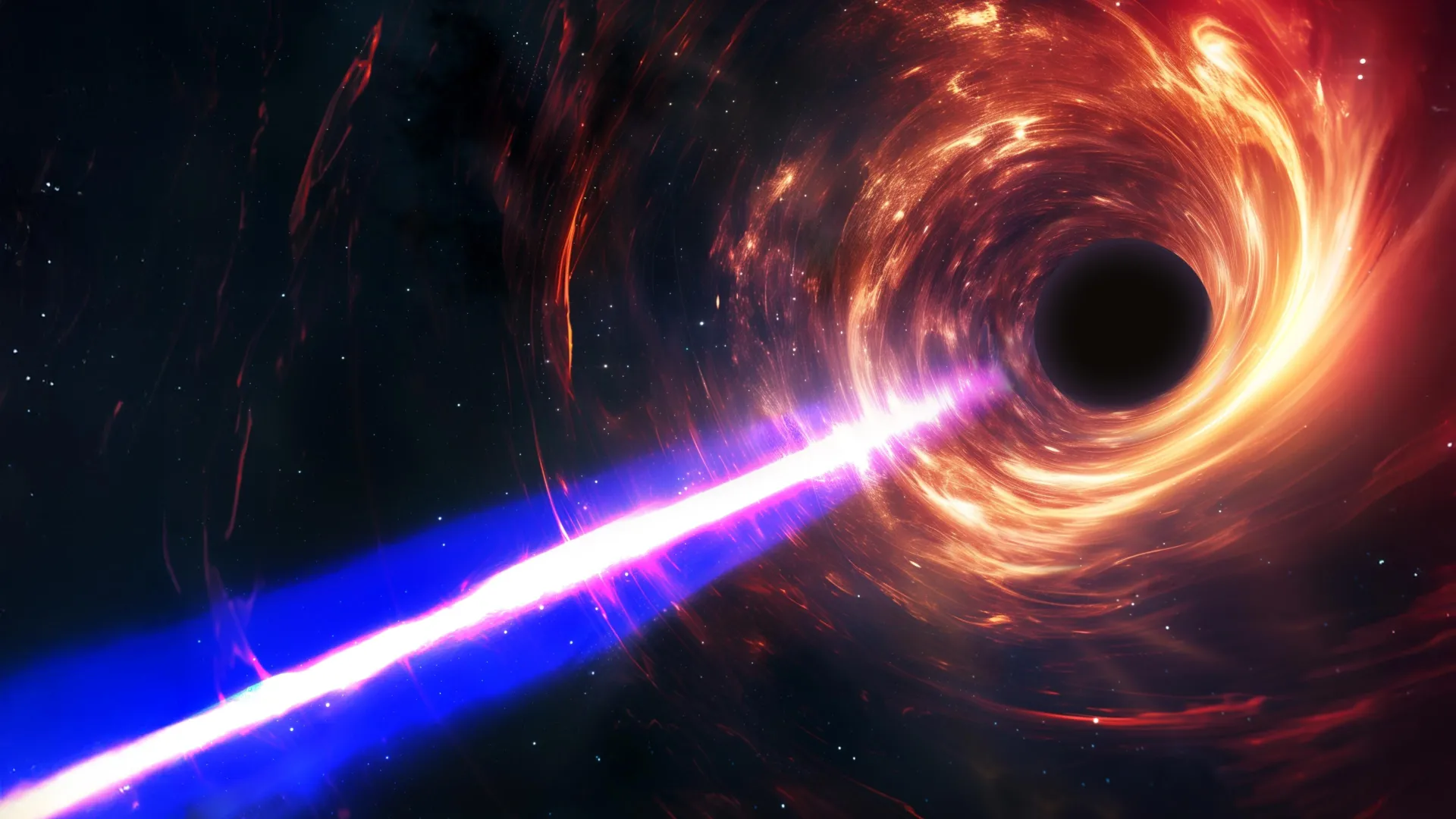
Black holes are often colloquially described as celestial vacuum cleaners, yet this analogy obscures the chaotic, highly energetic nature of their feeding habits. When a star wanders too close to a supermassive black hole, it is subjected to tidal disruption events (TDEs). These occurrences are characterized by extreme gravitational gradients that pull the star apart, turning it into a stream of superheated gas that spirals toward the event horizon.
However, the black hole does not consume this influx of material in its entirety. Instead, a significant portion of the stellar plasma is redirected, ejected into space as powerful, relativistic jets. These jets represent one of the most violent manifestations of energy in the cosmos, capable of shaping the chemical and structural evolution of entire galaxies. The research team sought to resolve a long-standing question in astrophysics: Why do some black holes exhibit an immediate, violent reaction to such an influx, while others remain dormant for months or even years before suddenly erupting?
A Collaborative Breakthrough in Madrid
The genesis of this discovery was not found in a laboratory, but rather through a serendipitous exchange at an astrophysics conference in Madrid. Mummery and Goodwin, while discussing the nuances of stellar-mass black hole behavior, realized that the mathematical models governing the "jet-trigger" in smaller systems—those roughly ten times the mass of the Sun—could be extrapolated to the supermassive black holes that reside at the centers of galaxies.
This theoretical leap required empirical validation. To test the hypothesis, the researchers analyzed twenty distinct tidal disruption events, selecting ten high-fidelity datasets that provided clear, multi-wavelength observations. By correlating optical, ultraviolet, X-ray, and radio data, the team mapped the feeding rate of the black holes against the timing of their jet emissions.
The data revealed a consistent pattern: the formation of these jets occurs at two distinct stages. The first is an immediate, high-rate feeding phase. The second, more elusive stage occurs significantly later—often hundreds or thousands of days after the initial disruption—when the accretion rate drops to precisely two percent of the black hole’s Eddington limit. The Eddington limit is the theoretical point of equilibrium where the inward pull of gravity is perfectly balanced by the outward pressure of radiation. Finding this two-percent "trigger" in supermassive systems confirmed that the physics of jet formation is essentially universal, independent of the mass of the central object.
Chronology and Methodology
The project required a sophisticated, multi-national observational campaign. Data were pooled from observatories across the United States, Australia, India, and South Africa, complemented by space-based telescope assets. This geographic and technical diversity was essential to capturing the full life cycle of TDEs.
Because supermassive black holes typically evolve over geological timescales—far too slow for human observation—the TDEs served as a natural laboratory. These events "speed up" the feeding process, allowing researchers to observe a cycle that would otherwise take eons to unfold. By monitoring these events over several years, the team could observe the drop in accretion rate and the subsequent "ignition" of the radio jets in real time.
Implications for Future Astronomy
The identification of this two-percent threshold is more than a theoretical milestone; it is a predictive tool. In the field of high-energy astrophysics, telescope time is a highly contested resource. Knowing when to look for a jet eruption allows astronomers to optimize their observation schedules, shifting focus from "blind" monitoring to targeted, high-probability windows.
This efficiency will be critical for the next generation of observatories, most notably the Square Kilometre Array (SKA). Scheduled to begin scientific data collection in 2028, the SKA will provide unprecedented sensitivity for detecting radio signals from the deep universe. With the Mummery-Goodwin model, astronomers can effectively "forecast" when a black hole is nearing its critical accretion stage, significantly increasing the probability of capturing the fleeting, high-energy moments of jet formation.
Broader Scientific Context and Analysis
The implications of this study extend to the role of black holes as "galactic thermostats." The energy released by these jets can heat the surrounding gas in a galaxy, potentially suppressing the formation of new stars. By understanding the timing and intensity of these jets, scientists can better model how galaxies grow and stabilize over the lifespan of the universe.
Furthermore, the confirmation of a universal rule suggests that the fundamental physics governing accretion disks—the spinning discs of material orbiting a black hole—are more robust than previously theorized. This consistency provides a bridge between different sub-disciplines of physics, from plasma dynamics to general relativity.
"The realization that a black hole’s size does not fundamentally change the logic of its feeding cycle is a major step forward," noted external observers familiar with the work. While the study provides a robust framework, the researchers acknowledge that further data are needed to account for the diversity of stellar material and the varying environments in which these TDEs occur. Nevertheless, the discovery marks a significant pivot toward a more unified and predictive science of black hole behavior.
Conclusion
As the international astronomy community prepares for the launch of the Square Kilometre Array and other advanced observatories, the work led by the Institute for Advanced Study and the International Centre of Radio Astronomy Research provides a roadmap for future exploration. By decoding the "burps" of supermassive black holes, humanity is gaining a clearer understanding of the forces that dictate the life and death of stars and the fundamental architecture of the galaxies they inhabit.
The research not only resolves a specific mystery regarding jet formation but also underscores the necessity of international cooperation in the pursuit of fundamental truths. By combining multi-wavelength data from across the globe, Mummery and Goodwin have successfully illuminated one of the most enigmatic behaviors of the cosmos, ensuring that future observations will be more precise, more efficient, and far more revealing. This is a testament to the power of collaborative science, where even a casual conversation between peers can lead to the uncovering of a universal law that has existed since the dawn of time.