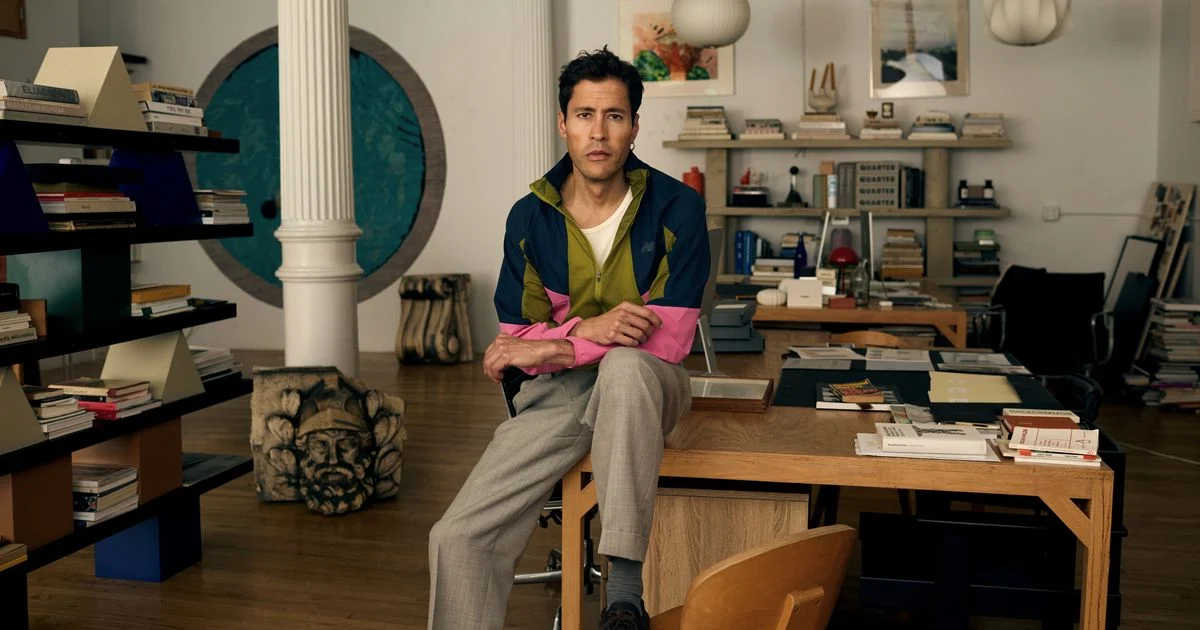
On a warm afternoon in late August, designer Rafael Prieto received visitors at his expansive Tribeca loft in lower Manhattan, a space that doubles as his residential home, his creative agency Savvy, and the incubator for his celebrated furniture designs. Known for his cross-disciplinary approach that blurs the lines between commercial branding, interior design, and conceptual art, Prieto has spent the last two decades building an aesthetic universe deeply informed by spatial theory, memory, and architectural heritage. The high-ceilinged industrial studio, characterized by vintage Venetian blinds and exposed ceiling architecture from the 1980s, currently serves as the staging ground for an upcoming solo exhibition titled "The Future of the Past." Scheduled to open on September 30 at the Emma Scully Gallery, the collection features a series of striking furniture pieces constructed from 16 architectural fragments salvaged directly from a Beaux-Arts building undergoing renovation across the street.
The genesis of this unique collection lies in an accidental proximity. For over a year, Prieto has had a direct view of the extensive scaffolding covering 366 Broadway, historically known as the Collect Pond House. Constructed in the early 20th century, the imposing structure originally served as corporate headquarters for the Royal Typewriter Company before transitioning into a residential cooperative housing various art galleries and local retail establishments. While observing the routine construction and facade restoration from his studio window, Prieto noticed discarded architectural elements accumulating on top of the scaffolding platforms. Rather than standard industrial waste like rebar or poured concrete, the debris comprised ornate Edwardian artifacts: copper cornices, Greek-key moldings, intricately carved marble columns, and a series of bearded male keystones. Recognizing the historical and aesthetic value of these discarded fragments, Prieto initiated discussions with the construction crew, ultimately securing permission to salvage the pieces before they were hauled away to a municipal landfill.
Chronology of the Salvage and Design Process
The timeline of "The Future of the Past" spans more than a year of observation, acquisition, and meticulous studio production. The project began organically:
- Mid-2025: Exterior restoration work commences on 366 Broadway, prompting the installation of extensive sidewalk sheds and roof-level scaffolding that obstructs and frames Prieto’s daily view from his Tribeca studio.
- Late 2025: Prieto identifies decorative terracotta, stone, and metal fragments left unsecured on the scaffolding overhangs. Recognizing the impending loss of historical craftsmanship, he approaches the contracting team to request access to the material.
- Early 2026: Prieto successfully acquires 16 distinct Edwardian architectural fragments, integrating them into his studio workflow. He spends months cataloging, photographing, and digitally analyzing the geometries of the building’s facade elements.
- Spring to Summer 2026: Utilizing the photographic catalog, Prieto collaborates with fabricators to translate the stone and metal details into precise, machined wooden components. He begins "Frankensteining" historical artifacts with sleek, contemporary support structures.
- September 14, 2026: Media previews and studio visits shed light on the conceptual underpinnings of the collection, highlighting the intersection of architectural preservation and adaptive reuse.
- September 30, 2026: "The Future of the Past" officially opens to the public at the Emma Scully Gallery, marking Prieto’s second major institutional collaboration with the gallery following their successful 2023 exhibition.
Materiality, Metaphor, and Manufacturing
In translating urban debris into high-end collectible design, Prieto employs a rigorous formal vocabulary that balances historical preservation with contemporary minimalism. Rather than simply mounting or repurposing the found objects as raw readymades, the designer subjects the Edwardian fragments to a sophisticated transformation. He photographed the architectural details of 366 Broadway, generating a digital taxonomy that allowed him to recreate and abstract the forms into lacquered wooden parts.
In one notable console table designed for the upcoming exhibition, a glossy black L-shaped frame—featuring ladder-like legs directly inspired by the fluted piers anchoring the corners of the Collect Pond House—cradles an original scrolled stone support. Another piece, a compact stool, nests a weathered, craggy stone core inside a rigid, column-like black shell. This juxtaposition yields a visual palimpsest, where the physical memory of early-20th-century New York architecture is grafted onto sleek, modern forms.
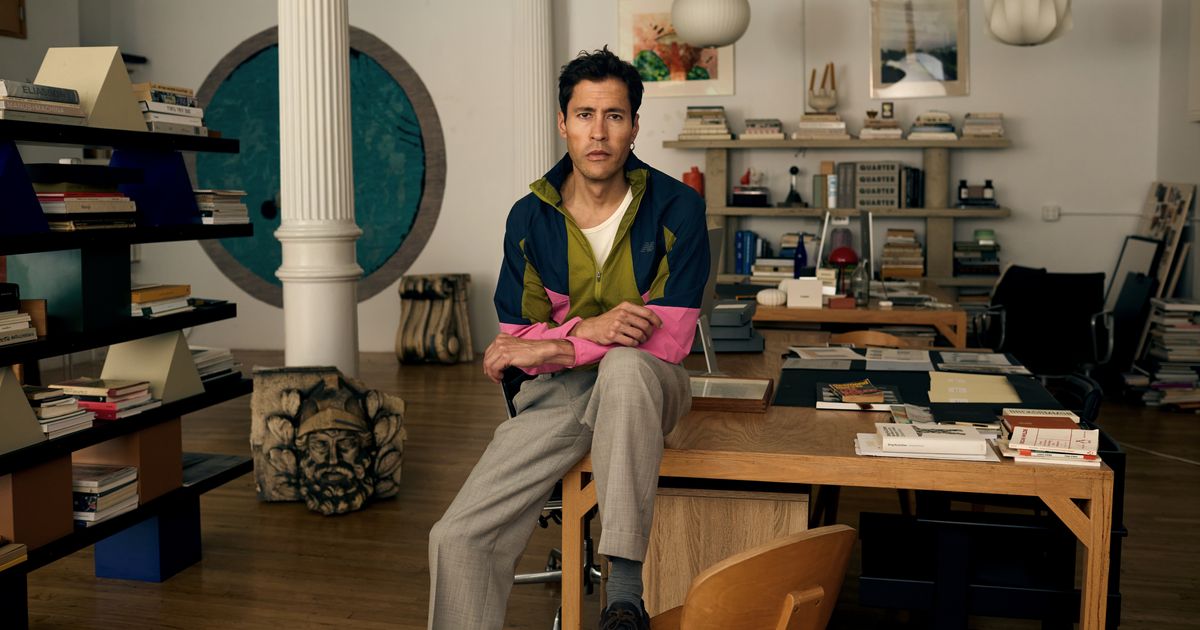
The resulting objects occupy a liminal space. While undeniably rooted in the specific urban fabric of lower Manhattan, the abstraction of the elements endows them with a universal quality, allowing the pieces to evoke historical architecture from any major metropolitan center worldwide. However, not all salvaged elements have been immediately integrated into functional objects. Several pieces remain untouched within Prieto’s studio, including a prominent, bearded stone keystone waiting for a bespoke residential commission. Prieto acknowledges the logistical realities of high-end design, noting that monumental architectural elements require specific spatial contexts that may ultimately find homes in suburban estates rather than compact urban apartments.
Conceptual Influences and Personal Background
Prieto’s artistic methodology is deeply anchored in conceptual art traditions, a lineage clearly visible in his Tribeca studio. Displayed alongside his own furniture and lighting collaborations—such as his corseted-linen light fixtures created with designer Loup Sarion and his literary-inspired swimming pool rugs developed with Christopher Farr—are canonical works of modern and contemporary art. His collection features a signed and numbered Man Ray reedition of a household iron studded with tacks, a stamped Joseph Beuys multiple of a chalkboard eraser, two classic red-and-blue Gerrit Rietveld chairs, a plywood Lawrence Weiner chair, and a silk-screened Plexiglass composition by John Cage created using the I Ching to determine random arrangements of letters and numbers.
These historical touchstones mirror Prieto’s reliance on chance, ephemera, and linguistic structures in his own creative output. Born and raised on a cattle ranch in northern Mexico, Prieto’s biographical trajectory has spanned multiple countries and urban environments, including Berlin, San Francisco, Mexico City—where he co-founded the hospitality and chocolate enterprise Casa Bosques—and finally New York City. This history of geographic displacement has cultivated a persistent sense of being an outsider, a psychological state that informs his engagement with language and physical environment.
Citing the conceptual text-based sculptures of Lawrence Weiner as a formative early influence, Prieto has frequently struggled with the nuances of linguistic expression in English, finding a profound sense of shared syntax in Weiner’s minimalist assertions. This exhibition at the Emma Scully Gallery represents a literal and metaphorical domestication of his adopted hometown. By absorbing literal fragments of New York infrastructure into his practice, Prieto is metabolizing the city’s relentless cycle of destruction and renewal.
Broader Implications for Urban Design and Adaptive Reuse
The intersection of historic preservation, urban densification, and contemporary art exemplified by Prieto’s exhibition arrives at a critical juncture for global architecture. As historic downtown cores face continuous pressure to modernize, demolish, or rezone, millions of tons of architectural ornamentation are routinely lost to municipal waste streams. Projects like "The Future of the Past" highlight the growing viability of adaptive reuse not merely as an architectural strategy for entire buildings, but as a micro-level intervention in product and furniture design.
Industry analysts note a rising consumer and institutional demand for circular design methodologies, where the provenance and embedded carbon of materials dictate aesthetic value. By diverting architectural ornaments from commercial dumpsters and recontextualizing them within domestic environments, Prieto challenges the disposable nature of contemporary real estate development. The collection serves as an implicit critique of the rapid erasure of urban history, arguing that the material remnants of the past can actively inform the functional design of the future.
Yet, as encapsulated by one of the bolded maxims in Prieto’s project notes—"Resist monumental grandeur"—the work stops short of nostalgic sentimentality. Instead, it embraces the inevitable mutation of the city, acknowledging that the physical fabric of New York will always continue its perpetual cycle of tearing down the old to build something new, while designers like Prieto attempt to capture fleeting fragments in the balance.