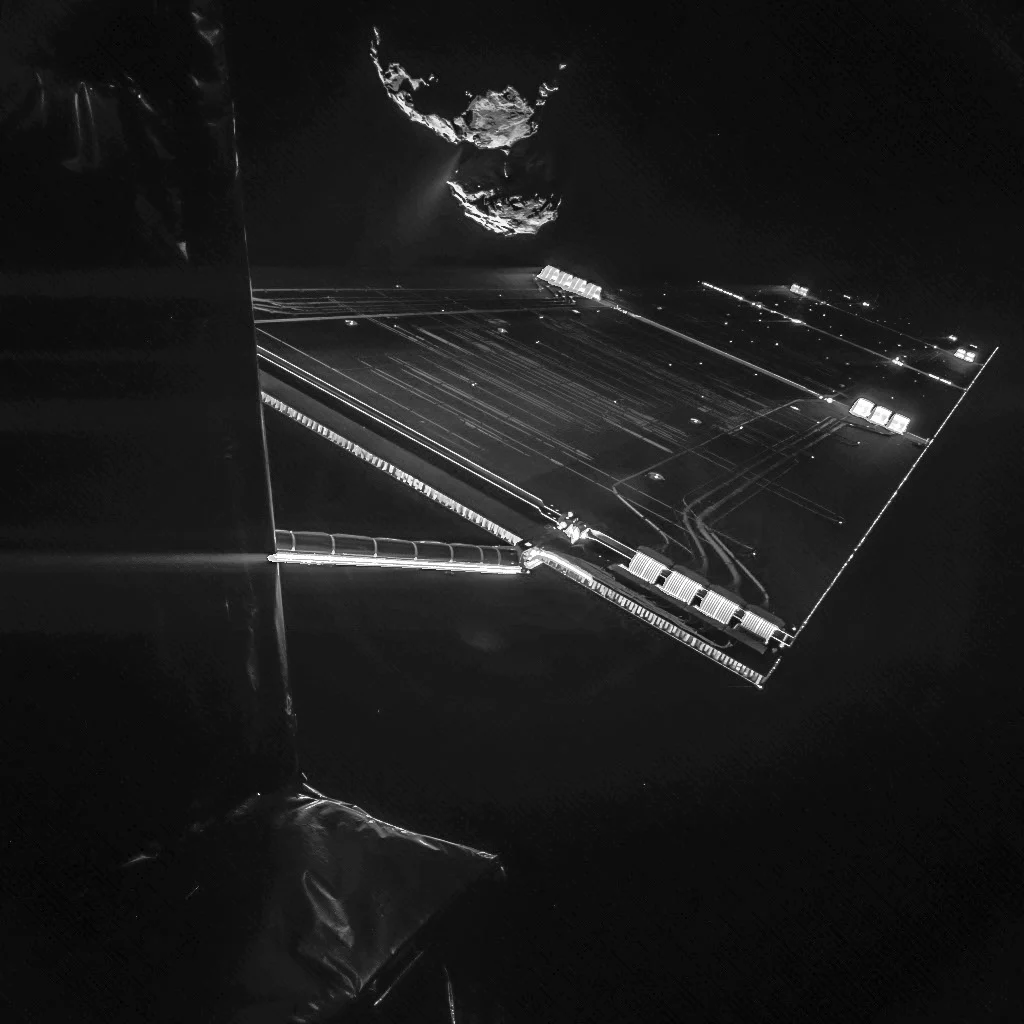
On October 7, 2014, the European Space Agency’s Rosetta spacecraft captured a definitive moment in deep-space exploration, recording a high-contrast self-portrait from a distance of 472 million kilometers from Earth. This image, taken by the CIVA camera system mounted on the Philae lander, features the stark, jagged nucleus of comet 67P/Churyumov-Gerasimenko looming in the background, contrasted against the reflective surfaces of one of the orbiter’s 14-meter-long solar arrays. Captured while the spacecraft was a mere 16 kilometers from the comet’s surface, the photograph remains one of the most iconic visual records of human ingenuity navigating the harsh, unpredictable environment of the outer solar system.
The Mission and Its Objectives
The Rosetta mission, launched in March 2004, represented a decade-long voyage into the unknown. Its primary objective was to rendezvous with and orbit a comet, eventually deploying a lander to conduct in-situ analysis. Comets are considered the "pristine" remnants of the early solar system, containing frozen materials that date back to the formation of the Sun and planets. By studying 67P/Churyumov-Gerasimenko, scientists sought to understand the chemical and physical processes that governed the primordial solar nebula.
The spacecraft was a feat of engineering, carrying a suite of eleven scientific instruments on the orbiter and ten on the Philae lander. The CIVA (Comet Infrared and Visible Analyser) camera, which produced the historic selfie, was specifically designed to provide panoramic imagery of the landing site and to characterize the surface composition of the comet.
A Chronology of the 2014 Encounter
The final months of 2014 served as the climax of the mission, characterized by high-stakes maneuvers and unprecedented scientific data collection.
- August 6, 2014: Rosetta officially achieved orbit around comet 67P, becoming the first spacecraft in history to orbit a comet nucleus.
- September 15, 2014: Mission controllers at the European Space Operations Centre (ESOC) in Darmstadt, Germany, announced the primary landing site for Philae, dubbed "Agilkia."
- October 7, 2014: Rosetta maneuvered to a close proximity of 16 kilometers, allowing the Philae lander to capture the high-contrast image using a combination of long and short exposures to account for the extreme lighting conditions near the comet.
- November 12, 2014: Following final systems checks, Philae separated from the Rosetta orbiter. The lander began its descent, providing a rare "look back" at the orbiter before beginning its historic touchdown.
- November 12, 2014 (Later): Philae successfully touched down on the surface of 67P. Although the landing was unconventional—the harpoons designed to anchor the lander failed to fire, causing the lander to bounce twice before settling in a shaded, rocky location—it nonetheless succeeded in transmitting initial data back to Earth.
Technical Challenges of the Imaging Sequence
The image captured on October 7 was not a simple snapshot. The environment of a comet is notoriously difficult for optical sensors. As the comet approaches the Sun, the warming ices sublimate into gas, creating a "coma"—a glowing shroud of dust and volatile materials. This material reflects sunlight, creating significant glare.
The CIVA system on Philae had to manage these high-contrast conditions. By merging multiple exposures, the engineers managed to capture the fine details of the comet’s double-lobed nucleus while preventing the bright sunlight glinting off the solar panels from washing out the frame. This technique highlighted the engineering duality of the mission: the delicate, gold-foil-covered instruments of the lander against the primordial, cratered landscape of a body that had remained largely unchanged for billions of years.
Scientific Significance and Data Analysis
The data returned by Rosetta and Philae fundamentally changed the scientific understanding of comets. Before the mission, many researchers hypothesized that comets were "dirty snowballs" composed largely of water ice and simple organic molecules. The findings from 67P, however, revealed a far more complex structure.

Analysis of the surface by Philae and the orbiter’s remote sensing instruments indicated that the nucleus was highly porous, with a density significantly lower than that of liquid water. Furthermore, the isotopic signature of the water detected on 67P—specifically the ratio of deuterium to hydrogen—differed from that found in Earth’s oceans, suggesting that the primary source of Earth’s water may not have been comets of this specific type.
The "double-lobed" structure of the nucleus, often described as resembling a rubber duck, provided evidence that the comet was likely formed by a low-velocity collision between two distinct objects in the early solar system. This "contact binary" structure suggests that such collisions were common during the protoplanetary disk phase.
Official Responses and Legacy
Reflecting on the mission, officials at the European Space Agency (ESA) have consistently highlighted the importance of the Rosetta-Philae partnership. Project scientists have noted that the 2014 imaging campaign provided the necessary topographical data to identify safe landing zones.
"The selfie was more than just a photo; it was a calibration of our position and a testament to the fact that we were truly there," said a mission spokesperson during the post-mission summary. The success of the imaging system, despite the extreme distance from the Sun and the challenging dust environment, set a new standard for future deep-space imaging missions, including the upcoming explorations of the moons of Jupiter and Saturn.
Broader Impact and Future Implications
The legacy of the Rosetta mission extends well beyond the data collected during its two-year tenure at the comet. The mission demonstrated that autonomous landing on a low-gravity, irregularly shaped object is achievable. This capability is critical for future missions focused on asteroid mining or planetary defense.
Furthermore, the mission fostered a unique public engagement effort. By releasing images like the October 7 selfie in near real-time, the ESA managed to bridge the gap between complex orbital mechanics and the general public. The "comet-chasing" narrative became a touchstone for science communication, proving that the public maintains a high level of interest in fundamental exploration when it is presented through the lens of human endeavor.
As the scientific community continues to analyze the petabytes of data returned by the Rosetta orbiter, the implications for astrobiology are becoming increasingly clear. The detection of complex organic molecules on the surface of 67P reinforces the theory that the building blocks of life may be delivered to planetary surfaces via cometary impacts. While the specific water signature may not match Earth’s, the organic chemistry observed suggests that the ingredients necessary for life are abundant throughout the solar system.
Conclusion
The October 7, 2014, image of the Rosetta solar array against the backdrop of 67P stands as a definitive artifact of the early 21st-century space age. It serves as a bridge between the engineering prowess of the present and the ancient history of our solar system. As humanity looks toward future exploration targets, the lessons learned from the Rosetta mission—both in terms of the technical challenges of deep-space navigation and the scientific value of long-term comet observation—remain the foundational pillars upon which the next generation of space exploration will be built. The mission concluded in September 2016, with the controlled crash-landing of the Rosetta orbiter onto the comet’s surface, but the images captured in 2014 continue to provide researchers with insights into the nature of our cosmic neighborhood.