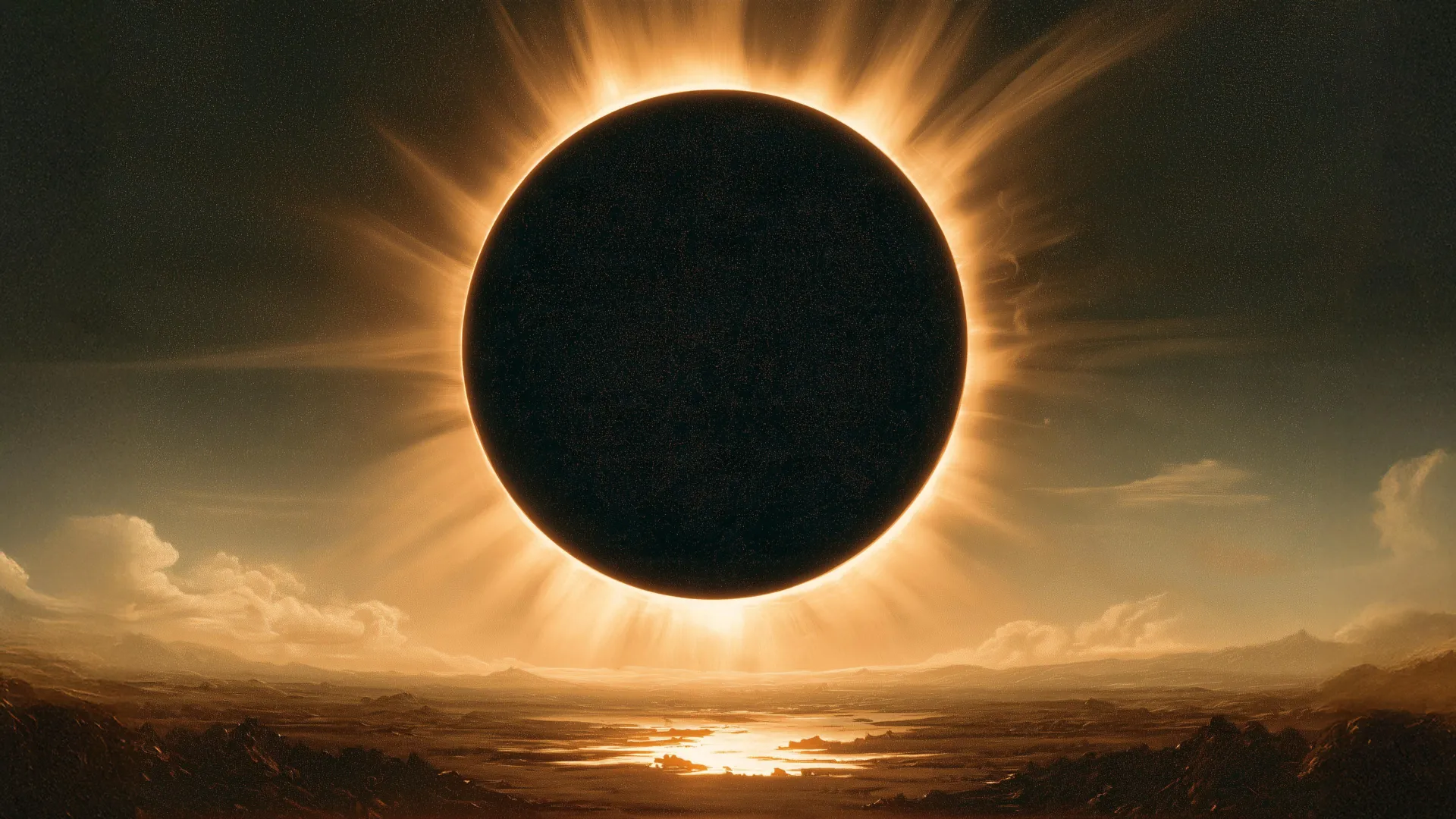
On July 17, 709 BCE, the skies over the ancient Lu Duchy in China darkened as a total solar eclipse plunged the region into an eerie, midday twilight. More than 2,700 years later, this celestial event has become the focal point of a multidisciplinary scientific investigation that bridges the gap between ancient historical chronicles and modern astrophysics. By meticulously re-examining the "Spring and Autumn Annals" and the later "Hanshu" (Book of Han), an international team of researchers has successfully refined our understanding of Earth’s historical rotation and the long-term behavior of the Sun. This study, recently published in the Astrophysical Journal Letters, highlights how the intersection of archaeology, history, and celestial mechanics can yield high-precision data from antiquity.
The Geography of History: Correcting a Millennial Error
The primary challenge for the research team was a persistent discrepancy between modern astronomical projections and the ancient historical record. When astronomers first attempted to map the path of the 709 BCE eclipse, their models suggested that a total eclipse should not have been visible from Qufu, the capital of the Lu Duchy. For years, this inconsistency left scientists questioning either the accuracy of the ancient chroniclers or the validity of current Earth rotation models.
The breakthrough occurred when the researchers conducted a granular review of archaeological excavation reports and historical geographic data. They discovered that previous reconstructions had relied on slightly inaccurate geographic coordinates for the ancient capital of Qufu. By identifying an eight-kilometer shift in the city’s historical location, the team reconciled the ancient observation with the laws of orbital mechanics. This correction was not merely a matter of cartography; it acted as a vital calibration point. With the precise location established, the team could calculate the exact conditions of the eclipse, which in turn allowed for an unprecedented measurement of Earth’s rotational speed at that specific epoch.
Chronology and the Evolution of the Record
The record of the 709 BCE eclipse is a testament to the sophisticated observational culture of ancient China. The timeline of this information begins in the 8th century BCE, with the initial observation recorded by court astronomers. These observations were later codified in the "Spring and Autumn Annals," a seminal work of Chinese literature traditionally attributed to Confucius, compiled between 200 and 300 years after the event occurred.
The narrative gained further depth seven centuries after the eclipse, when the "Hanshu" (Book of Han) added a crucial detail: the description of the Sun as "completely yellow above and below." Scientists interpret this as a potential reference to the solar corona—the diffuse, crown-like plasma atmosphere of the Sun that is only visible during totality.
The chronology of these documents is significant:
- 709 BCE: The occurrence of the total solar eclipse in the Lu Duchy.
- 5th–3rd Century BCE: Compilation of the "Spring and Autumn Annals," securing the eclipse as a historical fact.
- 1st Century CE: The "Hanshu" adds the descriptive note regarding the Sun’s appearance.
- 2024 CE: Modern researchers utilize computational models to validate these ancient texts against modern solar physics.
Earth’s Rotational Decay: The Delta T Factor
Earth’s rotation is not a static process. It is subject to gradual deceleration, primarily driven by tidal friction—the gravitational interaction between the Earth’s oceans and the Moon. As the Moon pulls on the Earth’s tides, the energy dissipation acts as a brake on our planet’s rotation, causing the length of a day to lengthen over millions of years.
To quantify these shifts, scientists use a parameter known as Delta T (ΔT), which measures the difference between Terrestrial Time (a uniform scale) and Universal Time (based on Earth’s rotation). The 709 BCE eclipse provided a rare, high-precision anchor point for Delta T. By confirming that the eclipse was indeed total at the corrected site of Qufu, the researchers established a range for ΔT between 20,264 and 21,204 seconds for that period. This data serves as a vital constraint for geophysicists, allowing them to refine models of how the Earth-Moon system has evolved over the last three millennia.
Solar Activity and the Grand Minimum Hypothesis
Beyond the mechanics of Earth’s spin, the study offers a window into the Sun’s historical temperament. The description of the corona from the "Hanshu" suggests a Sun in a state of high magnetic activity, which is of great interest to solar physicists studying long-term cycles.
For much of the 8th century BCE, the Sun was thought to be in the midst of the "Homer Grand Minimum," a period of reduced solar activity lasting from approximately 808 to 717 BCE. During such "grand minima," sunspot production drops, and the Sun’s magnetic field weakens. The 709 BCE eclipse occurred shortly after the conclusion of this minimum. If the description of the corona is accurate, it implies that the Sun had already begun its transition back into a more active phase, characterized by complex magnetic structures that would manifest as a visible, non-spherical corona.
This conclusion is supported by independent proxy data—specifically, radiocarbon levels found in tree rings. Radiocarbon (C-14) is produced in the upper atmosphere by cosmic rays. When the Sun is active, its magnetic field shields the Earth, reducing the influx of cosmic rays and, consequently, the production of radiocarbon. The alignment between the 709 BCE coronal observation and the radiocarbon trends of that era provides a rare instance of interdisciplinary validation, reinforcing the accuracy of both historical chronicles and tree-ring dating.
Omenology and the Institutionalization of Science
The precision of these ancient records is no accident. In the context of ancient Chinese political thought, the heavens were considered a reflection of the terrestrial order. "Omenology" was a sophisticated, state-sponsored practice wherein court astronomers were tasked with tracking every celestial anomaly. Eclipses were interpreted as moral warnings directed at the sovereign, signaling the need for rectification or reflection.
This cultural mandate transformed astronomical observation into a vital administrative duty. Successive dynasties invested heavily in the maintenance of these records, creating an unbroken chain of documentation that far exceeds the scope of many other ancient civilizations. This institutional commitment to monitoring the sky has left a legacy that contemporary scientists are only now fully capable of mining for data.
Expert Perspectives and Scientific Implications
Lead author Hisashi Hayakawa, an assistant professor at Nagoya University, emphasized the importance of the methodology, noting that the study’s strength lies in the integration of disparate fields. "What makes this record special isn’t just its age, but the convergence of historical geography and physics," Hayakawa stated. The collaboration, which included researchers from the National Astronomical Observatory of Japan and the University of Reading, demonstrates the potential for "archaeoastronomy" to inform current climate and solar models.
Co-author Dr. Meng Jin of the Lockheed Martin Solar and Astrophysics Laboratory underscored the value of this endeavor, remarking that modern computational power is essentially giving new life to the observations of the ancients. By applying modern digital simulations to the descriptions provided by court astronomers, researchers can "see" the Sun as it was thousands of years ago, providing a vital baseline for understanding how our star behaves over secular, or long-term, timescales.
The implications of this research are twofold. First, it provides a more accurate map of the secular deceleration of the Earth, which is essential for any study involving historical astronomy or planetary motion. Second, it adds weight to the theory that solar activity fluctuates in predictable, albeit very long, cycles. By validating the Sun’s "awakening" after the Homer Grand Minimum, the study provides a template for interpreting other historical astronomical records that remain obscure or unverified.
Conclusion: A Legacy in the Stars
The 709 BCE eclipse, once a minor point of contention in historical charts, has been transformed into a cornerstone of modern chronostratigraphy and solar science. This research underscores a fundamental truth: the history of science is not linear. It is a dialogue between the past and the present, where the meticulous efforts of ancient scholars provide the raw data required for modern breakthroughs. As scientists continue to refine their models of the Sun and the Earth, they will inevitably turn back to these ancient chronicles, ensuring that the legacy of the Lu Duchy astronomers continues to illuminate the path of discovery for generations to come.