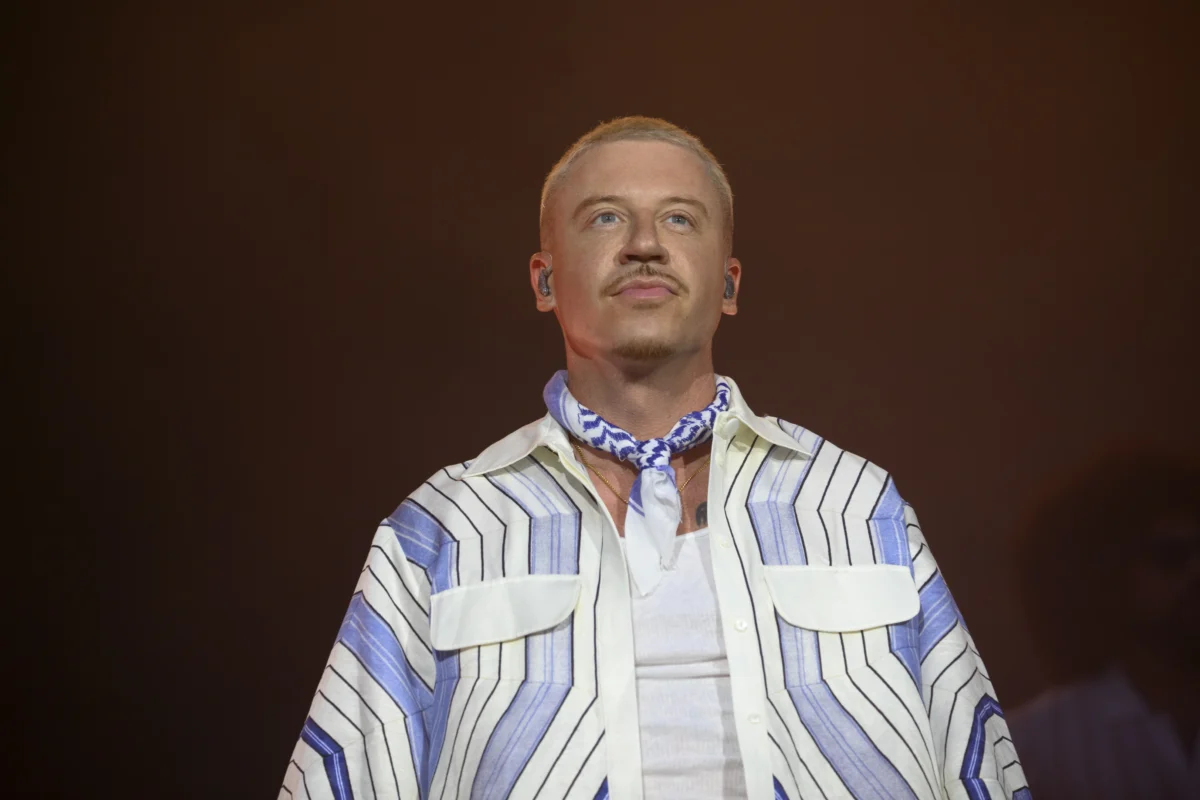
The intersection of global geopolitics, live entertainment, and artistic freedom reached a defining moment as Grammy-winning rapper Macklemore took the stage in Dublin, Ireland, to kick off a targeted three-show solidarity tour. Dedicated entirely to themes of love, liberation, and humanitarian advocacy for Palestine, the opening night featured surprise guest appearances by acclaimed singer-songwriter Hozier and the politically vocal hip-hop trio Kneecap. This European trek follows a tumultuous six-week period for Macklemore, who was abruptly removed from Ed Sheeran’s North American stadium tour in September following impassioned stage speeches addressing the ongoing Israel-Hamas war.
The Dublin performance serves as the emotional and financial cornerstone of a short tour that will also include stops in Paris and London. In a powerful display of conviction, Macklemore has pledged all proceeds from these concerts to charitable organizations aiding civilians in Palestine, augmenting his previous decision to donate his entire $1 million touring salary from the Ed Sheeran collaboration directly to the humanitarian cause.
The Genesis of Controversy: MetLife Stadium Speeches
The sequence of events that reshaped the fall touring calendar began on September 4 and 5 at MetLife Stadium in East Rutherford, New Jersey, during Ed Sheeran’s massive "Loop" tour. Serving as a direct support act, Macklemore utilized his platform to address tens of thousands of concertgoers, explicitly stating, "Free Palestine."
During the September 4 performance, the artist elaborated on his motivation, telling the stadium crowd that he wanted his words to resonate globally, reaching individuals from Gaza to the occupied West Bank to remind them they were not forgotten. On the following night, September 5, Macklemore reiterated the phrase while explicitly clarifying that his political declaration was not intended as a criticism of Jewish people.
Despite this caveat, the remarks triggered immediate, polarized reactions across the media landscape. Pop star Pink publicly addressed the statements via social media, while the Israeli American Council launched a formal petition demanding the rapper’s immediate removal from the tour. Critics argued that a commercial pop concert featuring global headliners should not serve as a proxy for geopolitical protests, maintaining that the platform breached boundaries between entertainment and one-sided political activism.
Promoter Intervention and the Domino Effect Across the Tour
The swift fallout culminated on September 14, when the Messina Touring Group—the promoters behind Ed Sheeran’s U.S. run—officially announced that Macklemore had been dropped from all remaining dates. In a public statement, the promoter cited venue pushback, explaining that several facilities had threatened to cancel upcoming events outright if Macklemore remained on the bill, a move that organizers claimed would have disrupted logistics for hundreds of thousands of ticket holders.
The dismissal sent shockwaves through the tour’s supporting lineup. In an unprecedented display of industry solidarity, several other opening acts—including Finneas, Lukas Graham, and Aaron Rowe—alongside a significant portion of Sheeran’s backing band, chose to withdraw from the tour in protest of the decision.
Compounding the tension, Macklemore publicly alleged that Robert Kraft, owner of Gillette Stadium in Massachusetts, had actively refused to host him and was lobbying other stadium executives to enact similar bans. Kraft responded to the claims by announcing a joint $2 million philanthropic donation alongside Ed Sheeran aimed at alleviating humanitarian suffering in the region, seeking to distance the venue’s operational decisions from the broader political fray.
Ed Sheeran’s Evolving Public Stance
Initially, Ed Sheeran attempted to distance himself from the controversy, emphasizing that the decision to remove Macklemore rested entirely with the tour promoters. In a detailed public statement, Sheeran articulated his long-standing policy of avoiding direct political discourse from the stage, arguing that his audiences—often comprising families and children from diverse backgrounds—attend his shows for sanctuary rather than political debate.
"There is a reason I do not use my professional platform for politics," Sheeran wrote, defending the value of maintaining a neutral space to foster open communication. He added, "I respect Macklemore’s strength of purpose… However, there is room for multiple approaches to the same end: peace."
Yet, as the tour progressed and public pressure intensified, Sheeran’s stance shifted noticeably. During a September 19 performance in Philadelphia, the British singer-songwriter broke his silence on the conflict. Addressing the audience directly, Sheeran characterized the October 7 attacks in Israel and the Nova Music Festival as horrific events that compounded historical Jewish pain, while simultaneously labeling the situation in Gaza as "catastrophic, unjustifiable, and disproportionate," while also noting systemic injustices in the West Bank.
The Dublin Address: Art as a Medium for Resistance
Taking the stage at his Dublin concert, Macklemore reflected deeply on the power and perceived threat of simple language in times of global crisis. Addressing the audience, he analyzed the intense pushback he faced over two words: "Free Palestine."
"Six weeks ago, it was two words. Two words is all that it took," Macklemore told the crowd. "Two words that are rooted in love and liberation. Not against anybody, not divisive. Not a call for hatred. But a call to recognize our shared humanity."
He continued by drawing attention to the broader implications of censorship and geopolitical debate, asserting that freedom cannot be decoupled from human dignity. "And yet, those words, right, those two words are so threatening to some people. They would rather silence those two words than confront what they actually mean. Because freedom that requires another person’s oppression is not freedom at all."
Highlighting the visual documentation emerging from the conflict zones—including images of families displaced and children pulled from rubble—Macklemore argued that the phrase itself had paradoxically become a lightning rod, drawing more controversy than the underlying humanitarian suffering that prompted it.
"That is why we are here, because throughout history, music has given people a place to resist, to come together as a collective, to share our grief, to share our stories, to move from the heart, to mobilize people with the frequency of love," he added.
Broader Implications for the Live Entertainment Industry
The confrontation between Macklemore, tour promoters, and venues highlights an ongoing, complex debate within the contemporary music industry regarding the responsibilities of artists who utilize global platforms. As musicians increasingly find themselves at the intersection of pop culture and international advocacy, industry analysts note that artist management teams and venue operators face escalating challenges in balancing freedom of expression with contractual obligations, security concerns, and diverse fan demographics.
For Macklemore, the fallout has catalyzed an independent pivot toward purpose-driven touring. Following his appearance in Dublin, the rapper is slated to perform at Colorado’s Red Rocks Amphitheatre before taking the "Free Palestine" advocacy tour to Paris and London. By channeling 100% of his concert proceeds and previous tour earnings into direct aid, the artist has demonstrated a willingness to trade commercial stadium support for direct, grassroots engagement, setting a distinct precedent for modern artist activism.