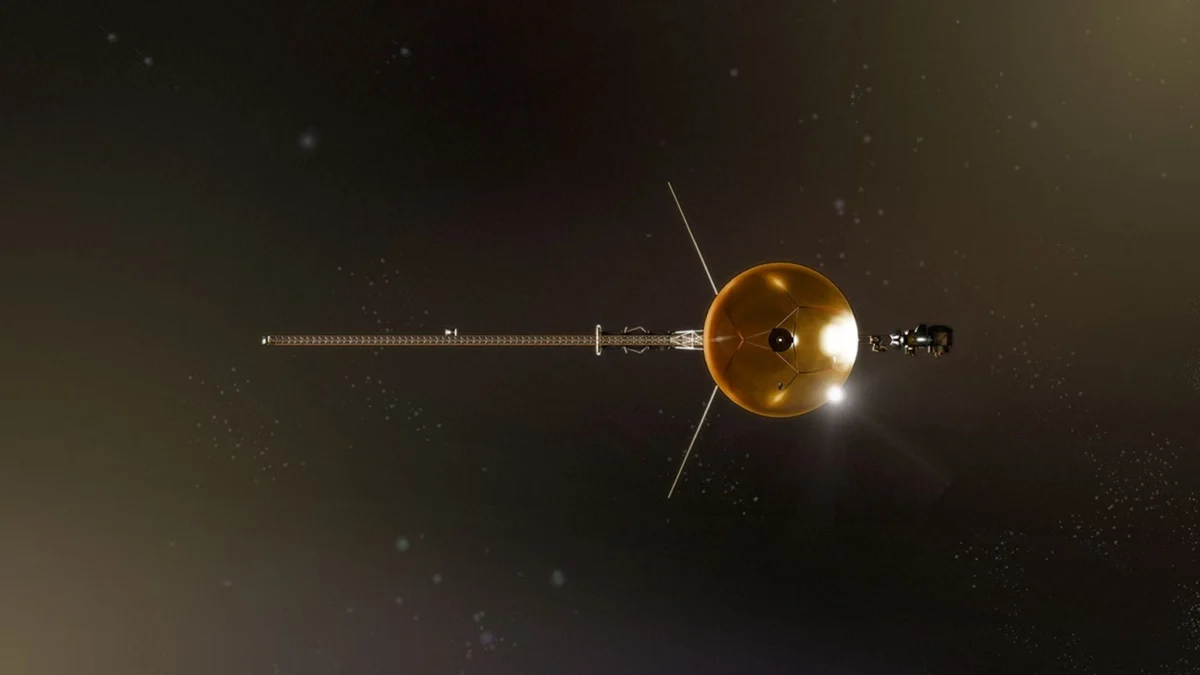
On Wednesday, November 18, NASA’s Voyager 1 spacecraft will achieve a staggering astronomical milestone: it will have traveled exactly one light-day away from Earth. This distance, amounting to more than 16 billion miles (25.9 billion kilometers), serves as a testament to the longevity and profound scientific contribution of a mission launched nearly 50 years ago. As the most distant human-made object in history, the probe now resides in a realm where even light, the fastest thing in the universe, takes a full 24 hours to bridge the gap between our home planet and the spacecraft. This event marks not just a measurement of distance, but a celebration of human ingenuity, resilience, and the relentless pursuit of cosmic discovery.
A Legacy of Exploration: The Grand Tour
The Voyager program was born from a rare celestial alignment that occurs only once every 176 years. By taking advantage of this specific positioning of the outer planets—Jupiter, Saturn, Uranus, and Neptune—NASA was able to design a "Grand Tour" trajectory that allowed the two probes to swing past these gas giants using gravity-assist maneuvers to accelerate them toward the outer reaches of the solar system.
Voyager 1 was launched on September 5, 1977, just weeks after its sibling, Voyager 2. While Voyager 2 was tasked with a more comprehensive tour of the four gas giants, Voyager 1 focused on a high-speed flyby of Jupiter and Saturn, eventually utilizing a gravity assist from Titan—Saturn’s largest moon—to catapult itself on an upward trajectory out of the ecliptic plane and toward the interstellar medium.
The Chronology of an Interstellar Journey
The history of the Voyager mission is a roadmap of human achievement. Below is a timeline of the key milestones that brought Voyager 1 to its current position in deep space:
- September 1977: Voyager 1 launches from Cape Canaveral, Florida, beginning its journey into the unknown.
- March 1979: The probe provides the first close-up images of Jupiter, discovering volcanic activity on the moon Io, a finding that fundamentally changed planetary science.
- November 1980: Voyager 1 makes its closest approach to Saturn, capturing data on the planet’s rings and atmosphere before heading out of the solar system.
- February 1990: At a distance of 3.7 billion miles, Voyager 1 turns its camera back toward Earth to capture the famous "Pale Blue Dot" photograph, a singular image that captured the fragility of our planet from the perspective of the outer solar system.
- August 2012: Voyager 1 becomes the first human-made object to cross the heliopause, officially entering interstellar space—the region between stars filled with the remnants of ancient supernovae.
- November 2024: The spacecraft reaches the "one light-day" threshold, a distance of 16 billion miles, continuing its operations despite the vast communication latency.
The Science of the Void
While the public often views the Voyager mission through the lens of its historic imagery of the planets, the ongoing mission is arguably more scientifically vital today. As the twin probes traverse the interstellar medium, they provide researchers with the only direct, in-situ measurements of the space beyond the heliosphere—the protective magnetic bubble created by the solar wind.
The probes act as sensors in the dark, detecting cosmic rays, magnetic field fluctuations, and plasma density in regions of space that were previously theoretical. Data from Voyager 1 has revealed that the interstellar medium is far more complex and dynamic than previously modeled. Keeping these machines operational at such extreme distances presents a unique engineering challenge. The power source for the Voyagers is a Radioisotope Thermoelectric Generator (RTG), which converts the heat from decaying plutonium-238 into electricity. As the RTG output declines, mission operators at NASA’s Jet Propulsion Laboratory (JPL) have had to make difficult choices, systematically shutting down non-essential heaters and instruments to extend the mission’s life into the 2030s.
Shine Bright for Voyager’s Light-Day
To honor this historic milestone, NASA has organized a global engagement event titled "Shine Bright for Voyager’s Light-Day." On Tuesday, November 17, the agency is inviting the public to participate in a symbolic demonstration of unity and scientific curiosity. By using a dedicated web interface, citizens around the world can program their smartphones and tablets to flash the letters "VGR"—Voyager’s call sign—in Morse code.
The goal is to create a "golden wave" of light as the sun sets across different time zones, reflecting the golden record carried by the spacecraft—a message from humanity to any potential extraterrestrial intelligence. Participants are encouraged to document their participation and share their signals on social media, using the tag @NASA to create a digital archive of the celebration.
Formal Discourse and Future Perspectives
On Thursday, November 19, NASA will host a formal moderated discussion at the von Kármán Auditorium at JPL. This venue is historically significant, as it served as the nerve center for mission briefings during the original planetary flybys. The event will feature a panel of mission veterans and current NASA leadership, focusing on the current operational health of the probes and the scientific implications of their long-term data sets.
The discussion will also address the logistical challenges of maintaining a 47-year-old mission, including the management of the Deep Space Network (DSN). The DSN, a global array of massive radio antennas, is the only bridge between Earth and the probes. As Voyager 1 moves further away, the signal it transmits is incredibly faint—about a billion times weaker than the energy required to power a digital watch. The precision required to capture this signal and maintain telemetry is a hallmark of the engineers who continue to support the mission.
Furthermore, attendees will be treated to a preview of the upcoming NASA+ documentary, slated for release in 2027 to coincide with the 50th anniversary of the launch. The documentary promises to pull from the archives of the mission’s inception, providing a retrospective on the "Grand Tour" and the visionaries who dared to send a message to the stars.
The Broader Implications of the Voyager Mission
The Voyager 1 mission is no longer just an exploration of space; it is an exploration of time. The mission has outlasted its original designers and has become a time capsule of 1970s technology, functioning in an environment that is hostile to electronics and communications.
The primary implication of the mission is the expansion of human knowledge regarding the Sun’s influence. By measuring the transition from the solar-dominated environment to the interstellar environment, the Voyagers have helped scientists understand how the Sun’s magnetic field protects our solar system from harmful high-energy cosmic radiation. This has direct relevance for the future of human space exploration, as understanding the radiation environment of deep space is a prerequisite for any future crewed missions beyond Mars.
Furthermore, the Voyager mission serves as a philosophical benchmark. It reminds society that scientific progress is a multigenerational endeavor. The data being received today is the result of a project initiated half a century ago, maintained by the dedication of successive generations of engineers and scientists who view themselves as stewards of a legacy that belongs to all of humanity.
As Voyager 1 continues its steady march through the dark, it carries with it the hopes of a civilization that, in 1977, decided to look upward and outward. Whether or not it is ever found by another intelligent lifeform, the Voyager mission has already succeeded in its primary objective: it has expanded the map of human understanding and proven that with sufficient persistence, our reach can truly extend to the stars.
For those interested in the technical aspects of the mission or in participating in the upcoming events, NASA has provided comprehensive resources at their mission website, where real-time status updates and archival data are available for the public to study. As we watch the light of our screens flicker in Morse code for the "Shine Bright" event, we are reminded that, like the spacecraft itself, our interest in the cosmos remains a constant signal in the dark.