For three consecutive years, the American real estate landscape defied conventional economic gravity, with home-sale prices climbing on a year-over-year basis every single month. This relentless upward trajectory—a hallmark of the post-pandemic housing boom—has officially concluded. As of October 2026, the national median home-sale price retreated by 0.4%, settling at $388,634. This shift marks the first year-over-year decline since May 2023 and underscores a significant deceleration from the 2.5% growth recorded just two months prior.
The end of this long-standing streak, which had persisted for 13 years with only brief interruptions in 2023, signals a pivot in the housing market’s fundamental dynamics. As mortgage rates hover at multi-year highs and prospective buyers exercise increased caution, the market is transitioning from an era of unchecked price appreciation to one characterized by cooling demand and expanding inventory.
A Chronology of Cooling Demand
To understand the current state of the market, one must look at the convergence of high borrowing costs and buyer fatigue. Throughout 2024 and 2025, the housing market remained resilient despite rising interest rates. However, the cumulative effect of a 7.33% average mortgage rate—a three-year high—has finally reached a critical threshold.
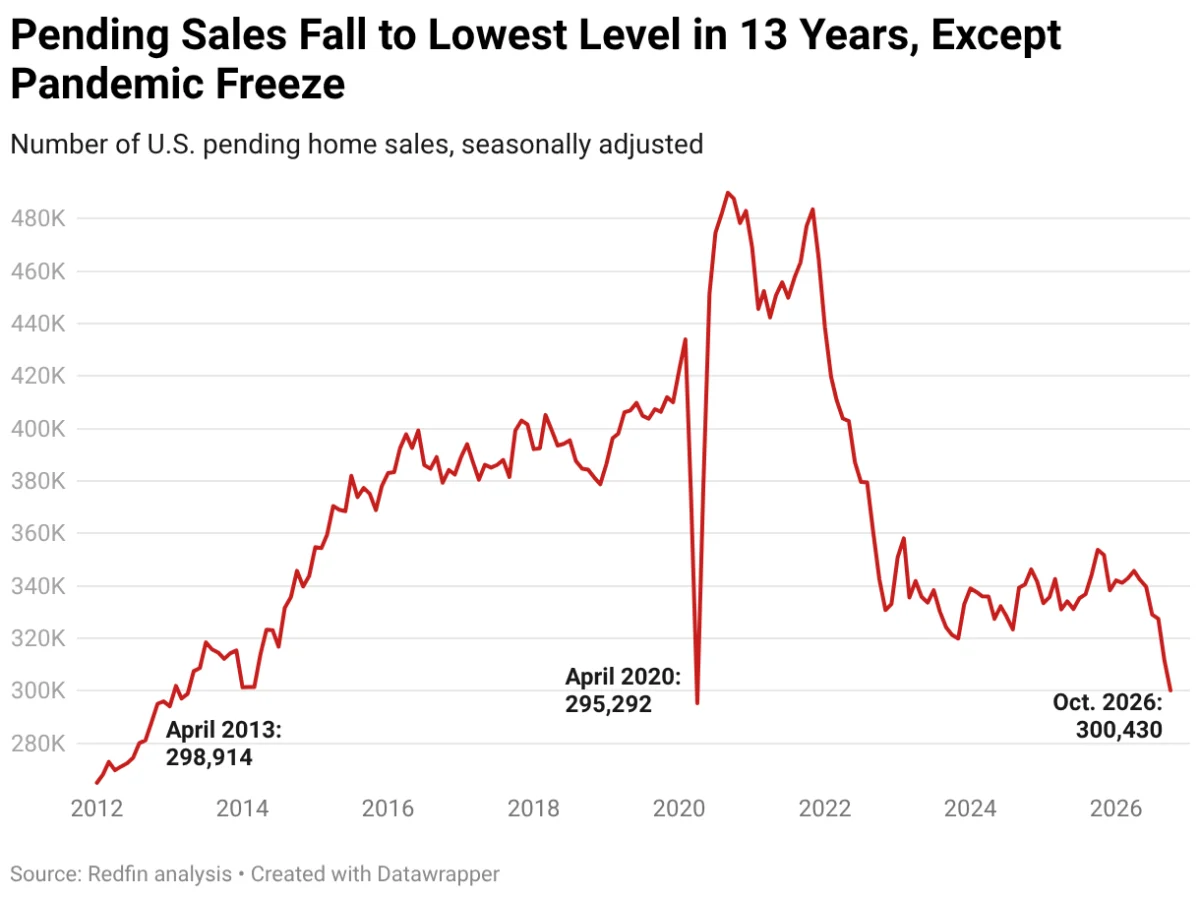
The decline in October’s home prices did not occur in a vacuum. It was preceded by a persistent slide in transaction volume. Pending home sales, a leading indicator of closed deals, fell 3.6% in October on a seasonally adjusted basis. This figure represents the lowest level of contract activity since 2013, with the notable exception of the initial pandemic lockdown in April 2020. Closed home sales followed a similar trajectory, dropping 2.1% month-over-month to reach their lowest level since December 2023.
This decline suggests that the market is finally recalibrating to reflect the reality of current economic conditions. While wages for the average American have grown by approximately 4% year-over-year, this modest increase has been insufficient to offset the rapid climb in mortgage payments, effectively pricing a significant segment of the population out of the market.
The Divergence of Local Markets
While the national aggregate suggests a cooling environment, the reality remains highly localized. The national median price decline hides the fact that in more than half of the 50 most populous U.S. metropolitan areas, prices actually continued to rise.
San Francisco currently serves as the most prominent outlier, with median sale prices surging 16.8% year-over-year—the largest increase in that market since 2018. This anomaly is driven by a unique confluence of factors: artificial intelligence-led wealth generation and a severe lack of inventory. Active listings in San Francisco were down 7% from a year earlier, creating a supply-demand imbalance that keeps prices elevated despite national trends.
In contrast, the New York City region—including New Brunswick, NJ, and Nassau County—has seen robust growth of 4.4% to 7.7%. These areas suffer from decades of constrained housing supply, ensuring that even in a high-rate environment, competition for the few available properties remains fierce.
On the other end of the spectrum, Austin, TX, has emerged as the epicenter of the market correction, with prices falling 6.5% year-over-year. Seattle (-5.1%) and Nashville (-4.9%) follow closely behind. These cities, which experienced explosive growth during the early pandemic years, are now witnessing the effects of market saturation and a cooling tech sector that has historically fueled demand in cities like Seattle.
Expanding Inventory and the Shift in Negotiating Power
A pivotal change in the current market is the growth of housing supply. Total active listings have reached their highest level since early 2020. This increase, which saw a 0.9% rise from September to October, provides a much-needed buffer for buyers who have been forced to navigate a "take it or leave it" market for the better part of a decade.
For the first time in recent history, the data suggests that buyers are beginning to regain leverage. The share of homes sold below the original list price has ticked upward, and the average sale-to-original-list-price ratio has softened.
Chen Zhao, Redfin’s head of economics, characterizes this transition as a “buyer’s market,” albeit one constrained by affordability hurdles. “It’s a buyer’s market, but not many people can afford to buy,” Zhao noted. “That could start to shift a bit, now that sale prices are closer to reflecting the shape of the market. House hunters in most of the country should know that the price they see on a listing may very well be a starting point.”
Zhao advises prospective buyers to be strategic: “Try offering below the asking price, and negotiate for closing costs, repairs, and maybe even mortgage-rate buydowns. If you can’t get the price or monthly payment you want on one house, move on to the next one—with a big pool of inventory sitting on the market, buyers can afford to be picky.”
The Supply Paradox: Why New Listings Are Falling
Despite the rise in total active listings, there is a paradoxical decline in new inventory entering the market. New listings fell 1% month-over-month in October, marking the lowest level in over two years. This suggests a "lock-in" effect where potential sellers, who may currently hold mortgages with significantly lower rates than the current 7% average, are choosing to stay in their homes rather than list them and face the prospect of a higher monthly payment on their next property.
Callie Kimmel, a Redfin Premier agent in Philadelphia, highlights the psychological component of the current market. “Buyers are nervous about rates, the economy, and everything they’re seeing in the news—so they need the house and the price to line up perfectly before they’ll make an offer,” she says.
Kimmel’s advice to sellers is stark: “I’m advising sellers to price just below current market value from day one—and not using comps from six months ago, but homes that are listed right now. Otherwise, the home is likely to end up sitting on the market for a bit and selling for less than they hoped.”
Broader Economic Implications
The cooling of the housing market carries significant weight for the broader U.S. economy. Housing is a critical driver of consumer spending and a key component of the Consumer Price Index (CPI). A sustained decline in home prices, coupled with lower transaction volume, could dampen the "wealth effect"—the tendency for consumers to spend more when they perceive their home equity to be rising.
Furthermore, the decrease in pending home sales is a harbinger of lower future construction and renovation activity. As transaction volumes drop, the demand for ancillary services—ranging from real estate brokerage and mortgage origination to home inspection and moving services—is likely to experience a concomitant contraction.
However, there is a potential silver lining. For those who are financially positioned to enter the market, the decline in prices and the increase in months of supply (now at 4.3 months) represent a rare window of opportunity. The market is shifting from a period of hysteria to a more normalized, albeit more expensive, environment.
A Data-Driven Snapshot
The current metrics highlight the complexity of this transition. While the median sale price has dipped, the median days on market remain largely unchanged at 50 days, suggesting that while the pace of the market has slowed, it has not come to a complete standstill. The 14.9% rate of pending sales falling out of contract is a clear indicator of market instability, as buyers navigate the dual pressures of economic uncertainty and volatile mortgage rates.
As we look toward the final months of 2026, the housing market appears to be searching for a new floor. The aggressive rate-hiking cycle that defined the last two years has successfully cooled the fervor of the pandemic-era market, but it has left a legacy of high costs that will continue to challenge both buyers and sellers for the foreseeable future.
For the average household, the dream of homeownership remains a difficult financial puzzle. Whether this price decline is a temporary correction or the beginning of a prolonged period of stagnant or falling values will depend largely on future shifts in the Federal Reserve’s monetary policy and the broader stability of the U.S. labor market. For now, the era of the endless price hike has reached its conclusion, ushering in a period of cautious negotiation and market recalibration.