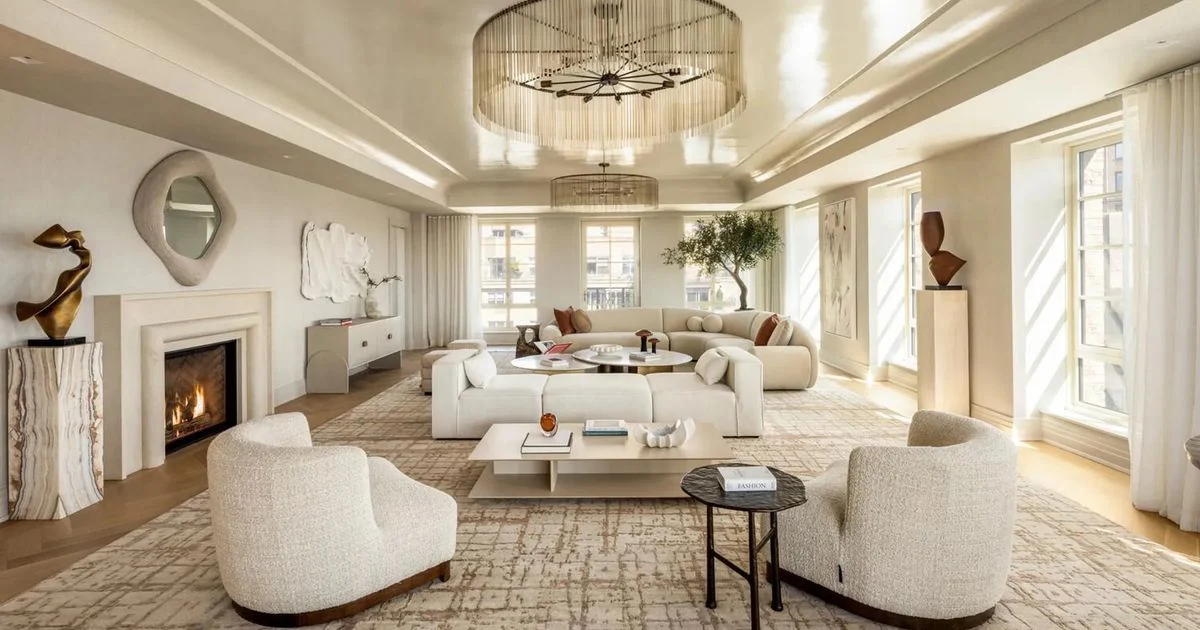
A triplex penthouse at 16 Fifth Avenue, designed by renowned architect Robert A.M. Stern, has entered contract under a $50 million asking price, positioning the transaction to shatter historical real estate boundaries for Manhattan’s lower Fifth Avenue corridor. Marketed by a Corcoran team led by Ryan Kaplan alongside Tara King-Brown and the Corcoran Sunshine Marketing Group, the impending sale is projected to close as the most expensive condominium ever sold in Greenwich Village.
This milestone represents a notable upward shift in a historically constrained residential market. For decades, Greenwich Village has resisted large-scale modern development, largely due to stringent municipal protections and the logistical challenges of assembling land in a deeply entrenched historic precinct. Yet, the enclave surrounding lower Fifth Avenue and north of Washington Square Park has experienced an unexpected surge of high-end vertical development. The transaction underscores a growing appetite among ultra-wealthy buyers for newly constructed luxury product, even amidst complex zoning environments and evolving tax landscapes.
The Anatomy of the Record-Breaking Penthouse
The residence under contract is an expansive, L-shaped triplex encompassing approximately 8,300 square feet across the uppermost levels of the 14-story limestone-clad tower. Originally brought to market by developers Madison Realty Capital with an aggressive $60 million asking price earlier in the project lifecycle, the property underwent a $10 million price adjustment to align with prevailing luxury absorption rates.
The spatial programming of the triplex is meticulously organized across its three levels. The lower floor is anchored by an expansive primary suite situated in the eastern wing, complete with a dedicated dressing room, a double-vanity bathroom, and a private balcony, flanked by two additional bedrooms. The middle floor serves as the primary zone for communal living, housing a grand great room, a formal library, and a fourth bedroom located in the western wing. The uppermost floor accommodates a fifth bedroom in the northeast corner, a sprawling sunroom, and an integrated private south-facing terrace. Throughout the residence, architectural details flow seamlessly, including a kitchen breakfast nook that opens directly onto an exterior limestone terrace.
The broader 16 Fifth Avenue building reflects Robert A.M. Stern Architects’ signature neoclassical aesthetic, characterized by traditional masonry, oversized windows, and contextual massing intended to harmonize with neighboring historic architecture. Out of the building’s 14 total residences, only four units remain unsold, signaling robust demand for primary-quality condominium assets in a neighborhood traditionally dominated by nineteenth-century townhouses and mid-century co-ops.
Chronology of Development: From Concept to Controvery
The realization of 16 Fifth Avenue was far from straightforward, serving as a case study in the friction between modern luxury development and historic preservation in Manhattan.
The project’s timeline was defined by intense public scrutiny, regulatory hurdles, and community opposition:
- Pre-2021: The site was occupied by an unremarkable mid-century rental building comprising 19 residential units, offering a low-density footprint that developers and zoning analysts viewed as an inefficient use of prime urban land.
- March 2021: Madison Realty Capital presented its design proposals to the New York City Landmarks Preservation Commission (LPC). The initial plans triggered immediate pushback from neighborhood preservationists and elected officials. Manhattan Borough President Brad Hoylman-Sigal, then-City Council Speaker Corey Johnson, and State Assemblymember Deborah Glick submitted formal testimony opposing the height and scale of the tower. Critics drew parallels to the supertall structures proliferating along Billionaires’ Row, arguing that the tower introduced out-of-scale luxury footprints into a protected historic district and resulted in a net loss of traditional rental housing stock.
- Late 2021: Following rigorous back-and-forth negotiations with the LPC, the development team made concessions to trim the overall height of the structure. Despite the compromises, the design continued to face internal commission dissent, with one dissenting commissioner famously remarking that trimming the building was akin to "giving Godzilla a haircut. It is still Godzilla."
- September 2023: The LPC ultimately granted approval for the revised Robert A.M. Stern design by a narrow 6-5 vote. Proponents of the project successfully argued that the existing rental structure possessed negligible architectural merit and that the new tower would elevate the architectural caliber of the streetscape.
- 2025–2026: Construction progressed toward completion, with sales launching for the building’s limited inventory. The project’s other penthouse, initially listed at $45 million, set an early market benchmark by selling for $32.5 million in April 2025, validating the developer’s trajectory ahead of the primary triplex contract agreement in late 2026.
Market Dynamics and Supporting Data
The impending record set by 16 Fifth Avenue eclipses the previous Greenwich Village condominium high-water mark established in 2017, when former Starbucks CEO Howard Schultz acquired a penthouse at the Greenwich Lane complex for $40 million. While a sprawling compound on West 11th Street—often referred to as a "Frankenmansion"—still holds the broader record for the most expensive townhouse sold below 34th Street, the 16 Fifth Avenue transaction redefines the upper ceiling for vertical luxury living in the neighborhood.
Market analysts attribute the recent influx of high-end condos to a fundamental scarcity of available development parcels across Manhattan. According to Wilson Parry, who operates the zoning-analysis firm PropertyScout, the supply of unbuilt or easily redevelopable land in prime historic districts has effectively reached zero. This supply constraint has forced developers to acquire underutilized or obsolete structures, navigate complex regulatory frameworks, and command record-setting price points to justify the high costs of acquisition and construction.
Ryan Kaplan of Corcoran emphasized the unique positioning of the property during marketing campaigns, noting that 16 Fifth Avenue represents a generational anomaly. "It is the first building to go up on lower Fifth Avenue in decades, and it’s the last that ever will," Kaplan observed, highlighting the near-impossibility of replicating a similar new-construction footprint within the heavily regulated Greenwich Village Historic District.
Broader Implications for Greenwich Village Real Estate
The success of 16 Fifth Avenue is part of a broader evolution occurring along the fringes of Greenwich Village, where developers are increasingly finding ways to insert boutique luxury product into historically protected zones. Nearby projects, such as Lionheart Capital’s conversion of a 10-story rental building on 9th Street into 45 high-end condominiums and boutique developments on West 8th and MacDougal streets, illustrate a sustained pivot toward high-net-worth housing stock.
Meanwhile, just outside the formal boundaries of the Greenwich Village Historic District, larger-scale projects are testing even higher price thresholds. The Legion Investment Group and EJS Group are currently advancing the Greenwich Spire at 11 West 13th Street. Rising 538 feet, the tower has rapidly absorbed initial inventory, securing buyers for 11 of its 34 units shortly after hitting the market, with an unlisted penthouse projected to command an asking price of $70 million.
While the Greenwich Spire has drawn intense opposition from preservation groups like the Greenwich Village Society for Historic Preservation—who view unconstrained vertical development as a threat to the neighborhood’s scale—projects like 16 Fifth Avenue demonstrate that navigating the stringent LPC review process can yield immense financial rewards for developers willing to endure the gauntlet.
As the transaction at 16 Fifth Avenue moves toward a formal closing, it signals a definitive maturation of Greenwich Village’s ultra-luxury tier. For the city’s wealthiest buyers, the combination of Robert A.M. Stern architecture, prime Fifth Avenue frontage, and scarce new-construction inventory has proven compelling enough to command record-breaking figures, permanently altering the economic and architectural landscape of Lower Manhattan.