Pulitzer Prize-winning author Colson Whitehead and his wife, literary agent Julie Barer, have officially listed their sophisticated, pre-war co-op apartment on Manhattan’s Upper West Side with an asking price of $4.495 million. Situated at 610 West End Avenue, the ninth-floor residence offers a distinct blend of classic New York architecture and contemporary literary history. The listing arrives as Whitehead concludes a prolific phase in his career, marked by the completion of his acclaimed Harlem Trilogy, and as the family adapts to shifting domestic needs now that their eldest child has transitioned to college.
Architectural Pedigree and Building History
The building housing Whitehead and Barer’s residence is itself a landmark of early 20th-century New York design. Completed in 1912, 610 West End Avenue—historically known as The Evanston—was designed by the renowned architectural partnership of George and Edward Blum. The Blum brothers, both alumni of the prestigious École des Beaux-Arts in Paris, earned a reputation among architectural historians as nonconformist masters. Rather than contributing to the repetitive grid of standard brick tower blocks proliferating across Manhattan during the era, the brothers incorporated artistic, individualistic touches into their facades and layouts.
The Evanston was originally constructed to cater to affluent New Yorkers, featuring expansive layouts that included ten-room duplex configurations. A central interior courtyard situated on 90th Street serves a dual purpose: it floods the upper-floor residences with natural light while optimizing interior privacy. The elevator landings are designed to serve only two apartments per floor, reinforcing a sense of exclusivity. True to its historical moniker, the building’s name is a nod to a wealthy dentist who amassed a substantial fortune tending to the dental health of Napoleon Bonaparte—a quirky historical footnote that easily aligns with the rich narrative tapestry characteristic of Whitehead’s fiction.
Interior Features and Literary Spaces
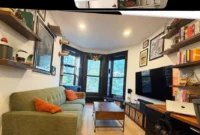
Spanning the ninth floor, the co-op apartment boasts classic pre-war details meticulously preserved over the decades. These architectural elements include rich parquet flooring, traditional French doors, antique glass door handles, ornate crown moldings, and sturdy ceiling beams. A unique semi-circular nook branching off the formal dining room features custom stained-glass windows, filtering soft natural light into the entertaining space.
As a corner unit, the primary bedroom benefits from windows facing in two directions, offering expansive, unobstructed views looking north and east over low-rise historical brownstones and toward the Hudson River.
However, it is the interior’s intimate connection to Whitehead’s creative process that distinguishes the property for literary enthusiasts. Public records and recent media profiles reveal that the apartment served as an active creative workshop. In a profile published earlier this year, a reporter noted that Whitehead crafted portions of his recent works from a classic Eames desk positioned at the far end of the expansive living room. Suspended on the wall directly behind the workspace hangs a vintage knife-sharpening sign. Whitehead has previously described this piece as a symbolic "totem," serving as a constant visual reminder to refine his prose and "work a sentence into something sharper."

Adding to the apartment’s distinct character, the formal dining room doubles as a personal library. Custom floating modular shelves line two entire walls, housing hundreds of volumes that reflect the household’s deep immersion in the literary world. Furthermore, listing photographs capture a collection of prestigious literary accolades displayed atop Haller consoles in the living room, most notably Whitehead’s large, bronze National Book Award.
Chronology of Whitehead’s New York Residences
Whitehead’s real estate trajectory in New York City has long mirrored the geography of his creative output. Growing up in a household that frequently relocated between apartments, Whitehead developed a lifelong pattern of moving across different boroughs and neighborhoods, frequently associating specific addresses with the books he produced there.
In a 2012 interview, the author reflected on this migratory habit, noting that walking past his former residences invariably triggers memories of where specific novels were drafted. Past chapters of his life include sustained stints in Clinton Hill, Fort Greene, the West Village, and various pockets of the Upper West Side.
- Early Career Phase: Whitehead established his literary reputation with works like The Intuitionist (1999) and John Henry Days (2001), written across various foundational Brooklyn and Manhattan apartments.
- The Pulitzer Milestones: In 2017, Whitehead was awarded the Pulitzer Prize for Fiction for The Underground Railroad, a watershed moment that elevated his commercial and critical standing.
- The West End Avenue Acquisition: Capitalizing on this sustained literary success, Whitehead and Barer purchased the 610 West End Avenue co-op in 2018, establishing a stable domestic and creative headquarters for the subsequent eight years.
- Recent Literary Conclusions: In July, Whitehead published Cool Machine, the final installment of his celebrated Harlem Trilogy, bringing a major multi-year writing project to a close.
Market Context and Implications
The decision to list the property at $4.495 million comes at a time of steady demand for high-end, historic pre-war co-ops on the Upper West Side, though buyers in this tier remain selective regarding layout and condition. Market analysts note that properties possessing unique provenance—particularly those tied to prominent cultural figures—frequently attract heightened initial interest from prospective buyers, though ultimate transactions depend heavily on co-op board requirements and competitive pricing relative to broader Manhattan inventory trends.
Beyond market mechanics, the move represents a natural lifestyle transition for the household. With their eldest child having recently graduated to college, the family no longer requires the full footprint of the expansive ninth-floor layout. Furthermore, having wrapped up the exhaustive research and writing cycle for his sprawling historical trilogy, Whitehead appears poised for a thematic and geographical shift.
Reflecting on the emotional resonance of leaving a long-term home in his 2003 nonfiction meditation The Colossus of New York, Whitehead wrote: "Cherish your old apartments and pause for a moment when you pass them. Pay tribute, for they are the caretakers of your reinventions." As the author prepares to part ways with his West End Avenue co-op, the sale closes the door on a prolific chapter of literary production while opening the path toward his next creative evolution.