
The popular narrative suggesting that millennials might own their dream homes if they simply eschewed avocado toast and lattes is a fiscal myth, according to a comprehensive analysis of Redfin and U.S. Census data. The reality of the modern housing crisis is not a matter of personal frugality, but rather a convergence of historical timing, interest rate volatility, and shifting socioeconomic structures. While slightly over half of millennials have successfully attained homeownership, the remainder face a market defined by soaring costs that render minor lifestyle cutbacks mathematically insignificant.
The Myth of Personal Responsibility
For decades, the public discourse around housing affordability has often focused on the spending habits of younger generations. However, economic data suggests that the barriers to entry for today’s homebuyers are structural. When adjusting for inflation, the cost of the median U.S. home has decoupled from wage growth, particularly in the post-pandemic era. Between 2020 and 2025, the national housing market experienced an unprecedented price surge, with median values climbing by approximately 40%. For the average millennial, who entered the workforce during or following the Great Recession, the goalposts for homeownership have shifted significantly, moving from a manageable milestone to an increasingly elusive objective.
A Chronology of Generational Opportunity
To understand the current crisis, one must compare the life cycles of baby boomers—born between 1946 and 1964—with those of millennials, born between 1981 and 1996. The comparison reveals a stark reversal of fortune based on the timing of entry into the market.
In the 1980s, baby boomers navigated an environment characterized by extreme interest rates, which peaked at over 16% in 1981. While these rates were high, home prices remained relatively modest, ranging from $235,000 to $265,000 in today’s inflation-adjusted dollars. Boomers who purchased homes during this era faced a difficult, high-cost start. However, the subsequent two decades provided a unique "refinancing window." As interest rates steadily declined throughout the 1990s and early 2000s, boomers were able to refinance their mortgages repeatedly, effectively lowering their monthly obligations while their properties gained equity.
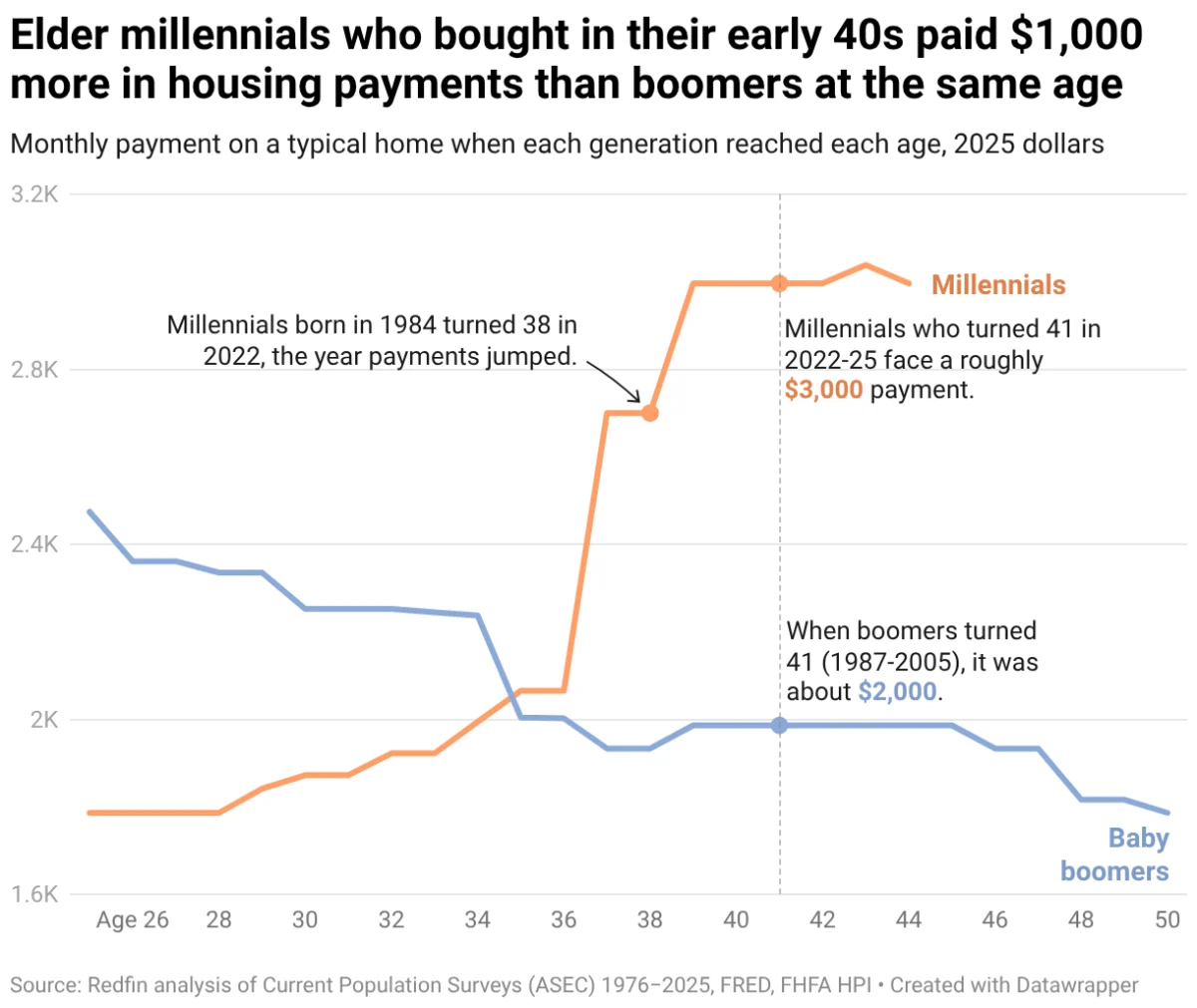
In contrast, elder millennials who entered the market in the 2010s enjoyed a period of historically low interest rates, often dipping below 3% by 2021. This allowed many to secure favorable financing, resulting in housing costs that consumed roughly 27% of their income at age 30—a figure lower than the 36% boomers paid at the same age. However, the advantage evaporated for those who delayed their purchase. The pandemic-era shift, which saw mortgage rates climb from 3% to nearly 7% while home prices remained high, trapped a significant portion of the millennial cohort in a "high-cost, high-rate" bottleneck.
Comparative Data: The Economic Squeeze
The financial burden placed on contemporary buyers is evidenced by the shift in the debt-to-income ratio. At age 37, the typical elder millennial household earns an average of $100,000 annually, bolstered by the prevalence of dual-income households. This is a marked increase from the $88,000 (inflation-adjusted) earned by baby boomers at the same age. Yet, despite higher household earnings, the percentage of income devoted to mortgage payments has spiked.
For an elder millennial born in 1984, purchasing a home at age 30 in the pre-pandemic market was financially sustainable. Had that same individual waited until age 40 to buy in the current market, their housing costs would consume approximately 35% of their income. This represents a significant deviation from the traditional "30% rule" of personal finance, which dictates that housing costs should not exceed one-third of gross monthly income.
The Role of Competing Financial Pressures
The housing crisis for millennials is exacerbated by the "compounding debt" effect. Unlike the baby boomer generation, which generally faced lower costs for secondary life milestones, millennials are currently navigating a high-cost environment for essential services. Childcare costs have risen to a point where they, combined with housing, often consume more than half of a household’s total income. Furthermore, student loan debt, which is significantly higher for millennials than for their predecessors, acts as a further drag on capital accumulation, preventing many from saving for a traditional 20% down payment.

Perspectives from Economic Research
Chen Zhao, head of economic research at Redfin, emphasizes that the current market dynamics are a departure from historical norms. "Before the pandemic, younger generations actually had it easier than the ones before them," Zhao noted. "But then home prices surged during the pandemic homebuying frenzy and mortgage rates shot up, while incomes kept growing at a normal pace—and the advantage flipped."
Zhao suggests that the market is currently in a period of recalibration. "Home prices are already falling in parts of the U.S. and they’re softening in others, which means we could be headed back to 2018 or 2019 levels sooner rather than later," she stated. However, this potential relief remains speculative, and for many prospective buyers, the current reality remains one of exclusion.
The Gen Z Outlook
The youngest cohort currently entering the housing market, Gen Z, faces even steeper hurdles. Tracking behind millennials at the same stage of life, many Gen Zers are currently spending between 40% and 60% of their income on housing if they manage to purchase a home. While this is partially due to the fact that they have not yet reached their peak earning years, the current market pricing reflects a systemic lack of inventory and high demand that shows little sign of immediate correction. Economists anticipate that as Gen Zers move further into their careers and earnings increase, homeownership may become more attainable, provided that the housing supply increases and interest rates stabilize.
Implications for Wealth Inequality
The long-term implications of this generational divide are profound. Because baby boomers were able to leverage declining interest rates to build substantial home equity, they have largely become "rich in real estate." A recent survey conducted by Redfin and Ipsos found that 76% of baby boomer homeowners report that they can easily afford their current mortgage payments. In contrast, only 53% of millennial homeowners express the same level of comfort.
This disparity suggests that the gap in wealth between generations will likely continue to widen. The inability of younger generations to enter the property market means they are missing out on the primary vehicle for middle-class wealth creation in the United States. Consequently, the social safety net provided by home equity—which allowed many boomers to fund retirements or assist their children—may not be available to the same extent for millennials.
Analysis of Future Market Trends
The path forward for housing affordability likely depends on two primary factors: the trajectory of the Federal Reserve’s interest rate policy and the acceleration of residential construction. While the "lock-in effect"—where current homeowners refuse to sell because they do not want to trade their low interest rates for new, higher-rate mortgages—has constricted supply, a move toward lower rates could theoretically trigger a wave of inventory.
However, even if rates fall, the structural deficit in housing supply remains a significant bottleneck. As long as demand outpaces the construction of new units, price stability will remain elusive. For millennials, the current market is not merely a cycle to be waited out, but a structural environment that necessitates a reevaluation of policy interventions, such as zoning reform, tax incentives for first-time buyers, and increased support for middle-income housing development.
In summary, the narrative of the "struggling millennial" is grounded in observable economic phenomena rather than individual behavior. The transition from a period of historical advantage to one of systemic barrier has created a generation of renters who, despite higher earnings and increased workforce participation, find themselves effectively locked out of the equity-building opportunities that defined the American Dream for the previous generation. As the nation looks toward the next decade of housing policy, the focus must shift from individual financial habits to the broader, systemic issues that determine access to the housing market.