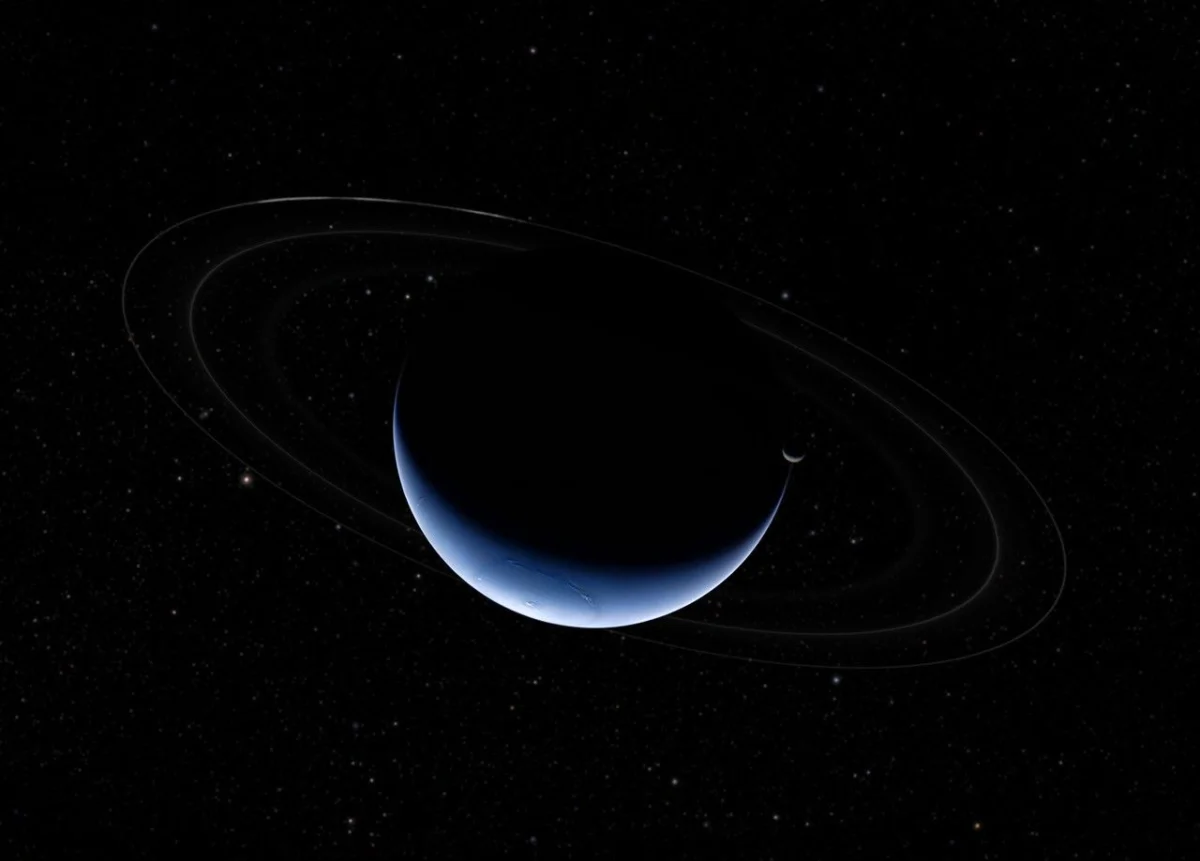
On August 25, 1989, humanity’s reach into the solar system achieved its most significant milestone to date when the Voyager 2 spacecraft performed a precise, high-speed flyby of Neptune. This encounter, which remains the only time a human-made object has visited the most distant ice giant, provided a treasure trove of data that continues to be reinterpreted by modern astronomers. A newly released composite image, reconstructed from original Voyager 2 telemetry and observational data, offers a breathtaking view of the Neptunian system as seen from an outbound trajectory, revealing the planet and its largest moon, Triton, as delicate, sunlit crescents set against the backdrop of the deep cosmos.
A Legacy of Exploration: The 1989 Neptune Encounter
The Voyager 2 mission, launched in August 1977, was designed to exploit a rare planetary alignment that occurred only once every 176 years. After successful flybys of Jupiter, Saturn, and Uranus, the spacecraft was redirected toward Neptune. The 1989 encounter was a technical triumph; to capture the necessary images, NASA engineers had to account for the fact that at such a vast distance—roughly 4.5 billion kilometers from the Sun—the sunlight reaching the planet is 900 times fainter than on Earth.
During the approach, the spacecraft’s instruments detected active, high-altitude cirrus clouds and a massive, dark, storm-like vortex situated near the planet’s south pole. The discovery of these atmospheric phenomena fundamentally changed our understanding of weather on ice giants, proving that Neptune possessed a dynamic and surprisingly active climate despite the frigid temperatures of the outer solar system.
Chronology of the Neptunian Mission
The history of the mission is defined by a series of precise orbital maneuvers and scientific objectives that pushed the limits of 1970s technology:
- August 20, 1977: Voyager 2 is launched from Cape Canaveral, Florida, on a Titan IIIE rocket.
- July 9, 1979: The spacecraft completes its Jupiter flyby, discovering active volcanism on the moon Io.
- August 25, 1981: The encounter with Saturn provides high-resolution data on the ring system and moon structures.
- January 24, 1986: Voyager 2 reaches Uranus, revealing the unique, tilted magnetic field of the ice giant.
- August 25, 1989: The Neptune encounter. Voyager 2 passes within 4,950 kilometers of the planet’s north pole. During this window, it captures images of the "Great Dark Spot," six new moons, and evidence of a ring system.
- August 29, 1989: The spacecraft completes its primary science objectives and begins its long-term trajectory toward the heliopause.
- November 5, 2018: Voyager 2 enters interstellar space, officially crossing the heliopause and continuing its mission to transmit data from outside the Sun’s influence.
Technical Analysis of the New Composite Image
The newly featured composite image is more than a mere photograph; it is a synthesis of historical data and modern digital reconstruction. By utilizing original frame-buffer data from the 1989 encounter, researchers have been able to map the faint ring system of Neptune—a feature that was barely detectable during the initial flyby. The image highlights the three bright "ring arcs" that were of particular interest to mission scientists, as their stability challenged existing models of how ring material is held in orbit around a planet.
The background starfield, which adds a sense of depth and scale, is derived from contemporary sky survey data focused on the constellation Camelopardalis. This constellation corresponds to the actual orientation of the spacecraft as it exited the Neptunian system. The resulting image serves as a "look-back" perspective, capturing the solar system from the vantage point of a departing visitor, providing a rare sense of the isolation and scale of the outer solar system.
The Scientific Significance of Triton
Central to the imagery is Triton, Neptune’s largest moon. Triton is widely considered one of the most geologically fascinating bodies in the solar system. Data from the 1989 encounter indicated that Triton is likely a captured Kuiper Belt object, given its retrograde orbit—a path that is opposite to the rotation of Neptune itself.
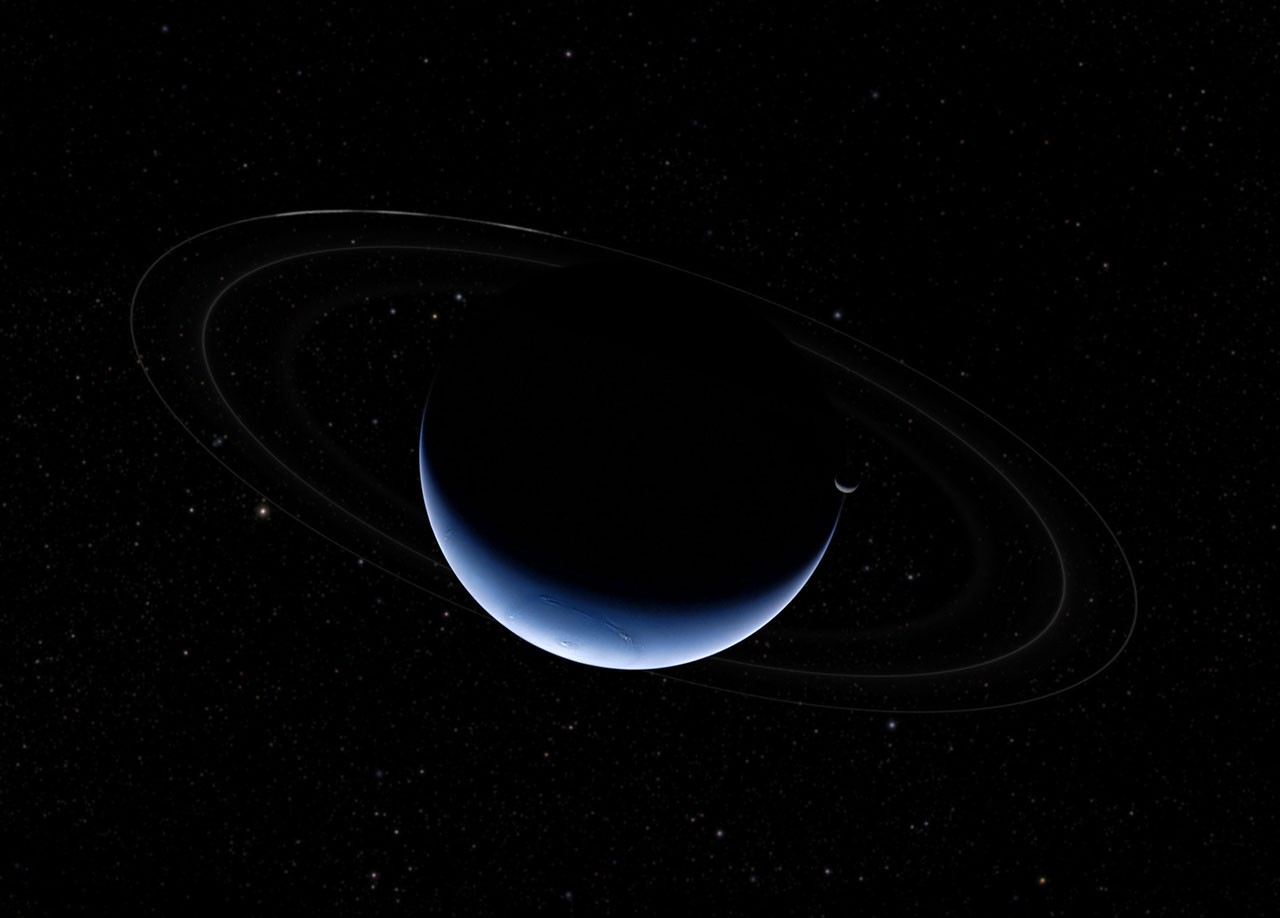
The images revealed a surface characterized by cantaloupe-like terrain and active geysers that eject nitrogen gas and dark dust particles high into the thin atmosphere. By observing Triton as a crescent in the recent composite, scientists are reminded of the complex gravitational interactions that define the Neptune-Triton relationship. Further analysis of these crescent-phase images allows researchers to study the scattering properties of the moon’s surface, which provides insights into its composition, believed to be a mixture of water ice and nitrogen frost.
Official Responses and the State of the Mission
NASA officials and the Voyager project team have frequently noted that the continued operation of Voyager 2, now more than 47 years since its launch, is a testament to the durability of its engineering. Though the spacecraft is currently operating with a limited suite of scientific instruments—having powered down non-essential systems to conserve the diminishing energy from its radioisotope thermoelectric generators—it continues to provide vital data on the plasma density and cosmic ray environment of interstellar space.
In recent briefings, mission managers emphasized that the "Voyager era" of planetary exploration remains a foundational chapter in human history. The ability to revisit raw data from 1989 and render it using modern computational techniques ensures that the legacy of the Neptune flyby remains relevant. "We are not just looking at a photo from the past," a spokesperson for the Jet Propulsion Laboratory (JPL) remarked. "We are viewing a dynamic system through the lens of a mission that never truly stopped observing."
Broader Implications: Preparing for Future Missions
The data gathered during the Neptune flyby, and the subsequent efforts to refine our visual understanding of that system, provide the groundwork for potential future missions. Currently, several proposals for a dedicated Neptune orbiter are under consideration by international space agencies. These missions aim to explore the "ice giant" class of planets, which are thought to be the most common type of exoplanet in the galaxy.
By analyzing the atmospheric vortices and the ring dynamics captured in the Voyager data, planetary scientists are developing the navigational and sensor requirements for future spacecraft. The lessons learned from the "crescent view" of Neptune—specifically how to manage light levels and imaging cadence at such extreme distances—are directly informing the designs for next-generation deep-space cameras.
The Interstellar Horizon
As of 2026, Voyager 2 is drifting through the vast, cold vacuum of interstellar space, far beyond the reach of the Sun’s magnetic shield. It continues to travel at a speed of approximately 15 kilometers per second. While the spacecraft will eventually lose the ability to transmit data as its power source reaches critical levels, its current mission remains active.
The image of Neptune released this month serves as a poignant reminder of the journey. It bridges the gap between the mid-20th-century ambition that launched the mission and the 21st-century technology that continues to interpret the results. It captures a moment of discovery that defined a generation of astronomers and serves as a beacon for the next generation of explorers who look toward the stars, hoping to one day return to the dim, icy world that Voyager 2 unveiled nearly four decades ago.
The mission of Voyager 2 was never intended to be a static event, but rather a long-duration narrative. Each time a new image is processed or a new piece of archival data is analyzed, the mission continues to contribute to the global understanding of the solar system’s architecture, its formation, and its ultimate place within the wider galaxy. As the spacecraft continues its silent transit through the interstellar medium, the scientific community continues to honor its original mission: to expand the boundaries of the known and to bring the distant, mysterious outer planets into clearer focus.