The landscape of the American real estate market is undergoing a fundamental transformation as prospective buyers shift their focus from traditional luxury aesthetics to health, safety, and environmental resilience. According to a comprehensive new report from Redfin, based on a survey conducted by Ipsos in May 2026, more than one-third of U.S. house hunters now identify "clean home" features—specifically high-end air and water filtration systems—as a top-three priority for their next residence. This shift marks a significant departure from historical trends where swimming pools, gourmet kitchens, and architectural uniqueness dominated the wish lists of the middle and upper classes.
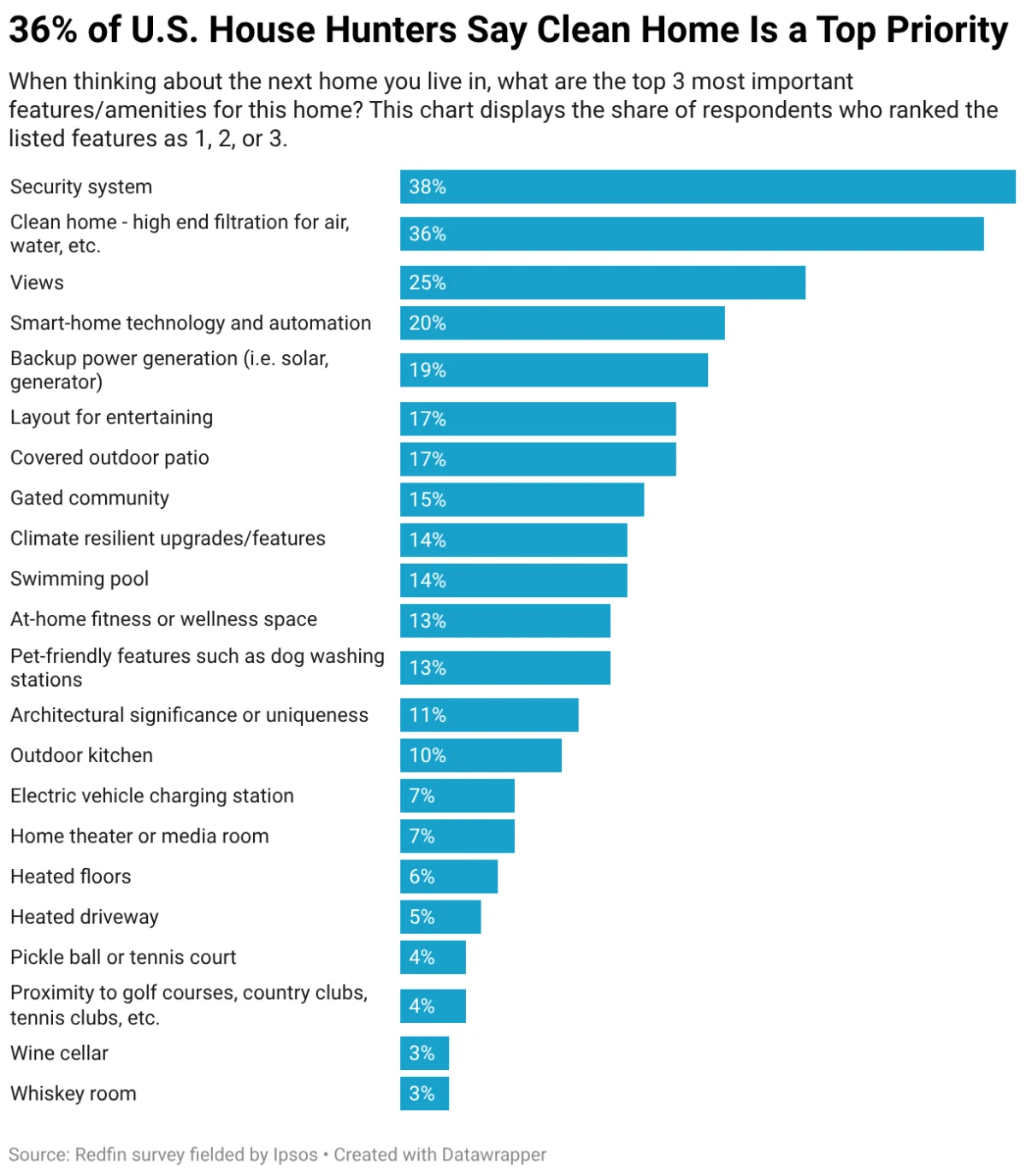
The data reveals that 36% of respondents prioritize clean home technologies, placing it on a statistical par with security systems, which were cited by 38% of participants. These two categories now represent the most common priorities among a list of 22 potential home features. The rise of the "clean home" as a primary demand reflects a growing national consciousness regarding environmental pollutants and the long-term health implications of indoor living environments.
The Environmental Catalyst: Wildfires and Air Quality
The timing of the report’s findings coincides with a period of intense environmental stress across the United States. In July 2026, smoke from hundreds of Canadian wildfires moved southward, blanketing the eastern half of the U.S. and triggering air quality alerts for more than 100 million people across 18 states and the District of Columbia. On July 17, 2026, major metropolitan areas in Minnesota, Ohio, Illinois, Indiana, and Michigan recorded some of the worst air quality levels in the nation, while the Northeast and New England regions also experienced "unhealthy" designations.
While the Redfin survey was conducted just prior to this specific emergency, the results underscore a broader trend of environmental anxiety. Homebuyers are increasingly recognizing that geographic distance from a wildfire does not grant immunity from its effects. Consequently, high-end filtration systems are no longer viewed as optional upgrades for the health-conscious elite but as essential infrastructure for the modern family.
Redfin Chief Economist Daryl Fairweather noted that the frequency of wildfire smoke events is fundamentally changing the definition of a "must-have" feature. Fairweather suggests that as these environmental events become a recurring part of the American experience, the market will see an increased demand for larger homes with versatile indoor spaces. When smoke or extreme heat forces residents indoors, the home must serve as a self-contained sanctuary for entertainment, exercise, and social interaction. For the condominium market, this translates to a premium on indoor amenities such as climate-controlled gyms and communal event rooms equipped with industrial-grade air purification.
A Generational Breakdown of Homebuyer Priorities
The demand for "clean" and secure homes is not uniform across all age groups, though it remains high across the board. The survey highlights a particularly strong preference among younger generations, who are statistically more likely to prioritize climate-related features and personal wellness.
Among Millennial house hunters, 37% rank clean home features as a top-three priority, tying with security systems for the number one spot. Millennials also show significant interest in backup power generation (20%) and climate-resilient upgrades (15%), reflecting a desire for self-sufficiency in an era of grid instability and extreme weather.
Gen Zers, the youngest cohort of buyers, place an even higher premium on these features. Approximately 40% of Gen Z respondents identified clean homes as a top priority, second only to security systems at 42%. Research from organizations like the Pew Research Center supports these findings, indicating that younger Americans are more engaged in climate activism and are more likely to take personal action—such as modifying their living environments—to mitigate the impacts of climate change.
In contrast, older generations exhibit slightly different preferences, though the "clean home" remains a major factor. For Gen Xers, security systems remain the top priority at 32%, with clean homes following at 25%. Baby Boomers continue to value "views" above all else, with 47% ranking it as a top-three priority. However, even among Boomers, security systems (40%) and clean homes (35%) rank significantly higher than many traditional luxury features.
The Decline of Traditional Luxury Features
One of the most striking revelations of the 2026 survey is the low ranking of features once considered the hallmarks of high-end real estate. As buyers pivot toward health and resilience, luxury upgrades like home theaters (7%), outdoor kitchens (10%), and tennis or pickleball courts (4%) have seen a decline in relative importance.
Even features associated with the transition to green energy, such as electric vehicle (EV) charging stations, only garnered a 7% priority rating. This suggests that while buyers are concerned about the environment, their immediate priority is the protection and health of their internal household environment. Similarly, "smart-home" technology, while still popular at 20%, has been surpassed by the more tangible benefits of air and water filtration.
The survey also indicates that specific lifestyle amenities are becoming niche. Wine cellars and "whiskey rooms" each received only 3% support, while specialized athletic facilities like golf course proximity (4%) and heated driveways (5%) failed to break into the top tier of requirements.
Climate Resilience and Infrastructure
Beyond filtration, the survey points to a growing interest in the structural integrity and energy independence of homes. Backup power generation, including solar panels and home battery systems or generators, was cited as a top-three priority by 19% of respondents. This interest is driven by an aging national power grid that has struggled to keep pace with the increased demand caused by extreme temperature fluctuations.
Climate-resilient upgrades—such as impact-resistant windows, fire-resistant roofing, and advanced drainage systems—were prioritized by 14% of buyers. This category is expected to grow as insurance companies increasingly mandate such features for coverage in high-risk zones, such as coastal Florida or the fire-prone hills of California.
Market Implications and the Future of Home Construction
The shift in buyer preferences is expected to have a profound impact on the home construction and renovation industries. Developers who historically focused on "open concept" layouts and aesthetic finishes may need to pivot toward "wellness-certified" buildings. Standards such as the WELL Building Standard and LEED certification are likely to become more prominent in residential marketing.
In the secondary market, homeowners looking to sell may find that investing in a whole-home HEPA filtration system or a comprehensive water purification unit yields a higher return on investment than a kitchen remodel or a bathroom upgrade. Real estate agents are already beginning to highlight "air quality reports" alongside traditional home inspections, providing prospective buyers with data on the home’s ability to filter out PM2.5 particles and other volatile organic compounds (VOCs).
Furthermore, the rise in security as a top priority (38%) suggests that "peace of mind" is a primary driver in the 2026 market. This includes not just digital security—such as smart cameras and alarm systems—but also physical security, such as gated communities (15%) and secure entry points.
Methodology and Scope of the Study
The Redfin survey was conducted by Ipsos in May 2026 and involved a diverse sample of 4,000 U.S. residents. The findings presented in this report focus on a subset of approximately 1,000 respondents who indicated they plan to move within the next 12 months. This specific demographic represents the most active and influential segment of the current housing market.
The survey utilized a "top three" ranking system, allowing respondents to select their most critical features from a list of 22 options. This methodology provides a clearer picture of what buyers consider "essential" versus merely "desirable." The results for the moving-ready group have a credibility interval of plus or minus 3.9 percentage points, ensuring a high level of statistical reliability.
As the U.S. continues to navigate a landscape defined by environmental volatility and a heightened focus on personal health, the 2026 Redfin report serves as a roadmap for the future of the American home. The data suggests that the "American Dream" is being redefined—no longer just a quest for status and space, but a search for a safe, clean, and resilient sanctuary in an uncertain world.