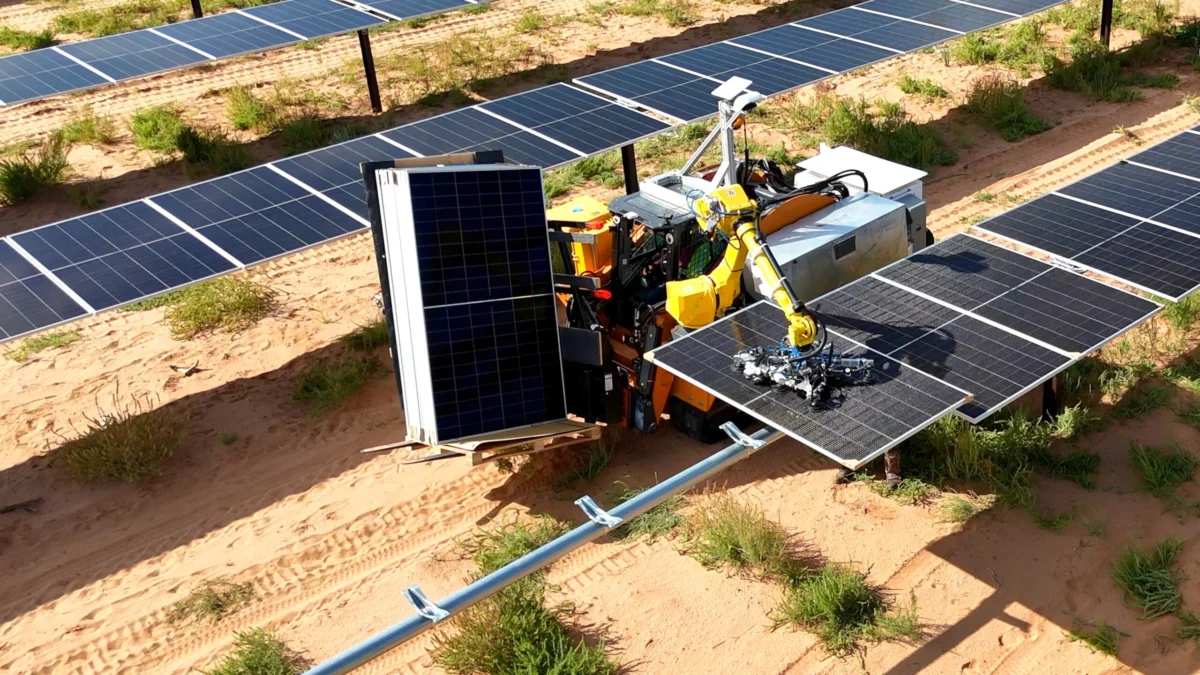
The global imperative to accelerate the build-out of solar energy infrastructure is facing a significant bottleneck: a shortage of skilled labor. As countries and companies worldwide race to achieve energy independence and combat climate change through widespread solar deployment, the demand for installation workers is outstripping supply. This critical labor market challenge is precisely where Gritt, a pioneering startup, is stepping in with an innovative AI-driven robotic solution, having recently announced a substantial $26 million Series A funding round. This investment, led by Obvious Ventures with participation from Union Square Ventures and Active Impact Investment, brings Gritt’s total funding to $34 million, following an earlier seed round.
The core mission of Gritt, founded by Carnegie Mellon-trained roboticists Puneet Puri (CEO) and Vishal Dugar (CTO), is to "help civilization build infrastructure faster." Their approach leverages the latest advancements in artificial intelligence to overcome the historical limitations of industrial robots in unstructured outdoor environments, such as sprawling solar farms.
The Growing Demand for Solar and the Labor Gap
The urgency behind Gritt’s mission is underscored by the unprecedented growth in solar energy. According to the International Energy Agency (IEA), solar PV generation is projected to account for over 90% of global renewable electricity capacity additions in the coming years. In 2023 alone, global solar PV capacity additions reached a record 440 GW, a nearly 50% increase from 2022. This exponential expansion, driven by climate policy, falling costs, and energy security concerns, places immense pressure on the construction sector.
However, the rapid deployment of solar farms requires a substantial workforce for site preparation, panel installation, and maintenance. The U.S. solar industry, for instance, employs hundreds of thousands of workers, a figure that needs to grow significantly to meet ambitious renewable energy targets. The shortage of experienced installers, coupled with the physically demanding and sometimes hazardous nature of the work, has created a persistent challenge for project developers and contractors. This gap highlights the critical need for innovative solutions that can augment human capabilities and accelerate project timelines.
Gritt’s AI-Driven Approach to Construction Robotics
Gritt’s thesis, as articulated by CEO Puneet Puri, is that "if we truly want to speed up construction, you need an intelligence which can work in the outdoor, chaotic environments of these construction sites, and it has to be generalizable enough that it can work in these varied environments." This is a significant departure from traditional robotic systems, which often require highly controlled and predictable settings.
Instead of developing bespoke robots from scratch, Gritt adopts a strategic approach by integrating its proprietary AI models with off-the-shelf hardware. This modular and adaptable strategy allows for quicker deployment and potentially lower costs. Thus far, the company has utilized rented equipment, including skidders and robotic arms from established manufacturers like Kawasaki, to build its intelligent platforms.
The initial application of Gritt’s systems focuses on a crucial and labor-intensive task: the unloading and precise positioning of large, glass solar panels onto metal frames. The system is designed to meticulously carry panels from delivery points to their installation locations and then place them onto the mounting structures with sub-millimeter accuracy. This precision is vital, as it ensures that human workers can efficiently and safely fasten the panels, minimizing the risk of errors and damage.
A Strategic Investment Fueling Innovation
The substantial Series A funding round signifies strong investor confidence in Gritt’s vision and technological capabilities. Andrew Beebe, partner at Obvious Ventures and lead investor for the round, commented on the company’s focus, stating, "There are people who used to build rockets into space and had infinite budget for the smallest little part, and then there are people who know what it means to get into dirty, dull, and dangerous jobs and scale them like mad. These guys are in the second camp, and that’s a special kind of entrepreneur that has the technical chops, the AI, and the machine vision skills to make it work."
This sentiment highlights the practical, problem-solving ethos driving Gritt. Their focus on tackling the "dirty, dull, and dangerous" aspects of construction work, while possessing the sophisticated AI and machine vision expertise, positions them uniquely in the market. The funding will be instrumental in scaling Gritt’s operations, expanding its team, and further developing its AI technology.
Real-World Deployment and Performance Metrics
Gritt is not just operating on a theoretical plane; the company has two systems currently deployed in active field operations. The data collected from these deployments is continuously feeding back into the AI models, enhancing their performance and adaptability. The results are compelling. Puri reports that a typical eight-person crew can install approximately 800 solar panels per day. In contrast, the same crew working in conjunction with Gritt’s robotic systems can achieve an installation rate of 3,000 to 4,000 panels daily. This represents a potential fourfold increase in productivity, a transformative impact for solar project timelines and economics.
The company’s forward-looking trajectory is equally impressive. Gritt is contracted to contribute to the installation of 2.8 gigawatts (GW) of solar panels over the next 18 months. Its client roster includes three of the top 10 U.S. power construction companies, indicating a strong market validation and adoption by industry leaders. Gritt aims to have 48 of its systems operational within the next six months, a testament to its rapid scaling plans.
Customer Perspectives and Competitive Landscape
Feedback from customers, even those who prefer to remain anonymous due to competitive sensitivities, has been overwhelmingly positive. One Gritt customer highlighted the system’s ability to alleviate labor challenges in remote areas, where attracting and retaining workers is particularly difficult. Furthermore, the customer anticipates a significant reduction in workplace injuries, as workers will no longer need to repeatedly lift heavy 100-pound panels overhead. This focus on worker safety and well-being is a critical, often overlooked, benefit of robotic augmentation.
Gritt operates in a burgeoning market with several other companies vying to develop robotic solutions for solar panel installation. Competitors like Luminous Robotics and Cosmic, as well as China’s Trinabot, are also developing their own panel-installing robots. A key differentiator for Gritt is its reliance on off-the-shelf hardware, which contrasts with some competitors who are building their own proprietary hardware. This strategic choice could allow Gritt to achieve faster scaling and maintain a leaner cost structure as demand continues to surge across the renewable energy sector.
Future Expansion and the Power of Generalizable AI
Gritt’s ambition extends beyond the initial panel unloading and positioning tasks. The company plans to expand its system’s capabilities to include fastening the solar panels, drilling posts for mounting structures, and even constructing the racks themselves. This phased approach aims to gradually automate more complex and labor-intensive construction processes.
Looking further ahead, Gritt envisions its technology being applied to other common, demanding construction tasks, such as tying rebar before concrete pouring. This broader vision is underpinned by the rapid advancements in AI models. The founders emphasize that while creating a system for a single solution was achievable even five years ago, current AI capabilities enable true generalizability. The same underlying AI pipeline can be reused and refined across a multitude of tasks. As an example, Puri notes that training the system to stack cinder blocks previously took weeks, whereas a similar demonstration involving rebar tying took just a single day using the same software. This rapid learning and adaptation are key to Gritt’s long-term scalability and impact.
Beyond Installation: Enhancing Site Management and Decision-Making
Gritt’s vision does not stop at automating physical labor. The founders believe that the suite of sensors and intelligence integrated into their systems can offer significant benefits to site management and decision-making. Imagine a system that detects an open trench during an approaching storm and alerts workers to cover it before rain damages components, or one that flags missing inventory before it causes delays.
"Gritt becomes now this layer of physical AI, which is doing this dextrous, labor-intensive task, plus it can help you take decisions on the site," Puri explained. This dual functionality transforms Gritt’s robotic systems from mere task executors into intelligent collaborators, capable of enhancing safety, efficiency, and overall project oversight.
The convergence of a global push for renewable energy, a persistent labor shortage, and transformative AI advancements has created a fertile ground for companies like Gritt. Their strategic focus on adaptable robotics, powered by generalizable AI, positions them as a significant player in the ongoing effort to accelerate the construction of critical infrastructure, not only for solar energy but potentially for a wide array of construction projects in the future. The successful deployment of their technology could fundamentally alter the landscape of construction, making it faster, safer, and more efficient.