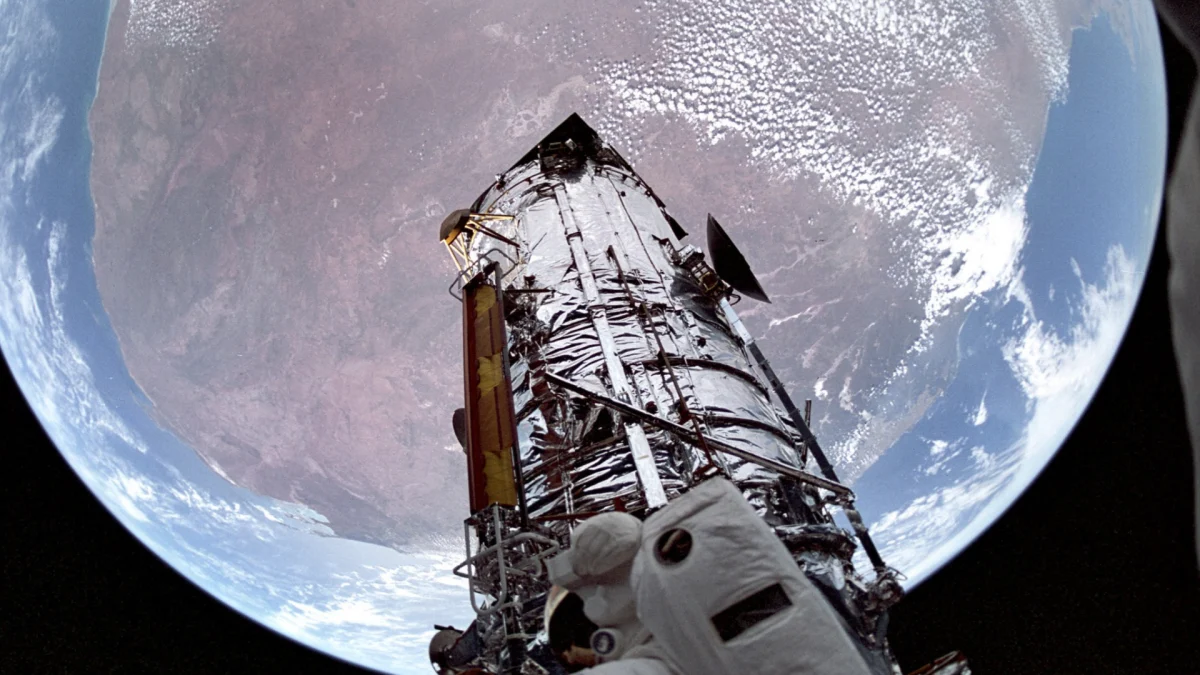
For over thirty years, the Hubble Space Telescope has served as humanity’s premier eye in the sky, fundamentally transforming our understanding of the cosmos. Launched in April 1990 aboard the Space Shuttle Discovery, Hubble has captured some of the most breathtaking, scientifically invaluable imagery in human history, peering deep into stellar nurseries, mapping the expansion rate of the universe, and providing unprecedented views of distant galaxies. However, this legendary instrument is now facing a definitive, ticking clock. Plagued by orbital decay due to trace atmospheric drag in low-Earth orbit, Hubble is slowly spiraling downward toward an uncontrolled and potentially hazardous atmospheric re-entry.
Without external intervention, projections indicate that NASA’s most celebrated observatory will plunge back into Earth’s atmosphere sometime between 2033 and 2034. While much of the massive spacecraft would disintegrate during the intense heat of re-entry, substantial components could survive and make an unguided impact on the surface, posing potential risks to populated areas. Yet, this fiery demise is not entirely inevitable. Facing tight budgetary constraints that preclude a dedicated, agency-funded rescue mission, NASA has turned its gaze outward, issuing a formal Request for Information (RFI) to the rapidly expanding commercial spaceflight sector. The agency is actively seeking private-sector solutions to either push Hubble into a higher, safer orbit—thereby extending its operational lifespan—or execute a controlled, guided de-orbit into a remote oceanic expanse.
The Technical Challenge of Orbital Maintenance
Boosting Hubble is no trivial undertaking. The telescope currently resides at an altitude of approximately 325 miles (540 kilometers) above Earth. A successful orbital rescue and elevation mission would require a technical ascent of more than 370 miles (600 kilometers) to place the observatory into a stable orbit. From a purely engineering perspective, this represents an astonishingly difficult challenge. Hubble was never designed to be serviced autonomously; its architecture relies heavily on human astronauts performing extravehicular activities, utilizing specialized handrails, docking rings, and modular instrument bays built specifically for Space Shuttle servicing missions.
Furthermore, servicing missions of the past required precise orbital rendezvous, robotic arm manipulations, and intricate spacewalks. Replicating these capabilities using modern robotic spacecraft or crewed commercial vehicles demands cutting-edge technological adaptation. The docking mechanism must interface securely with an aging spacecraft that has spent over three decades exposed to extreme thermal fluctuations, solar radiation, and micrometeoroid impacts.
A Storied History of Servicing and Repairs
To understand the gravity of Hubble’s current predicament, one must look back at its storied history of maintenance. Hubble’s journey has never been straightforward. Shortly after its deployment in 1990, scientists discovered a flaw in its primary mirror, rendering its initial images blurry and threatening to turn the multi-billion-dollar project into a historic failure.
The turning point came in December 1993 during the STS-61 mission of the Space Shuttle Endeavour. Astronauts successfully installed corrective optics, restoring Hubble’s vision and proving the value of a serviceable space observatory. This set a precedent. Over the subsequent years, NASA launched four additional Space Shuttle servicing missions—STS-82 in 1997, STS-103 in 1999, STS-61 (repeated in spirit through subsequent upgrades), and most notably STS-109 in 2002 aboard the Space Shuttle Columbia.
During the STS-109 mission, astronauts replaced Hubble’s power-drive unit, installed new solar arrays, upgraded its reaction wheel assemblies, and added the Advanced Camera for Surveys. These missions not only repaired failing hardware but progressively upgraded Hubble with state-of-the-art scientific instruments, ensuring it remained at the cutting edge of astrophysical research. However, following the retirement of the Space Shuttle fleet in 2011, NASA lost its heavy-lift, human-tended servicing capability, leaving Hubble essentially stranded in its orbital decay path with no further upgrades possible under traditional agency operations.
The Shift Toward Commercial Partnerships
Faced with fiscal realities and competing priorities—chiefly the development and maintenance of the James Webb Space Telescope (JWST) and the Artemis lunar exploration program—NASA has increasingly relied on private aerospace companies to shoulder complex logistical and operational burdens.
In a statement published on the official NASA website, Nicky Fox, associate administrator of the Science Mission Directorate, emphasized the maturation of private industry. "Commercial industry has rapidly evolved in recent years to offer new capabilities for in-space satellite capture and servicing," Fox stated. "Given the time we have until Hubble’s anticipated re-entry, we are eager to explore the breadth of possibilities to boost Hubble to a higher orbit while we develop the flagship mission to follow."
The outreach to private entities represents a paradigm shift in how government space agencies manage legacy assets. Rather than decommissioning a still-functioning scientific instrument, NASA is testing the waters of the free market to see if commercial innovation can bridge the funding gap. This follows a growing trend of public-private cooperation. In recent years, commercial entities have routinely supplied cargo, conducted crew rotations to the International Space Station, and even executed high-profile rescue operations, such as SpaceX’s assistance in returning stranded astronauts safely to Earth.
Potential Commercial Contenders and Capabilities
The commercial space sector has experienced exponential growth over the past decade, driven by advances in reusability, autonomous docking, and in-space propulsion. While NASA has not yet awarded a formal contract, the RFI is expected to attract intense interest from industry heavyweights.
Companies like Elon Musk’s SpaceX, which has demonstrated sophisticated orbital maneuvering and autonomous docking capabilities with its Crew Dragon and Falcon vehicle fleets, possess the fundamental rocketry required to reach Hubble’s orbital plane. Similarly, Peter Beck’s Rocket Lab—renowned for precision orbital insertion and pioneering innovations such as catching returning rocket boosters mid-air with helicopters—has continually expanded its technological footprint in small- and medium-class launch vehicles and spacecraft manufacturing. Other emerging firms specializing in orbital debris removal, satellite life-extension, and in-space refueling are also prime candidates to evaluate the technical feasibility of the Hubble rescue project.
Importantly, any commercial partner attempting to service Hubble would need to address the unique complexities of grappling a massive, non-cooperative target. Unlike modern satellites equipped with standardized docking plates or magnetic capture fixtures, Hubble requires a custom-engineered capture mechanism that can safely secure the telescope without damaging its delicate solar panels, scientific sensors, or outer thermal insulation blankets.
Implications for Science and the Future of Astronomy
The stakes for this mission extend far beyond preserving a piece of aerospace engineering history. While the James Webb Space Telescope has captured the world’s attention with its infrared capabilities, Hubble operates primarily in the ultraviolet and visible light spectrums. This spectral range is critical for observing young stars, mapping planetary atmospheres within our solar system, tracking weather patterns on distant gas giants, and measuring the expansion rate of the universe via distant supernovae.
Operating Hubble concurrently with newer observatories like JWST, the upcoming Nancy Grace Roman Space Telescope, and ground-based mega-telescopes allows astronomers to conduct multi-wavelength analyses. This synchronized observational power yields insights that no single instrument could achieve independently.
Furthermore, successfully executing a commercial servicing mission for Hubble would establish a vital commercial precedent. If private companies can successfully service, re-fuel, or boost a dead-stick, non-standard satellite built in the late 1980s, it opens the door to a multi-billion-dollar market in orbital maintenance. This capability would not only mitigate the growing crisis of orbital debris in low-Earth orbit but also extend the economic and scientific utility of expensive space-based assets indefinitely.
As NASA evaluates the responses to its Request for Information, the scientific community watches with cautious optimism. Whether private industry can successfully intercept, secure, and elevate the grand old observatory remains to be seen. However, the mere exploration of this path underscores a changing era in space exploration—one where government vision and commercial ingenuity increasingly merge to protect humanity’s hard-won windows to the universe.