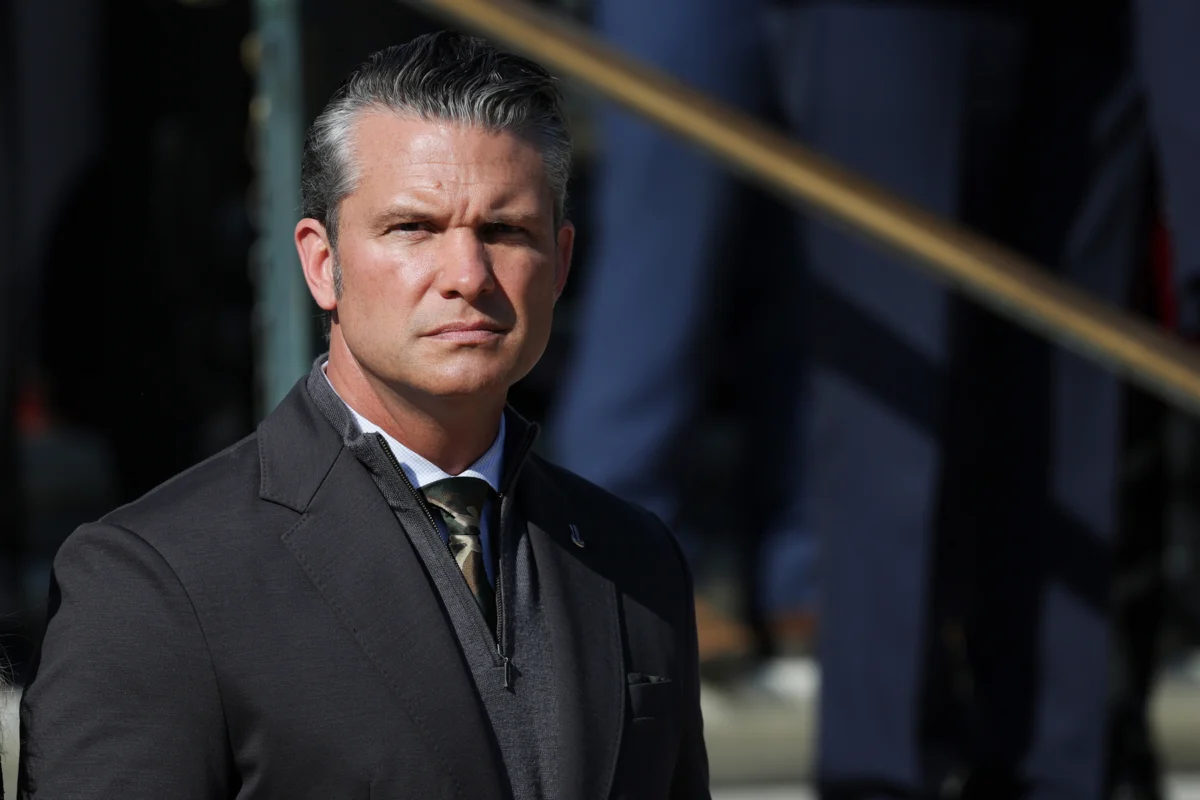
The solemn grounds of Arlington National Cemetery witnessed an extraordinary breach of protocol on Wednesday afternoon when an elite Army sentinel publicly reprimanded a high-ranking government delegation. Defense Secretary Pete Hegseth, accompanied by his wife and key senior advisors, was visiting the sacred memorial site to observe Veterans Day. The somber atmosphere of the national shrine was abruptly shattered when members of Hegseth’s entourage began laughing shortly after posing for photographs near the Tomb of the Unknown Soldier. The sharp rebuke from the guarding sentinel—demanding strict adherence to the cemetery’s long-standing code of absolute silence and respect—was captured on camera and quickly broadcast nationwide, adding a layer of public embarrassment to an administration already navigating intense legislative scrutiny.
The incident unfolded just hours after Hegseth narrowly averted a political crisis in the halls of Congress. On Tuesday night, House Republicans successfully neutralized a Democratic-backed impeachment effort, voting to block the resolution and spare the Pentagon chief from an imminent political trial. Buoyed by the legislative victory, Hegseth had spent the previous evening exchanging celebratory remarks with political allies, including President Donald Trump. However, the transition from partisan triumph to national mourning required a measured, respectful demeanor appropriate for Veterans Day—a shift that visibly eluded members of the delegation as they traversed the hallowed grounds of America’s most revered military cemetery.
Chronology of Events Surrounding the Incident
The sequence of events leading up to the public reprimand highlights a tense forty-eight-hour period for the Department of Defense leadership. On Monday, political tensions reached a boiling point when Representative Thomas Massie (R-Ky.) introduced formal articles of impeachment against Hegseth. The resolution cited serious allegations, including alleged violations of the War Powers Agreement of 1973, failures to adequately minimize civilian casualties in ongoing military operations, and accusations involving extrajudicial actions.
Despite the gravity of the constitutional challenge, the Republican-controlled House moved swiftly to protect the embattled defense chief. Late Tuesday evening, the House voted to send the impeachment resolution to committee, effectively shelving the effort and handing Hegseth a crucial political lifeline.
Seeking to project stability and unity following the legislative battle, Hegseth participated in official Veterans Day commemorations on Wednesday morning at Arlington National Cemetery. Following the formal ceremony, Hegseth, alongside his wife Jennifer, Chief of Staff Ricky Buria, Deputy Chief of Staff Patrick Weaver, and Senior Advisor and Deputy Assistant Tami Radabaugh, walked toward the vicinity of the Tomb of the Unknown Soldier.
According to footage broadcast by CNN and subsequently shared widely across public platforms, the delegation paused near the monument to take photographs. Shortly thereafter, audible laughter emanated from the group. Recognizing a blatant violation of the sanctuary’s strict behavioral guidelines, an Army sentinel assigned to the Third Infantry Regiment—the elite unit tasked with guarding the tomb 24 hours a day, 365 days a year since 1948—intervened immediately.
"All visitors will maintain an atmosphere of silence and respect at all times!" the sentinel shouted across the plaza. Following the sharp reprimand, the delegation hurriedly ascended the steps in front of the monument, while observers and media outlets noted the stark contrast between the guard’s unwavering dedication to protocol and the perceived levity of the civilian officials.
Historical and Cultural Significance of the Tomb of the Unknown Soldier
To fully contextualize the public outcry surrounding the incident, it is essential to examine the profound historical weight carried by the Tomb of the Unknown Soldier. Situated on a hill overlooking Washington, D.C., Arlington National Cemetery serves as the final resting place for more than 400,000 military service members, veterans, and their dependents. Within these grounds, the Tomb of the Unknown Soldier stands as the ultimate symbol of national sacrifice.
First established in 1921 with the interment of an unidentified American soldier from World War I, the monument has since expanded to include unidentified service members from World War II, the Korean War, and briefly the Vietnam War, though the remains of the latter were eventually identified through DNA testing. The site is guarded continuously by sentinels from the Army’s 3rd U.S. Infantry Regiment, known as "The Old Guard." These soldiers undergo an extraordinarily rigorous selection and training process, maintaining a silent, unyielding vigil regardless of weather conditions, holidays, or time of day.
For nearly a century, visitors to the memorial have been expected to observe strict rules of decorum. Signs explicitly mandate absolute silence, solemn behavior, and a respectful demeanor. Any disruption, whether intentional or inadvertent, is treated by the sentinels and veterans’ organizations as a profound disrespect to the memory of those who made the ultimate sacrifice without ever receiving identification or formal recognition from a grateful nation.
Official Reactions and Institutional Silence
In the wake of the broadcast, reactions from military advocacy groups, political analysts, and the public were swift and critical. Veterans’ organizations expressed deep dismay that individuals occupying the highest echelons of the national defense apparatus would display such a lack of situational awareness at a monument dedicated to the fallen. Critics pointed out that the civilian leadership of the military is expected to model exemplary respect for military traditions and institutional protocols, particularly on a national holiday dedicated to honoring service and sacrifice.
Despite multiple inquiries from major news organizations, including Rolling Stone and CNN, the Pentagon did not immediately issue a formal statement addressing the incident. Spokespersons for the Department of Defense declined to comment on whether Hegseth or his staff received formal counseling regarding their conduct at the national cemetery, leaving the public relations fallout largely unaddressed by official channels.
Broader Political Implications and Ongoing Scrutiny
The Arlington reprimand arrives at a uniquely precarious time for the Department of Defense and the current administration. Hegseth has remained a polarizing figure since taking office, facing continuous legislative battles, policy controversies, and intense media scrutiny over his management style and past military directives.
While the successful blocking of the House impeachment resolution temporarily insulated Hegseth from a constitutional crisis, political analysts note that public perception plays a critical role in the ongoing stability of any cabinet-level official. Incidents that undermine the perceived gravitas, professionalism, or judgment of senior civilian leaders can significantly impact their political capital on Capitol Hill.
Furthermore, the optics of the event carry substantial weight within the broader military community. Rank-and-file service members and military families place immense value on the traditions and symbols associated with the armed forces. A public reprimand by an enlisted sentinel—who represents the strict, non-negotiable standards of the United States military—serving as a corrective to the nation’s top defense official creates an uncomfortable symbolic inversion of authority and discipline.
As the political dust settles from the failed impeachment effort, the video of the Arlington sentinel’s rebuke serves as a lingering reminder of the high standards expected of those entrusted with the nation’s defense. Whether this momentary lapse in decorum will result in long-term political consequences or simply fade into the background of an already tumultuous tenure remains to be seen, but the incident has undeniably left an indelible mark on the administration’s public relations narrative during a week meant for solemn reflection and national unity.