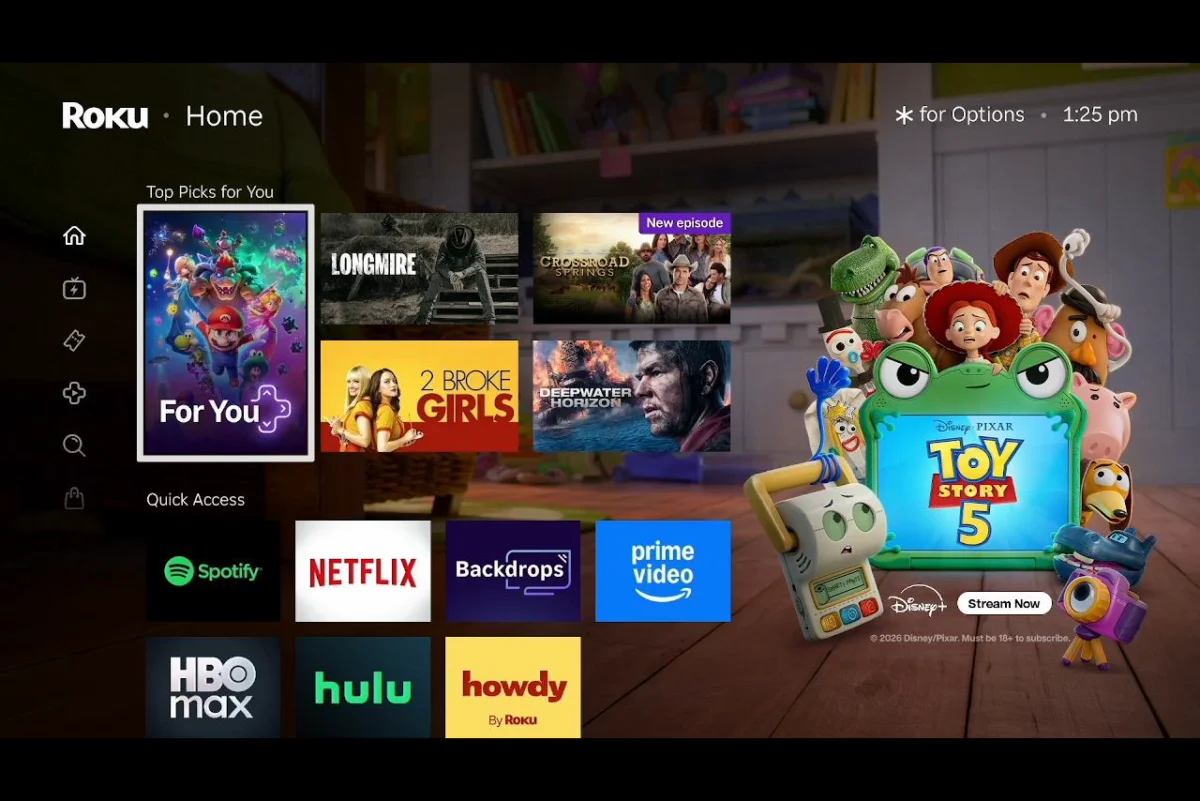
Roku’s financial engines are operating at peak performance as the streaming platform giant races toward its impending acquisition by Fox Corp. next year. The company’s latest financial disclosures reveal a thriving enterprise characterized by robust top-line expansion, surging advertising revenues, and a staggering seven-fold year-over-year increase in net income. These powerful results underscore the underlying strength of Roku’s business model at a critical juncture in its corporate history.
For the third quarter, Roku handily surpassed Wall Street earnings expectations, posting a 24% year-over-year increase in top-line growth to reach $1.50 billion in total revenue. Total gross profit mirrored this upward trajectory, climbing 24% to $649 million. Most notably, Roku generated a net income of $183 million, representing an astronomical leap of more than seven times the profit recorded in the corresponding period a year prior.
The impressive performance highlights how the streaming ecosystem continues to mature and monetize effectively, even amid shifting macroeconomic conditions and structural corporate changes. As Roku prepares to transition into a new era under the Fox Corp. umbrella, its operational metrics demonstrate that the platform remains a dominant force in modern television viewing and digital advertising.
Platform Segment Drives Growth Through Advertising and Subscriptions
A primary driver of Roku’s financial success in the third quarter was its core Platform segment. Revenue within this division grew 23% year over year, reaching $1.3 billion. Both the advertising and subscription sales sub-sectors within the segment experienced matching 23% growth rates, illustrating a balanced and diversified revenue stream.
Roku highlighted two major catalysts that fueled its advertising momentum during the quarter. First, political advertising on the platform significantly outperformed expectations, exceeding the comparable quarter from the 2024 U.S. presidential election cycle. This trend highlights the increasing migration of political ad dollars away from traditional linear television and into connected TV (CTV) environments, where targeting and measurement capabilities are more granular.
Second, advertising within Roku’s media and entertainment (M&E) category shattered recent benchmarks. The company reported that the most recent quarter marked the highest year-over-year revenue growth for M&E in four years. This surge was propelled by media companies aggressively investing on the Roku platform to promote their newly launched content, streaming services, and theatrical releases.
Engagement remained exceptionally strong across the board. Total streaming hours consumed on Roku devices reached a remarkable 39.9 billion in the third quarter, reflecting a 9% increase compared to the same period last year. This sustained engagement ensures that Roku remains an indispensable gateway for viewers navigating an increasingly fragmented media landscape.
Hardware Costs and the Devices Segment Strategy
While Roku’s platform business continues to rake in high-margin revenue, its hardware division operates under a fundamentally different financial philosophy. Revenue in Roku’s Devices segment jumped 33% year over year to reach $194 million. However, the company deliberately operates its hardware business as a loss-leader to drive user acquisition and expand its active account base.
In the third quarter, the operating loss for the Devices segment widened to $48.6 million, translating to a negative gross margin of 25%. Roku management attributed this margin pressure primarily to higher memory component costs plaguing the broader consumer electronics supply chain. Despite these hardware-related losses, the strategic value of placing Roku-enabled smart TVs and streaming sticks into households far outweighs the short-term manufacturing costs, as every new device brings in a lifetime of high-margin platform and advertising revenue.
The Timeline and Context of the Fox Corp. Acquisition
The backdrop to Roku’s stellar financial report is the blockbuster announcement made on June 15, when Fox Corp. revealed a definitive agreement to acquire Roku in a transaction valued at $22 billion. The multi-billion-dollar deal is slated to close in the first half of calendar year 2027, pending customary regulatory approvals and shareholder sign-offs.
Because of the pending acquisition, Roku has maintained the policy it established in the previous quarter of forgoing a live earnings conference call and withholding forward-looking financial guidance. This approach is standard procedure for publicly traded companies navigating complex, multi-billion-dollar merger and acquisition processes, as it prevents market manipulation and aligns with regulatory compliance frameworks.
The road to this historic union represents a monumental evolution for Roku, which began as a hardware pioneer before transforming into the leading operating system for connected television in the United States. By combining Roku’s immense reach and software expertise with Fox Corp.’s vast content production and broadcasting assets, the merged entity is positioned to become a dominant powerhouse spanning both content creation and distribution.
Leadership Perspectives on the Future of Streaming
In their joint letter to shareholders, Roku founder and CEO Anthony Wood, alongside CFO and COO Dan Jedda, addressed the pending acquisition with immense optimism. They characterized the deal as an extraordinary opportunity to accelerate the company’s foundational vision.
"The pending acquisition by Fox is an extraordinary opportunity to accelerate our vision, allowing us to scale faster and innovate more aggressively for viewers, partners, and advertisers," Wood and Jedda wrote.
The executives emphasized that Roku is methodically constructing a diversified and durable business model. Their strategic focus remains heavily centered on key monetization initiatives, including deepening technological integrations with third-party advertising platforms, scaling Roku-billed subscriptions, and continually enhancing the user-facing Roku Experience.
"With our open platform, we help our content partners attract and retain audiences, and we offer advertisers the ability to reach viewers at scale, all while providing viewers with an outstanding streaming experience," the executives added in the shareholder letter.
Crucially for continuity, leadership confirmed that following the successful close of the Fox acquisition, Anthony Wood will maintain an active, ongoing operational role within the combined company and will secure a seat on the Fox board of directors. This ensures that the pioneering vision which built Roku will remain deeply embedded in its future strategic direction.
Broader Market Implications and Industry Impact
The marriage of Fox Corp. and Roku carries profound implications for the media and technology sectors. As traditional broadcast and cable networks continue to bleed subscribers to streaming alternatives, legacy media conglomerates are aggressively seeking owned-and-operated distribution pipelines. By acquiring Roku, Fox secures direct control over one of the most vital gateways to the living room, bypassing third-party platform fees and gaining unprecedented access to first-party viewer data.
For advertisers, the consolidation creates a formidable ecosystem where premium sports, news, and entertainment content from Fox can be seamlessly paired with Roku’s advanced targeted advertising tools. This vertical integration allows brands to execute sophisticated, data-driven campaigns across both linear broadcasts and streaming environments with frictionless ease.
Furthermore, industry analysts suggest that the Fox-Roku deal could ignite a new wave of consolidation across the connected TV landscape. As tech giants, telecommunications companies, and traditional media empires vie for dominance over the digital living room, independent operating systems face mounting pressure to align with deep-pocketed conglomerates capable of funding aggressive global expansion and technological innovation.
Conclusion and Outlook
Roku’s third-quarter financial results provide definitive proof that the company is entering its merger with Fox Corp. from a position of absolute strength. With $1.50 billion in quarterly revenue, a 24% top-line jump, and a dramatic seven-fold surge in net income, Roku has silenced any doubts regarding its profitability and operational resilience.
As the industry looks toward the anticipated closing of the $22 billion transaction in the first half of 2027, Roku’s robust engagement metrics, booming advertising sectors, and visionary leadership ensure that it will remain at the forefront of the television revolution. Whether measured by streaming hours, platform monetization, or strategic positioning, Roku’s financial engines are primed and firing on all cylinders for the road ahead.