The demographic fabric of the United States is undergoing a profound transformation as Gen Z and millennial cohorts pivot away from historically dominant urban centers in favor of more strategic, sustainable living arrangements. While both generations are largely abandoning the nation’s most expensive coastal hubs—specifically New York City and Los Angeles—their motivations and destinations differ significantly, reflecting the distinct life stages of young adulthood. Recent data analysis reveals that while Gen Z is prioritizing career acceleration and social connectivity, millennials are increasingly focused on the pursuit of space, affordability, and long-term homeownership.
This shift represents more than a simple change of address; it is a recalibration of the American Dream for the modern era. Where the previous decade favored a "smaller-city" movement, the current landscape is defined by regional reshuffling and a calculated search for economic stability in the face of rising national housing costs.
A Tale of Two Generations: Diverging Priorities
The fundamental driver behind these migration patterns is the stage of life each generation occupies. For Gen Z, which includes adults currently aged 19 to 27, the priority is entry-level professional opportunity. They are gravitating toward high-energy metropolitan areas that provide a mix of robust job markets and vibrant social ecosystems. San Antonio, Texas, currently holds the title for the most popular destination for Gen Z, witnessing a net inflow of 10,678 residents. This trend is mirrored in Washington, D.C., Austin, Nashville, and Dallas, all of which are increasingly viewed as "launchpad" cities for young professionals.
In contrast, the millennial generation—now aged 28 to 43—is firmly entrenched in the "nesting" phase of adulthood. Their migration patterns lean heavily toward cities that offer a tangible return on their paycheck, particularly in terms of square footage and real estate accessibility. Houston, Las Vegas, and Atlanta have emerged as top-tier destinations for this cohort. These cities offer large-scale employment opportunities alongside housing markets where median prices frequently remain below the $450,000 threshold, a stark contrast to the high-barrier entry of coastal markets.
Historical Context: A Decade of Change
To understand the current migration landscape, it is necessary to examine the evolution of these trends over the past ten years. In 2014, as the U.S. economy began its recovery from the Great Recession, young adults were primarily flocking to secondary cities like Sacramento, Columbus, and Seattle. At that time, these locations were prized for their ability to provide a high quality of life at a lower cost than the traditional "megalopolis" centers.
Today, the landscape has shifted. While Austin and Dallas remain constants as attractive hubs for young people, the broader list of popular destinations has become more concentrated in the South and the Sun Belt. Conversely, the list of cities being vacated has remained remarkably consistent. New York and Los Angeles were among the most frequently abandoned cities in 2014, and they maintain that unenviable distinction today. The persistence of this trend suggests that the "pull" of the coastal hubs is being systematically eroded by the "push" of extreme housing costs, regardless of the generation involved.
Data-Driven Insights into Urban Exodus
The scale of this migration is significant. New York City, for instance, experienced a net outflow of 29,554 Gen Zers and 42,698 millennials in the most recent reporting period. These figures, derived from the U.S. Census Bureau’s American Community Survey, underscore a growing disillusionment with the cost-to-benefit ratio of the nation’s largest financial and cultural capitals.
Other cities, including Minneapolis, Denver, and Detroit, are also seeing notable net outflows of younger demographics. For Gen Z, these moves are often tied to the specific transitions inherent in early adulthood—college graduation, the pursuit of a first professional role, or the search for an entry-level market that offers a lower cost of living without sacrificing the amenities of urban life.
The Myth of the Cross-Country Trek
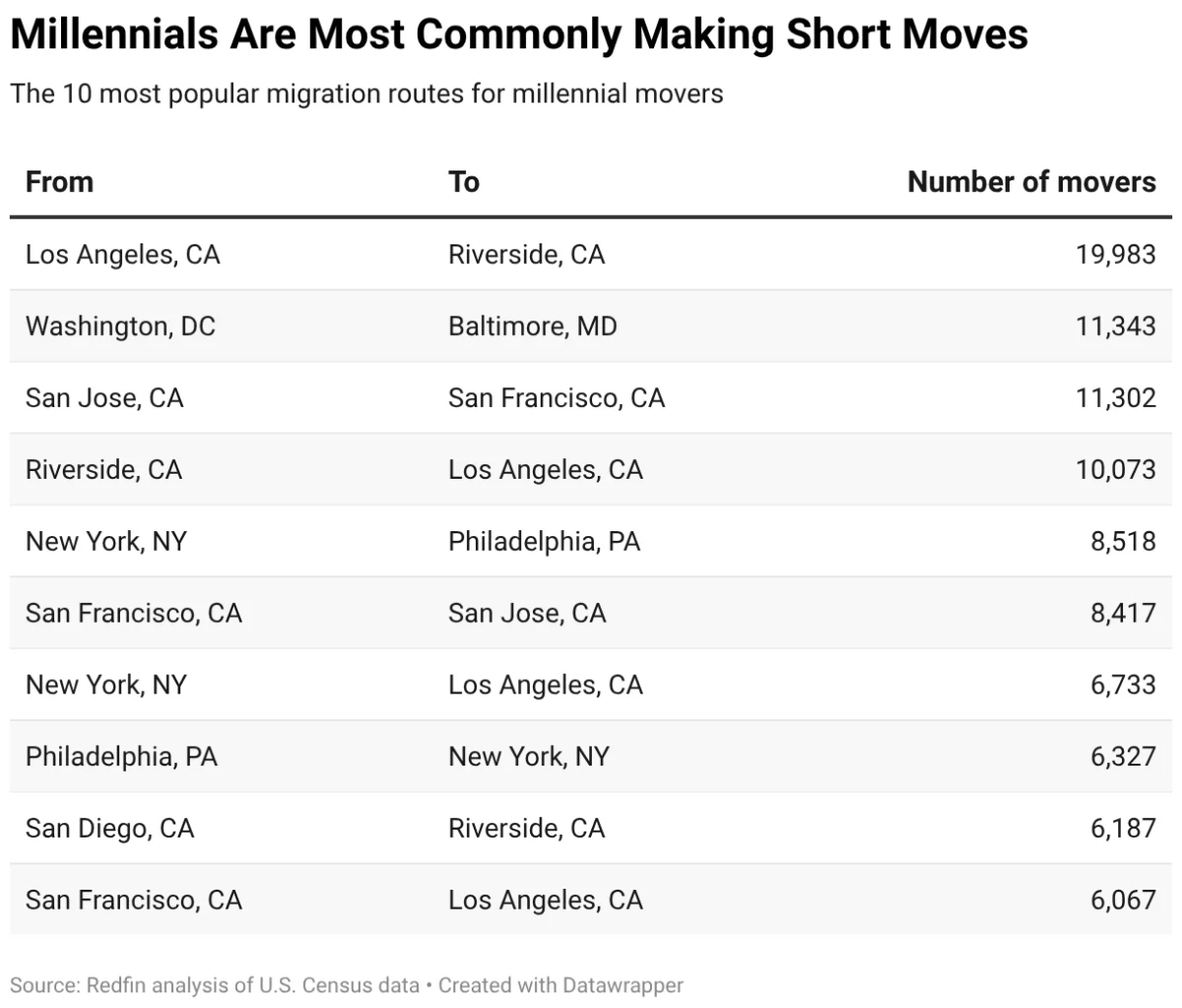
A common misconception regarding modern migration is that young Americans are frequently moving across the country in search of a total fresh start. However, the data suggests otherwise. The most common moves are, in fact, short-range relocations between neighboring metropolitan areas.
For example, the most popular move for both Gen Z and millennials is from Los Angeles to the Riverside-San Bernardino area in California’s Inland Empire. This relocation is rarely a search for a new lifestyle, but rather a functional trade-off: workers retain their proximity to the Los Angeles job market while accessing significantly lower housing costs. Similar patterns are evident in the movement from New York to Philadelphia, or Baltimore to Washington, D.C. These "short hops" indicate that young adults are looking to optimize their personal balance sheets while maintaining their established social and professional networks.
Economic and Professional Drivers
The role of the corporate sector in these shifts cannot be understated. Cities like Nashville, which has become a primary target for relocation, are benefiting from the strategic decisions of major corporations. Companies such as Amazon and Apple have invested heavily in regional hubs, creating a gravitational pull for young professionals in sectors like technology, healthcare, and entertainment.
"Nashville has become a magnet for young professionals because the job market is growing right alongside the city," notes Kristin Sanchez, a real estate expert familiar with the regional surge. "For those moving from high-cost environments like California or New York, these cities offer the ‘best of both worlds’—a vibrant culture and strong career trajectory, paired with a cost of living that allows for a higher standard of life."
The "Remote Work" Factor and Decreased Mobility
Interestingly, while the geographic distribution of young people is changing, the total rate of mobility has actually declined over the past decade. In 2014, roughly 15% of 19-to-24-year-olds relocated away from their metro area; in 2024, that figure has dipped to 14%. A similar, if more pronounced, trend is visible among those aged 25 to 34, with relocation rates dropping from 11% to 9%.
This decline can be attributed to two primary factors: the stabilization provided by remote work and the financial barriers to moving. Remote work has decoupled the need to live in a specific city from the ability to hold a job, allowing many young adults to remain in their current homes even when transitioning between employers. Furthermore, the high cost of housing and the broader inflationary environment have made the physical act of moving—which carries significant upfront costs—less attractive or entirely prohibitive for some.
Broader Implications for Urban Policy
The findings suggest that the largest U.S. cities are at a crossroads. When major job centers lose their appeal due to housing costs, it creates a ripple effect throughout the entire regional economy. The exodus of young talent from places like San Francisco and New York is a warning sign to municipal leaders that affordability is no longer a secondary concern; it is a prerequisite for maintaining a sustainable, multi-generational workforce.
As millennials age into the middle of their careers and Gen Z continues to establish its foothold in the workforce, cities that successfully bridge the gap between "career-launching potential" and "attainable living" will be the ones that define the next decade of American economic growth. For the cities currently seeing a massive influx of residents, the challenge will be to manage this growth through infrastructure, housing supply, and policy, ensuring that they do not eventually succumb to the same "affordability trap" that is currently driving people away from the coastal hubs.
In summary, the American migration narrative is shifting from a pursuit of the "big city dream" to a pursuit of "economic utility." Whether it is a young graduate moving to Washington, D.C., to start a career or a 35-year-old moving to the outskirts of Houston to buy a home, the motivation is clear: young Americans are actively seeking environments where they can build a life without being anchored by the unsustainable costs of the previous generation’s urban centers.