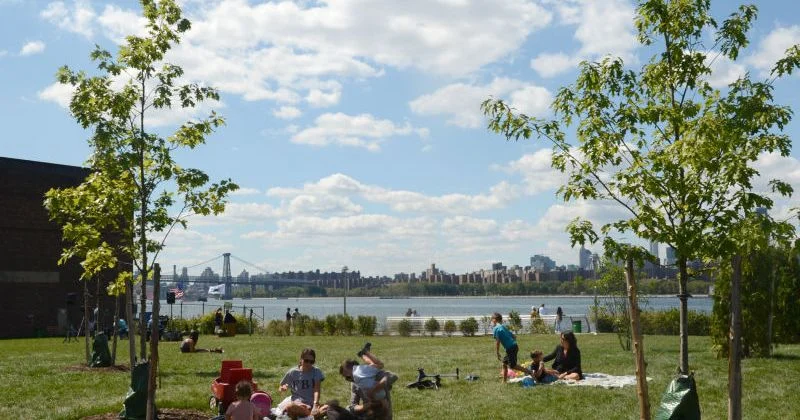
The contentious, large-scale commercial proposal to transform Greenpoint’s intimate WNYC Transmitter Park into a sprawling marina and restaurant complex has been officially canceled. Following a fierce, months-long public resistance campaign spearheaded by local residents and preservationists, a decisive community board meeting brought a definitive halt to the controversial project. The decision marks a significant victory for community-led urban planning in North Brooklyn, effectively shifting the city’s municipal focus away from commercialization and back toward essential public park infrastructure, most notably the long-overdue installation of public restrooms.
The unexpected demise of the project unfolded during a joint session held by the waterfront parks subcommittee of Brooklyn Community Board 1, alongside neighborhood volunteers and officials from the New York City Department of Parks & Recreation. According to community stakeholders, the final blow to the developer’s ambitious blueprint came in the wake of mounting public pressure, highlighted by a localized petition drive that rapidly gathered upwards of 500 signatures. Faced with clear, unified neighborhood opposition to the scale and commercial nature of the proposal, city officials and subcommittee members opted to scrap the plan entirely, pivoting toward a more community-centric approach for the park’s future.
A Chronology of Contention: From Announcement to Cancellation
The flashpoint for the neighborhood battle ignited in July, when city officials first publicized the winning concessionaire bid for WNYC Transmitter Park. The proposal immediately drew sharp criticism from Greenpoint residents, environmental advocates, and local park-goers who argued that a commercial marina and restaurant were entirely out of scale for the narrow, 1.6-acre green space nestled along the East River waterfront.
From its inception, the project faced heavy scrutiny over its massive footprint. The underlying driver of the large-scale commercial plan stemmed from a stringent requirement imposed by the Parks Department: any entity awarded the concession contract would be legally obligated to fully fund the comprehensive structural rehabilitation of the park’s historic 1937 brick building. Originally serving as the transmission hub for municipal radio station WNYC—from which the park derives its name—the striking art deco-inflected structure has stood vacant, decaying, and plagued by water damage for decades.
City engineers and local council representatives previously estimated that simply stabilizing and restoring the dilapidated broadcasting house would require an investment of roughly $5 million. Faced with these steep baseline remediation costs, initial prospective bidders began to drop out as they ran the financial numbers. Eventually, a final development team emerged with a financial model designed to offset the steep restoration costs, relying heavily on slip rental fees from a new boat dock and lucrative private event rentals, such as weddings and corporate parties.
However, as details of the winning proposal trickled out, neighborhood groups pointed out significant deficiencies. The plan was remarkably vague regarding architectural specifics, lacked explicit contractual guarantees for completing the historic building renovation, and threatened to turn a quiet neighborhood green space into a bustling commercial hub for sunset cruises and tourist traffic. The resulting backlash gave rise to grassroots coalitions, including the Friends of WNYC Transmitter Park, who mobilized opposition through public rallies, informational campaigns, and targeted petitions.
Shifting Priorities: Trading Historic Renovations for Basic Park Needs
The pivotal turning point arrived during Tuesday night’s Community Board 1 committee meeting. Recognizing the widespread community discontent, the subcommittee introduced and passed a heavily revised resolution that fundamentally alters the city’s approach to the park’s concession strategy.
Under the newly approved framework, the burdensome requirement for a full-scale architectural restoration of the 1937 WNYC building has been formally stripped away. In its place, the city will likely require a much simpler commemorative acknowledgment—such as an informative historical plaque or public monument—honoring the site’s rich broadcasting legacy.
Perhaps the most surprising revelation to emerge from the proceedings involved the legal status of the contentious project itself. Elissa Iberti, chair of the Friends of WNYC Transmitter Park, shared with attendees that a Parks Department representative disclosed a striking administrative detail: the winning operator’s contract had never actually been officially signed. This bureaucratic technicality significantly streamlined the cancellation process, sparing the city from complex legal entanglements or breach-of-contract disputes with the developers.
"I will be completely honest, I did not think Parks would come back and listen," Iberti noted following the meeting. "I think this is sort of unheard of."
The Focus Returns to Infrastructure: The Hunt for a Public Restroom
With the commercial marina and restaurant blueprint officially dead, community advocates and city planners are refocusing their collective energy on addressing the fundamental deficiencies of WNYC Transmitter Park. Chief among these long-standing needs is the absence of a dedicated public restroom.
For years, visitors, families, and local runners utilizing the park have faced a glaring lack of basic amenities. The new committee resolution explicitly directs the Parks Department to pursue alternative avenues to secure a public bathroom facility for the space. City officials are now exploring whether a scaled-down concessionaire might be brought in under different terms—one whose primary operational scope is modest enough to integrate a clean, accessible public restroom and a storage shed for park maintenance equipment without transforming the waterfront into an event venue.
Furthermore, local observers are already speculating whether Transmitter Park might become an ideal candidate for integration into broader municipal initiatives, such as the city’s ongoing efforts to expand automated, high-maintenance public restrooms across underserved urban neighborhoods.
Broader Implications for New York City Waterfronts
The swift rise and fall of the Transmitter Park marina proposal serves as a compelling case study in contemporary New York City urban planning, highlighting the ongoing tension between municipal revenue-generation strategies and hyper-local neighborhood preservation.
In recent years, cash-strapped city agencies have increasingly leaned toward public-private partnerships and commercial concession models to offset the immense capital costs required to maintain and restore aging municipal infrastructure. By shifting the financial burden of historic preservation onto private operators, the Parks Department has historically sought to fund major renovations without draining public coffers. However, the Greenpoint uprising demonstrates the strict limits of this model when applied to beloved, densely populated neighborhood parks where residents fiercely prioritize passive green space, open waterfront access, and environmental tranquility over commercial entertainment.
As the Department of Parks & Recreation returns to the drawing board for WNYC Transmitter Park, the neighborhood has successfully defended its waterfront from overdevelopment. The challenge ahead will lie in balancing fiscal pragmatism with community desires, ensuring that future proposals respect the scale of the park while finally delivering the basic public amenities that local residents have demanded for years.