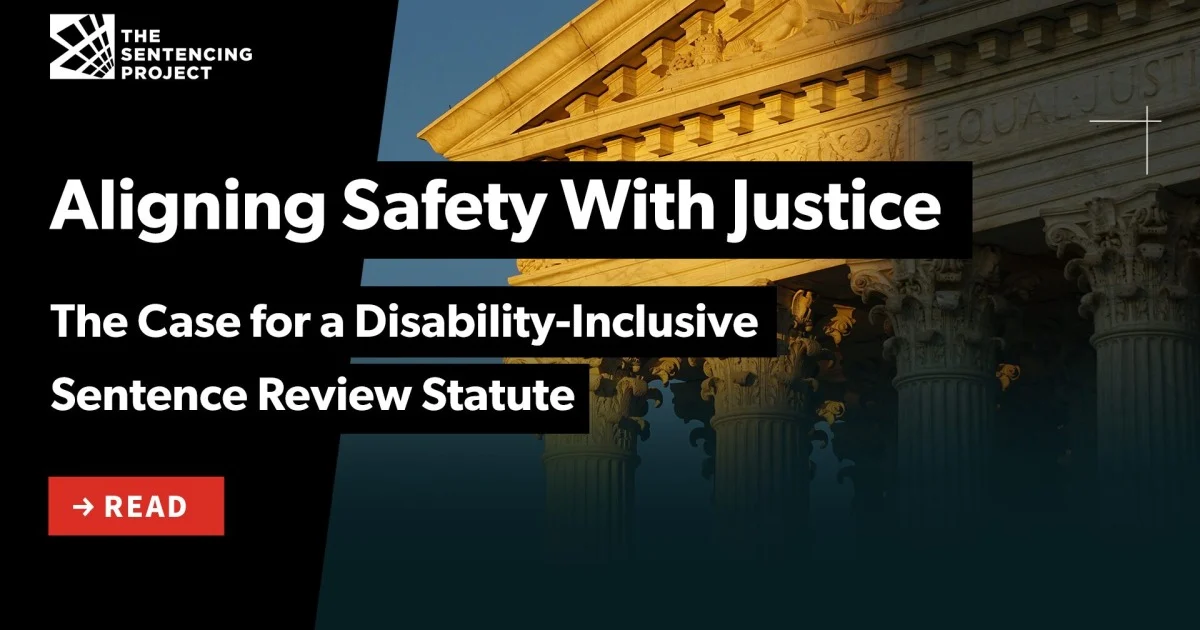
The Sentencing Project, a leading national advocacy organization focused on criminal justice reform, has officially proposed the implementation of "disability second look" statutes across American jurisdictions. This legislative push aims to provide individuals with physical, cognitive, or social disabilities currently serving long-term prison sentences with a structured pathway for judicial review. By creating a legal mechanism to re-evaluate sentences, the initiative seeks to rectify a profound systemic imbalance: while people with disabilities are disproportionately represented within the correctional system, they currently lack the specific legislative avenues for relief that have been extended to other vulnerable demographics, such as veterans, survivors of domestic violence, and youth offenders.
The Scope of the Disability Disparity
The necessity for these statutes is rooted in stark statistical realities. According to data analyzed by the organization, individuals within state and federal prisons report one or more impairments at a rate of 38%, compared to just 15% of the general U.S. population. This suggests that people with disabilities are roughly two and a half times as likely to be incarcerated as those without such conditions.
Research indicates that this overrepresentation is not the result of a higher propensity for criminal activity among disabled populations. Rather, it is a byproduct of a legal system that often fails to accommodate specific needs, leading to increased rates of arrest and conviction. During interactions with law enforcement, behaviors associated with cognitive or psychiatric disabilities—such as difficulties with social cues, communication barriers, or emotional regulation—can be misinterpreted as defiance or guilt. These misperceptions often trigger escalations that lead to arrests that might have been avoided had proper training and de-escalation protocols been in place.
The Procedural Lifecycle of Injustice
The vulnerability of disabled individuals begins well before a trial. Throughout the criminal legal process, the lack of reasonable accommodations can impede an individual’s ability to participate in their own defense. In many instances, individuals with intellectual or developmental disabilities struggle to comprehend the intricacies of courtroom proceedings or the implications of legal advice, effectively compromising their due process rights.
Once incarcerated, the challenges compound. The prison environment, characterized by rigid routines and high-stress social dynamics, often proves inherently hostile to those with specific medical or cognitive needs. Frequently, individuals who struggle to comply with institutional rules due to their disability face disciplinary action, which in turn results in the loss of "good time" credits or exclusion from essential rehabilitative programming. This creates a cycle where a disability leads to behavioral infractions, which are then used as justification for longer sentences and the denial of parole, regardless of the individual’s actual risk to public safety.
Chronology of Legislative Advocacy
The current proposal for a "second look" statute fits into a broader, multi-year movement to reform extreme sentencing practices in the United States.
- Pre-2020: Advocacy groups begin identifying the intersection of disability rights and criminal justice as a critical blind spot in sentencing reform.
- 2020–2025: Several states, including California and Illinois, implement various "second look" laws for juvenile offenders, recognizing that human development—specifically the maturation of the brain—renders extreme sentences for young people fundamentally unjust.
- 2026 (July): The Sentencing Project publishes its comprehensive model statute, formalizing the argument that disability, like age, is a mitigating factor that warrants a judicial check on long-term incarceration.
- 2026 (July 24): Concurrently, courts in states like Pennsylvania grapple with the legal fallout of mandatory life-without-parole sentences, highlighting the urgency of reviewing legacy cases that no longer align with contemporary standards of justice or medical understanding.
The Model Statute: A Framework for Reform
The proposed model statute developed by The Sentencing Project provides a blueprint for legislators to integrate disability considerations into sentencing review hearings. Under this framework, an individual would be eligible for a sentence review if their disability significantly influenced several key phases of their involvement with the justice system. Specifically, the statute accounts for:
- The Offense: Whether the nature of the crime was directly tied to the individual’s disability or a lack of appropriate support.
- Interaction Dynamics: Whether the individual’s behavior or perceived intent before, during, and after the arrest was influenced by a lack of capacity or miscommunication.
- Due Process: Whether the individual was denied meaningful access to legal counsel or failed to understand court proceedings due to their disability.
- Institutional Experience: Whether the individual’s time in prison was marked by disability-related disciplinary issues or an inability to access necessary rehabilitative programs.
- Reentry Barriers: Whether current sentencing requirements pose an unnecessary obstacle to the development of a viable reintegration plan.
Training as a Pillar of Policy
Recognizing that legislative change is insufficient without cultural and operational shifts, the proposal mandates extensive training for justice system actors. This includes law enforcement officers, prosecutors, defense attorneys, and judges. The objective is to ensure that these stakeholders understand their legal obligations under the Americans with Disabilities Act (ADA) and other relevant statutes.
Effective training would focus on recognizing signs of cognitive impairment, understanding the limitations of certain disabilities, and providing reasonable accommodations to ensure that justice is administered equitably. For example, law enforcement would be trained in identifying sensory processing issues, while courts would be required to ensure that courtroom modifications—such as auxiliary aids or simplified language—are available to defendants who require them.
Analysis of Broader Implications
The implications of adopting these statutes extend far beyond the individual cases. Sociologically, the research shows that the risk of re-offending declines significantly with age. For those with criminal records, data demonstrates that after seven years of living in the community without a new arrest, the recidivism risk for a formerly incarcerated person becomes statistically indistinguishable from that of an individual with no criminal history. By providing a "second look," the system would be able to transition aging or rehabilitated individuals out of the prison system, significantly reducing the massive fiscal burden of long-term incarceration while simultaneously honoring the principles of redemption and reform.
Furthermore, there is a strong moral argument being made: if the criminal legal system is designed to assess culpability, it must logically account for factors that diminish a person’s agency. If a disability prevents an individual from understanding the law or navigating the complex social requirements of a prison, then keeping them incarcerated for a duration that ignores these realities is viewed by proponents as a failure of the state’s obligation to provide equal protection.
The Path Forward
While 15 states, the District of Columbia, and the federal government have already moved to provide sentence review hearings for specific groups, the exclusion of people with disabilities represents a notable policy vacuum. Lawmakers are now being asked to reconcile the recognition that personal characteristics reduce culpability with the reality that disability-related challenges are currently ignored in the sentencing calculation.
As of late 2026, the discourse is shifting toward a more nuanced understanding of "rehabilitation." The Sentencing Project’s model statute suggests that it is possible to grow, mature, and rehabilitate even within the constraints of a disability, provided the environment supports it. The proposal asks the legal system to accept that an individual’s current state of maturity or health is a more accurate measure of their risk to society than the state they were in at the time of their original sentencing.
By advocating for these reforms, The Sentencing Project is positioning disability rights as a central pillar of the next generation of criminal justice reform. Whether legislatures will adopt these model statutes remains to be seen, but the push reflects a growing consensus that the "tough on crime" policies of the past must be updated to account for the modern understanding of human neurodiversity and the social obligations of the state to its most vulnerable citizens. As courts continue to face pressure from ongoing felony murder litigation and other challenges to extreme sentencing, the "disability second look" statute provides a clear, actionable path toward a more equitable and efficient correctional system.