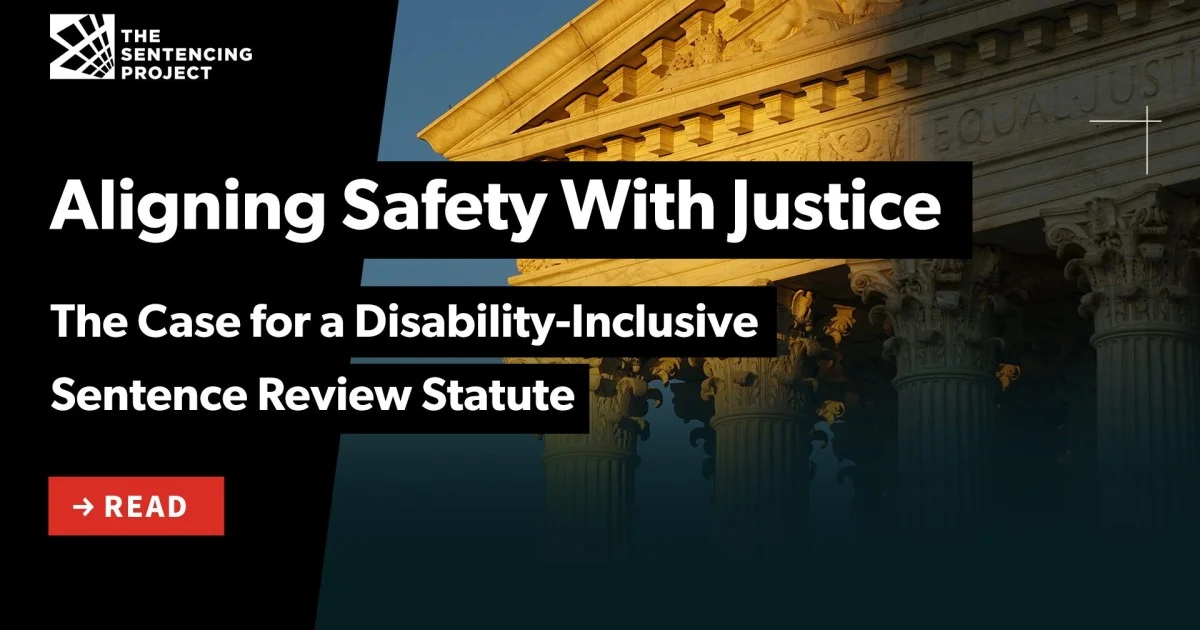
The American criminal legal system stands at a critical juncture regarding its treatment of incarcerated individuals living with physical, cognitive, and social disabilities. According to a recent policy proposal from The Sentencing Project, a leading advocacy group for decarceration, jurisdictions across the United States must enact "disability second look" statutes. These proposed laws aim to provide a formal mechanism for sentence review for incarcerated people whose disabilities have historically contributed to their over-policing, harsher sentencing, and exclusion from rehabilitative opportunities.
Current data underscores a profound disparity in the composition of the prison population. While individuals with disabilities represent approximately 15% of the general U.S. adult population, they account for 38% of those currently serving time in state and federal prisons. This indicates that people with disabilities are roughly two and a half times more likely to be incarcerated than their counterparts without impairments. By proposing a targeted legislative intervention, advocates hope to correct a systemic failure to account for the role of disability in criminal adjudication and incarceration.
The Mechanism of Exclusion and Systemic Bias
The proposed model statute for a disability-inclusive second look process is designed to address five distinct areas where disability impacts the trajectory of a criminal case. First, the statute would allow for review if a disability contributed directly to the nature of the offense. Second, it considers how cognitive or social impairments may have led to misperceptions or problematic behaviors during arrest and subsequent interrogation. Third, it addresses the frequent denial of due process, where individuals with disabilities are unable to fully participate in their own defense or comprehend the intricacies of courtroom proceedings.
Beyond the courtroom, the proposal highlights the "prison-to-prison" experience for those with impairments. Incarcerated individuals with disabilities often face significant barriers to accessing educational and vocational programming. Frequently, these individuals are disciplined for infractions that are actually manifestations of their disabilities, creating a feedback loop that results in longer sentences and the denial of parole. Finally, the statute aims to rectify obstacles to reentry, acknowledging that individuals who have matured and gained management over their conditions while incarcerated deserve an opportunity to demonstrate their fitness for community reintegration.
The Aging Population and Culpability
A central pillar of the argument for second look legislation is the well-documented decline in criminal risk as individuals age. Sociological and criminological research has long established the "aging out" phenomenon, wherein the risk of recidivism drops precipitously after the age of 40 or 50. Further data suggests that for those with criminal records, the risk of re-arrest after seven years of non-offending is statistically indistinguishable from the risk posed by individuals with no criminal history at all.
By refusing to provide a second look, the current system effectively ignores the reality of personal evolution and the mitigation of risk over time. Legal scholars argue that if the justice system acknowledges reduced culpability for other vulnerable populations—such as young people whose brains are still developing, or veterans suffering from service-related trauma—it should logically extend that same consideration to those whose criminal involvement was inextricably linked to physical or cognitive impairments. Currently, while fifteen states and the District of Columbia have enacted second look laws for specific demographics, none have integrated disability as a primary criterion for judicial review.
Mandatory Training as a Prerequisite for Reform
The Sentencing Project’s proposal goes beyond the legislative framework by advocating for mandatory, systemic training for all stakeholders in the legal system. The organization argues that a law is only as effective as the actors who implement it. Therefore, the model statute includes provisions for comprehensive education for law enforcement officers, prosecutors, judges, and public defenders.
This training would focus on the intersection of disability and the law, specifically emphasizing the legal obligations under the Americans with Disabilities Act (ADA) and other federal mandates to provide reasonable accommodations. In many cases, current systemic failures are not the result of malicious intent but rather a lack of training regarding how to interact with individuals who may have neurodivergent needs, mobility limitations, or sensory processing disorders. By fostering an environment where these accommodations are standard, the justice system can prevent the initial missteps that often lead to disproportionate sentencing.
Contextualizing the Call for Reform
The call for disability-focused reform arrives during a broader national conversation about "extreme sentencing" and the constitutionality of life-without-parole (LWOP) sentences. In jurisdictions like Pennsylvania, for example, the legal system is currently grappling with the aftermath of rulings such as Commonwealth vs. Lee, which challenged the constitutionality of mandatory life sentences for felony murder. With over 1,100 felony murder cases still unresolved, the urgency for legislative clarity is high.
These developments, while distinct from disability-specific statutes, share a common objective: to re-evaluate sentences that were imposed without regard for the individual circumstances of the defendant. Advocacy groups argue that the "on-ramp" to extreme sentencing—often characterized by mandatory minimums and the failure to consider mitigating factors—has disproportionately impacted the most vulnerable members of society.
Broader Implications and Future Outlook
The implementation of disability second look statutes would represent a significant shift in the philosophy of the American carceral system. It moves away from a purely retributive model toward one that incorporates restorative justice and acknowledges the human capacity for growth and rehabilitation.
Critics of such measures often cite concerns regarding public safety and the finality of judicial rulings. However, proponents point out that second look statutes do not guarantee release; rather, they guarantee a hearing. At these hearings, judges and parole boards would retain the discretion to weigh evidence of rehabilitation against the severity of the original crime. This allows for a nuanced assessment that current, rigid sentencing structures simply do not permit.
Furthermore, the economic implications of such reforms are significant. The cost of incarcerating an aging population with disabilities is exponentially higher than that of the general prison population, primarily due to medical needs and the requirement for specialized facility modifications. By allowing for the release of individuals who have demonstrated rehabilitation and pose a low risk to public safety, states could potentially redirect significant resources toward community-based mental health and disability support services.
Conclusion
The proposal for disability second look statutes is a call to align the criminal legal system with the constitutional mandates of fairness and due process. By addressing the unique barriers faced by people with disabilities—from the point of arrest through the duration of their sentence—policymakers can ensure that the justice system operates with a higher degree of accuracy and humanity.
As state legislatures weigh these proposals, the focus will likely remain on the necessity of bridging the gap between current legal practice and the realities of disability. Whether this will lead to a wave of new state-level statutes remains to be seen, but the data presented by organizations like The Sentencing Project provides a compelling case that the status quo is both inefficient and fundamentally inequitable. The challenge for the coming years will be to transform these proposals into concrete policies that can withstand the scrutiny of the courtroom while providing a pathway to redemption for those who have been left behind by the rigid application of law.