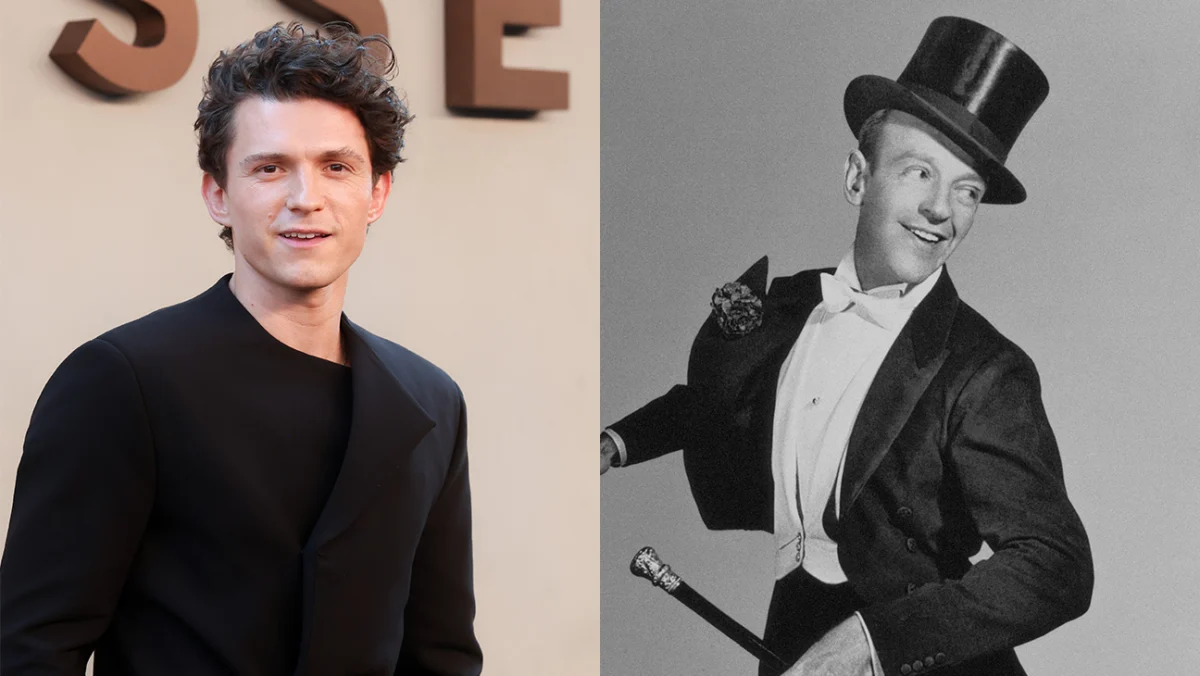
Tom Holland is officially transitioning into a new era of his career, moving from the high-flying acrobatics of the Marvel Cinematic Universe to the sophisticated, rhythmic grace of the Golden Age of Hollywood. While currently dominating the global box office with Christopher Nolan’s epic The Odyssey and preparing for the late-summer release of Spider-Man: Brand New Day, the 30-year-old actor has confirmed that his primary focus is now shifting toward the long-awaited Fred Astaire biopic for Sony Pictures. Directed by Paul King, the project represents a significant pivot for Holland, who is seeking to shed his image as a teenage protagonist in favor of more complex, adult-oriented roles that challenge his physical and dramatic range.
The Long Road to the Dance Floor: A Five-Year Development Timeline
The announcement of a Fred Astaire biopic starring Tom Holland first made headlines five years ago, but the project remained in a state of quiet development as Holland fulfilled his extensive commitments to the Spider-Man franchise and other blockbuster ventures. The film is being produced by Sony Pictures, a studio that has maintained a long-standing and lucrative relationship with Holland.
The timeline of the project reflects the careful planning required to bring a figure as iconic as Astaire to the screen. Following the initial announcement, the search for a director concluded with the appointment of Paul King, whose recent success with Wonka and the Paddington series demonstrated a unique ability to blend whimsical storytelling with musical elements.
During a recent appearance on Good Morning America, Holland confirmed that the developmental phase has concluded and the preparation phase has begun in earnest. "We have Fred Astaire next, [which] is what we’re planning on doing," Holland stated. He noted that while he is currently occupied with the global press tours for his two summer blockbusters, his schedule is clear for a return to the dance studio immediately following his promotional duties.
Commitment to Technical Authenticity: The One-Shot Vision
One of the most ambitious aspects of the upcoming biopic is Holland’s insistence on performing the dance sequences with the same technical rigor that Astaire himself demanded. Fred Astaire was famous for his "full-body" philosophy, insisting that the camera capture his entire frame during a dance number, often in a single, unbroken take. This was a radical departure from the quick-cut editing style that would later become standard in film.
Holland has expressed a desire to honor this legacy by eschewing the use of body doubles and digital enhancements. "I have a desire to use no doubles. To do all of the dancing. To shoot those dances in one shot. How he would have done it," Holland explained. This commitment places an immense physical burden on the actor, requiring him to master complex tap and ballroom routines to a professional standard.
Industry analysts suggest that this approach, while risky and time-consuming, could elevate the film from a standard biopic to a technical masterpiece. By utilizing long takes, Paul King and Holland aim to recreate the immersive, breathless experience of watching Astaire in classics such as Top Hat (1935) or Swing Time (1936). The "absolute dread" Holland mentioned feeling during early rehearsals highlights the scale of the challenge; Astaire was not merely a dancer but a perfectionist who would rehearse routines for months until they appeared effortless.
Reclaiming a Lost Passion: From Billy Elliot to the Big Screen
For Holland, the role of Fred Astaire is not just a career move but a return to his artistic roots. Before becoming a household name as Peter Parker, Holland was a standout performer in London’s West End. From 2008 to 2010, he starred in Billy Elliot the Musical, a role that required rigorous training in ballet, tap, and acrobatics.
In a reflective interview on Live With Kelly and Mark, Holland admitted that he had distanced himself from the world of dance after his tenure in the West End ended. "One of my biggest regrets in my career is after I finished Billy Elliot, I quit dancing," he said. This hiatus makes the Astaire project a form of personal redemption for the actor. He described the opportunity to "re-explore that world" as a significant motivator, suggesting that his background in live theater will provide the foundational discipline necessary for the role’s demands.
The transition from a musical theater background to a cinematic portrayal of a legendary dancer is a path previously trodden by actors like Catherine Zeta-Jones and Hugh Jackman. However, the specificity of Astaire’s style—a blend of "outlaw" tap and elegant ballroom—requires a unique physiological adjustment that Holland is currently undergoing in his initial rehearsals.
A Career Peak: The Odyssey and the Future of Spider-Man
The news of Holland’s dance training comes at a moment when his star power is at an all-time high. He is currently starring in Christopher Nolan’s The Odyssey, a high-concept reimagining of Homer’s epic. In this production, Holland portrays Telemachus, the son of Odysseus and Penelope. The film has been lauded by critics for its visual scale and Holland’s ability to hold his own alongside a heavyweight ensemble cast.
Simultaneously, the entertainment world is bracing for the July 31 release of Spider-Man: Brand New Day. This marks Holland’s fourth solo outing as the web-slinger and is expected to be a pivotal chapter in the Marvel Cinematic Universe. The title suggests a fresh start for the character, potentially moving Peter Parker into his collegiate or young adult years, mirroring Holland’s own desire to move away from "teenager" roles.
The confluence of these projects—a Nolan epic, a massive superhero sequel, and a prestige musical biopic—positions Holland as one of the most versatile and bankable actors of his generation. By diversifying his portfolio with a biopic of a cultural icon, Holland is following a trajectory similar to that of Austin Butler or Cillian Murphy, using blockbuster success to pivot into roles that garner awards-season attention.
Supporting Data: The Rise of the Musical Biopic
The untitled Fred Astaire project enters a market that has shown a renewed appetite for musical biopics. Over the last decade, films centered on musical icons have seen significant commercial and critical success:
- Bohemian Rhapsody (2018): Grossed over $910 million worldwide and won four Academy Awards.
- Rocketman (2019): Earned $195 million and widespread acclaim for its blend of fantasy and biography.
- Elvis (2022): Grossed $288 million and secured eight Oscar nominations, including Best Actor for Austin Butler.
- Bob Marley: One Love (2024): Demonstrated strong box office legs, proving the genre’s continued viability.
However, a biopic of a dancer presents a different set of challenges than that of a singer. While vocal performances can be dubbed or enhanced in post-production, the physical language of dance is much harder to simulate. Sony’s investment in the project suggests confidence in the "spectacle" of dance as a primary draw for audiences.
Furthermore, the project faces unique competition. A separate Fred Astaire and Ginger Rogers project, titled Castle Rock, has been in development with Jamie Bell (who also played Billy Elliot) and Margaret Qualley. This "dueling biopics" scenario is not uncommon in Hollywood, but Holland’s version, backed by Sony and directed by Paul King, appears to have the stronger momentum following Holland’s recent public updates.
Broader Implications: Redefining the Modern Movie Star
Tom Holland’s move toward the Fred Astaire biopic signifies a broader shift in how modern movie stars manage their "post-franchise" lives. For years, Holland has been synonymous with the MCU. By taking on a role that requires such specific, non-superhero skills, he is signaling to the industry that he is capable of carrying a film through sheer performance rather than IP (Intellectual Property) alone.
The choice of Paul King as director is also telling. King’s filmography is defined by a sense of earnestness and technical precision. His involvement suggests the film will avoid the "gritty reboot" tropes that have plagued some modern biopics, instead opting for a celebration of the elegance and charm that defined the 1930s and 40s.
As Holland prepares to "dive back into the dance studio," the stakes are high. He is not just attempting to play a character; he is attempting to emulate a man who is widely considered the greatest popular music dancer of all time. If Holland succeeds in his goal of shooting long-form, single-take dance sequences, the film could set a new standard for how dance is captured on modern film, bridging the gap between the golden age of cinema and the contemporary blockbuster era.
The upcoming months will be grueling for the actor as he balances the final legs of his current press tours with the physical exhaustion of dance training. However, as Holland himself noted, the "excitement and absolute dread" he feels are the very things that draw him to the job. For an actor who has spent the last decade swinging from skyscrapers, the challenge of a perfectly executed tap routine may be his most daunting—and rewarding—stunt yet.