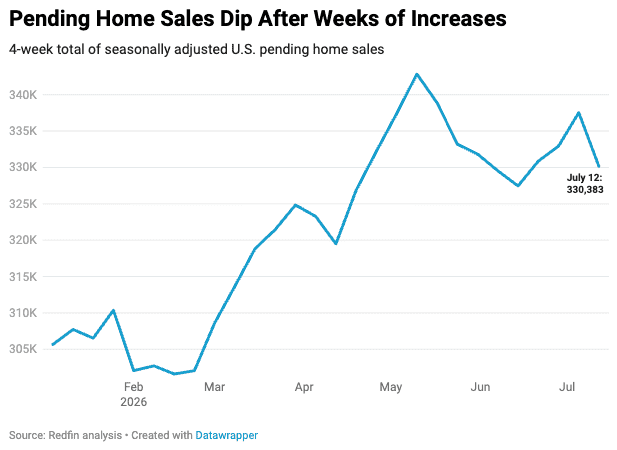
U.S. pending home sales experienced their first decline in a month during the four-week period ending July 12, 2026, as a combination of escalating mortgage rates, record-level housing prices, and sudden geopolitical instability forced many prospective buyers to reconsider their positions. According to the latest market data, pending home sales fell by 2.2% on a week-over-week basis, signaling a cooling trend in a market that has struggled to find a balance between supply and affordability. This downturn in buyer activity was mirrored on the supply side, with new listings dropping 1.2% to their lowest level since the beginning of the year.
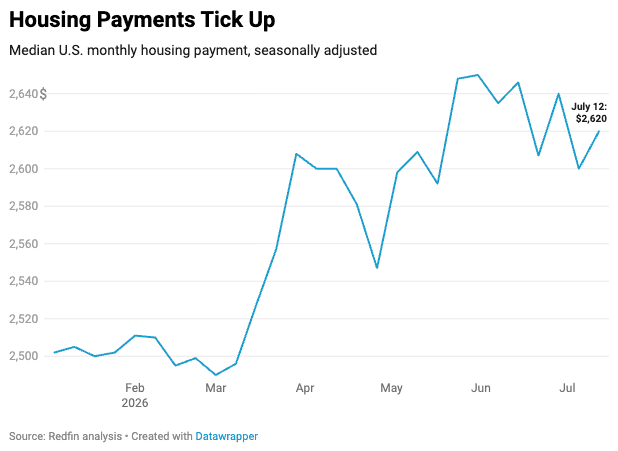
The housing market’s current stagnation is largely attributed to a "double-squeeze" on consumers: the persistent high cost of borrowing and a scarcity of affordable inventory. For the four weeks ending July 12, the median sale price reached $408,804, a figure that sits just $800 below the all-time record. When coupled with a weekly average mortgage rate that climbed back to 6.49%, the financial barrier for the average American family has become increasingly insurmountable. This environment has created a bifurcated market where high-income individuals and retirees remain active, while first-time and middle-income buyers are being pushed to the sidelines.
A Shifting Economic Landscape and Geopolitical Pressures
The recent dip in market activity cannot be viewed in isolation from the broader global economic climate. During the final week of the reporting period, the international community witnessed the collapse of the U.S.-Iran ceasefire, an event that sent shockwaves through the global energy markets. As oil prices jumped in response to the renewed tensions, concerns over a secondary wave of inflation began to permeate the U.S. economy. This uncertainty has a direct correlation with consumer confidence; when energy costs rise and the global outlook turns "shaky," major financial commitments like home purchases are often the first to be deferred.
Simultaneously, the domestic financial landscape showed signs of renewed volatility. While the weekly average 30-year fixed mortgage rate sat at 6.49%, the daily average rate spiked to 6.64% by mid-July—the highest level seen in nearly a year. This rapid fluctuation has made it difficult for buyers to lock in predictable monthly payments. According to data from the Mortgage Bankers Association, mortgage-purchase applications fell by 7% from the previous week, reflecting a 2% decline compared to the same period in 2025. This downward trend suggests that even though search interest remains relatively stable—with Google searches for "homes for sale" up 8% month-over-month—the conversion from "looking" to "buying" is stalling at the financing stage.

The Inventory Crisis and the Seller’s Dilemma
The supply side of the equation offers little relief for the market’s underlying tensions. New listings fell by 1.2% week-over-week, reaching their lowest point since the start of 2026. This contraction in new inventory is driven by a phenomenon often referred to as the "lock-in effect." Many current homeowners are currently paying off mortgages with rates significantly lower than the current 6.5% to 6.6% range. For these individuals, selling their current home would mean taking on a new, much more expensive debt, even if they are "moving up" to a larger property.
Consequently, the total number of active listings has remained largely stagnant, hovering around 1.48 million units. While this represents a marginal 0.6% increase over the previous year, it is far from the level of inventory needed to normalize the market. The current "months of supply" stands at 3.4 months. In real estate terms, a balanced market typically requires four to five months of supply. Anything below this threshold indicates a seller’s market, where the lack of options keeps prices elevated despite lower overall demand.
The lack of fresh inventory is particularly acute in the affordable segment. Real estate professionals report that homes priced under $350,000 are becoming increasingly rare and subject to intense competition when they do appear. This has led to a situation where 32.7% of homes are still going off the market within just two weeks of being listed, despite the overall decline in pending sales volume.
Regional Variations: Growth in the Sunbelt vs. Contraction in the West
The national average masks a significant degree of regional divergence. While the country as a whole saw a decline in activity, certain metropolitan areas continue to see robust growth in both prices and sales volume. West Palm Beach, Florida, led the nation with an 8.5% year-over-year increase in median sale prices, followed closely by San Francisco and Philadelphia, both at 7.2%.
In terms of sales volume, Austin, Texas, showed remarkable resilience with a 13.7% year-over-year increase in pending sales. Other East Coast hubs like Boston and Nassau County, New York, also saw double-digit growth in sales activity. These areas appear to be benefiting from a mix of local economic strength and a slight easing of inventory constraints in specific sub-markets.
Conversely, the Pacific Northwest and parts of the Mountain West are seeing a more pronounced correction. Seattle saw the sharpest decline in prices, with the median sale price falling 4% year-over-year. San Jose followed with a 3.9% decrease. These tech-heavy regions are likely feeling the impact of broader industry shifts and the exhaustion of buyer affordability after years of exponential price growth. Houston, Texas, also experienced a significant hit to demand, with pending sales plummeting 14.4% compared to the previous year, a decline that may be linked to the recent volatility in the energy sector following the breakdown of the U.S.-Iran ceasefire.
Expert Perspectives and Local Market Realities
The challenges facing the modern buyer are perhaps best illustrated by the conditions on the ground in mid-sized markets. Christine Kooiker, a Redfin Premier agent based in Grand Rapids, Michigan, noted that the market has become increasingly difficult for those without significant cash reserves.
"First-time buyers are having a tough time breaking into the market," Kooiker said. "High mortgage rates mean that even homes in the most affordable price point—under $350,000 in the Grand Rapids area—are a stretch for a lot of buyers, and they’re hard to find and competitive."
Kooiker’s observations highlight a growing trend where the only active participants are those at the top of the economic ladder. "High-income buyers and retirees who spend the summer in Michigan are most active, scooping up newly built single-family homes and luxury condos," she added. This shift toward luxury and new construction is a survival mechanism for the industry, as developers focus on higher-margin projects and wealthy buyers remain less sensitive to interest rate hikes.
Chronology of Market Indicators: July 2026
To understand the trajectory of the housing market, it is essential to look at the week-by-week shifts that occurred leading up to the July 12 report:
- Mid-June 2026: Pending sales showed a slight upward trend as mortgage rates dipped to 6.43%, briefly encouraging buyers who had been waiting for a window of opportunity.
- Late June 2026: Median sale prices continued their upward crawl, approaching the $409,000 mark. Inventory remained tight, but touring activity was up 20% from the start of the year.
- July 1–July 8, 2026: Geopolitical tensions escalated. The U.S.-Iran ceasefire officially ended, leading to an immediate jump in Brent Crude prices. Simultaneously, the daily average mortgage rate began to climb.
- July 9–July 12, 2026: The weekly average mortgage rate hit 6.49%. New listings dropped by 1.2%, as homeowners reacted to the economic uncertainty by staying put. Pending sales recorded their first weekly decline in a month, dropping 2.2%.
- July 15, 2026: Post-reporting data showed the daily mortgage rate hitting 6.64%, suggesting that the cooling trend observed in the July 12 report is likely to persist into the latter half of the month.
Broader Implications and Future Outlook
The current data suggests that the U.S. housing market is entering a period of "wait-and-see" volatility. The primary concern for economists is whether the current decline in pending sales is a temporary reaction to a bad news cycle or the beginning of a deeper structural shift in demand.
One of the more telling metrics is the "Share of home listings with price drops," which currently stands at 19.8%. While this is down from 21% a year ago, it indicates that nearly one-fifth of sellers are still having to adjust their expectations to meet the reality of what buyers can afford. However, the "Average sale-to-list price ratio" remains high at 99.1%, meaning that when a home is priced correctly for the current environment, it still commands nearly its full asking price.
The broader impact of this market behavior extends beyond real estate. A stagnant housing market often leads to reduced spending on home improvements, furniture, and appliances, which can have a cooling effect on the wider retail economy. Furthermore, if first-time buyers continue to be locked out of homeownership, the long-term wealth gap could widen, as a generation misses out on the equity-building potential of residential property.
As the market moves into the late summer and autumn months, all eyes will be on the Federal Reserve and the geopolitical situation in the Middle East. If energy prices continue to rise and inflation remains sticky, mortgage rates are unlikely to see a significant retreat. Without a meaningful influx of new listings or a reduction in borrowing costs, the U.S. housing market appears destined to remain in a state of low-volume, high-price equilibrium, where only the most affluent can comfortably participate.