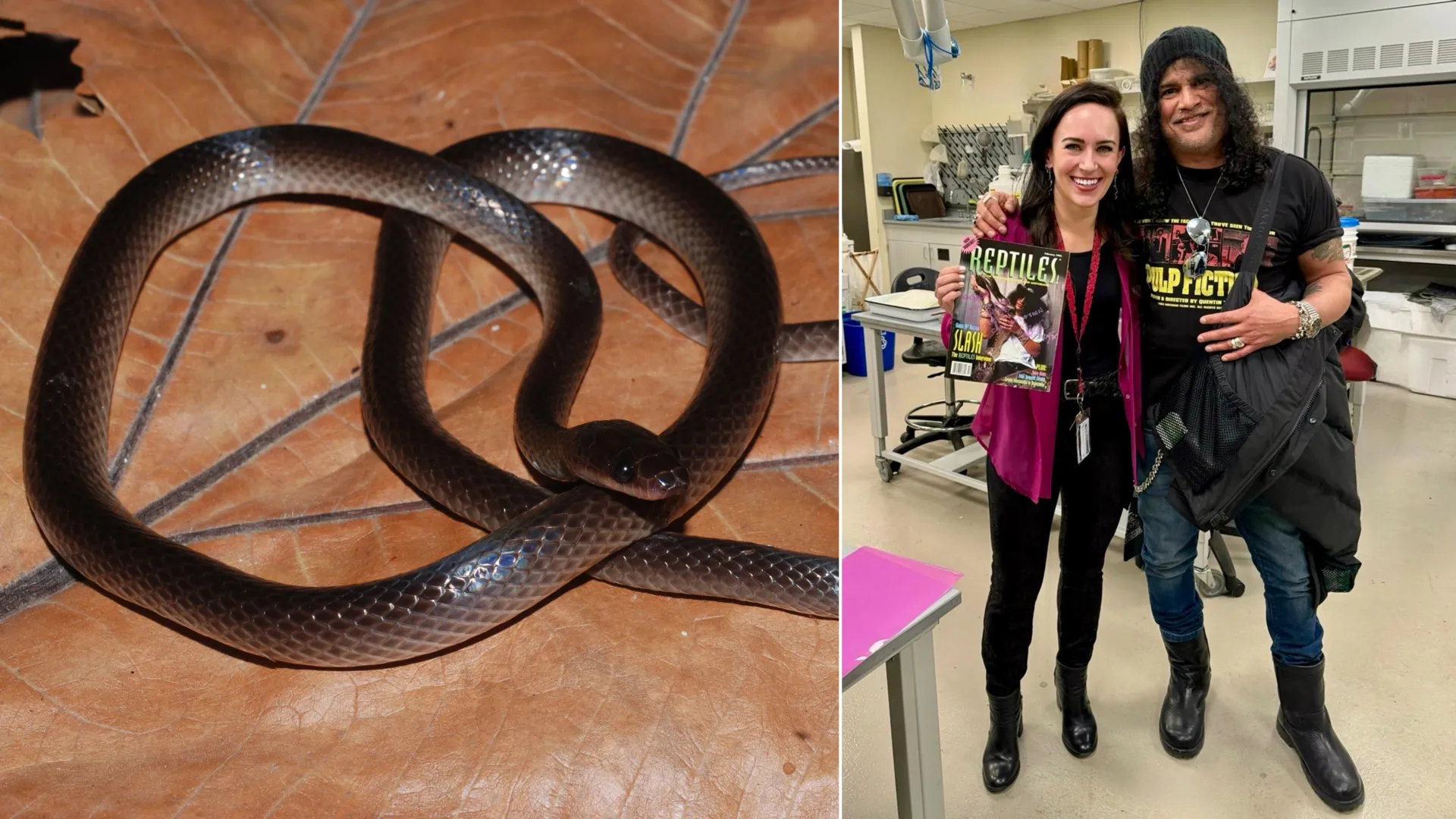
The legendary guitarist Saul Hudson, known globally by his stage name Slash, has traded his signature top hat and Gibson Les Paul for a permanent place in the annals of biological taxonomy. In a remarkable intersection of rock-and-roll culture and academic zoology, a team of researchers led by the Field Museum has formally identified a new species of snake discovered in the dense, biodiverse forests of New Guinea. The species, scientifically classified as Lielaphis slashi and commonly referred to as Slash’s groundsnake, serves as both a testament to the guitarist’s lifelong passion for herpetology and a critical reminder of the urgent need for biodiversity conservation in the Pacific.
The discovery, published in the peer-reviewed journal Zootaxa, is the result of years of collaborative fieldwork and sophisticated genetic analysis. For Slash, who has long been a vocal advocate for zoos, museums, and the protection of reptilian habitats, the honor is a career milestone that transcends his musical achievements.
A Chronology of Discovery: From the Field to the Laboratory
The journey of Lielaphis slashi began long before it was formally recognized. The genesis of this identification dates back to a 2006 nocturnal expedition led by Dr. Chris Austin, a professor and curator of herpetology at the Louisiana State University Museum of Natural Science. While navigating the rugged, tropical terrain of New Guinea—the world’s second-largest island and a bastion of undocumented biological complexity—Austin encountered a specimen that defied standard classification.
The specimen, a reddish-brown, 28-inch-long snake, remained a subject of investigation for years. It was not until 2016, when Dr. Sara Ruane—the Field Museum’s Associate Curator of Herpetology and the study’s senior author—began collaborating with Austin at LSU, that the team possessed the resources and longitudinal data necessary to definitively distinguish the animal from its known relatives.
The research team employed a multi-faceted approach to verify the species, utilizing cutting-edge genomic sequencing to map the snake’s evolutionary lineage. Dr. Tianqi Huang, the study’s first author and a post-doctoral researcher at the Field Museum, spearheaded the laboratory analysis. According to the team’s findings, Lielaphis slashi exhibits distinct genetic markers and morphological variations—specifically in scale count and anatomical structure—that set it apart from other members of its genus. Beyond physical traits, the researchers utilized ecological modeling to establish that the species occupies a unique environmental niche, further confirming its status as a distinct biological entity.
The Intersection of Music and Herpetology
The decision to name the species after Slash was not merely a gesture of fan appreciation; it was rooted in a shared appreciation for natural history. Dr. Ruane, who grew up listening to Guns N’ Roses, recalls being influenced by a 1990s cover of Reptiles Magazine that featured the guitarist posing with a reticulated python.
"Guns N’ Roses has been one of my favorite bands since I was in first grade, and by fifth grade, I had already told my teacher that I wanted to be a herpetologist," Ruane explained. Years later, while reviewing historical interviews with the artist, she discovered that Slash’s childhood was defined by the same curiosity that drives modern field biologists. His long-standing commitment to natural history institutions provided a compelling narrative bridge between the world of international touring and the quiet, meticulous work of taxonomy.
In response to the news, Slash expressed a sense of profound humility. "As a long-time herpephile, I am extremely honored and humbled to have Lielaphis slashi from New Guinea named after me," the guitarist stated. "It is really exciting; I never would have imagined this moment would arrive."
Biological Context and Behavioral Insights
Lielaphis slashi is a nocturnal predator, a trait that makes it particularly elusive to researchers. As Dr. Austin noted during the initial discovery, finding such species in New Guinea requires both expertise and extreme caution. The region is home to a high concentration of venomous snakes, many of which share superficial physical characteristics with the non-venomous groundsnakes of the Lielaphis genus.
Despite its connection to a band often described as the "most dangerous in the world," the snake itself is harmless to humans. It does not possess the complex venom delivery systems found in its more hazardous neighbors. Instead, its anatomy suggests a specialized diet. The snake features large, recurved teeth in the rear of its mouth, which scientists believe are adapted for securing slippery prey, such as small lizards and reptilian eggs. Unlike constrictors, which exert pressure to subdue their food, Lielaphis slashi appears to rely on these specialized dental structures to manage prey within the confines of the forest floor.
Biodiversity, Habitat Loss, and Conservation Implications
The formal identification of Lielaphis slashi is more than a taxonomic update; it is an alarm bell regarding the status of New Guinea’s ecosystem. The island is currently facing significant ecological pressure, driven by the expansion of industries such as mining and large-scale coffee farming.
"The habitats that Slash’s groundsnake is from are under threat," Dr. Ruane stated. "That’s part of why describing the species that live there is important. Every species should be recognized in order for us to better understand how ecosystems work, how everything fits into the environment. We can’t conserve animals or other living things that we don’t know about."
The study highlights the broader reality of global biodiversity loss. Scientists estimate that a significant percentage of the world’s reptile species remain undescribed by science, and many of these creatures may face extinction before they are ever formally recorded. By cataloging species like Lielaphis slashi, researchers are building a foundational dataset that can be used to advocate for protected status in areas targeted for industrial development.
The Broader Impact: Why Taxonomy Matters
The collaboration between institutions such as the Field Museum, the Louisiana State University Museum of Natural Science, the Papua New Guinea National Museum and Art Gallery, and the Virginia Museum of Natural History underscores the international nature of modern conservation science. The paper in Zootaxa represents a synthesis of contributions from experts across the globe, including Justin Bernstein of Slippery Rock University, Bulisa Iova, and Jackson Roberts.
The naming of the snake also highlights the role of public figures in fostering scientific interest. By associating the name of a globally recognized icon with a specific, endangered species, the researchers have managed to draw public attention to a field—herpetology—that is often overlooked in mainstream discourse.
For the scientific community, the legacy of Lielaphis slashi will be measured in data points, habitat maps, and conservation policy. For the public, it serves as a reminder that the natural world is still full of mysteries waiting to be solved. As the forests of New Guinea continue to change, the recognition of this single, 28-inch-long snake provides a small, but vital, anchor for future efforts to preserve the delicate balance of one of the world’s most mysterious and biologically diverse landscapes. The marriage of rock history and biological science serves as a poignant reminder: even in a world of high-speed change, there is still much to discover, and even more to protect.