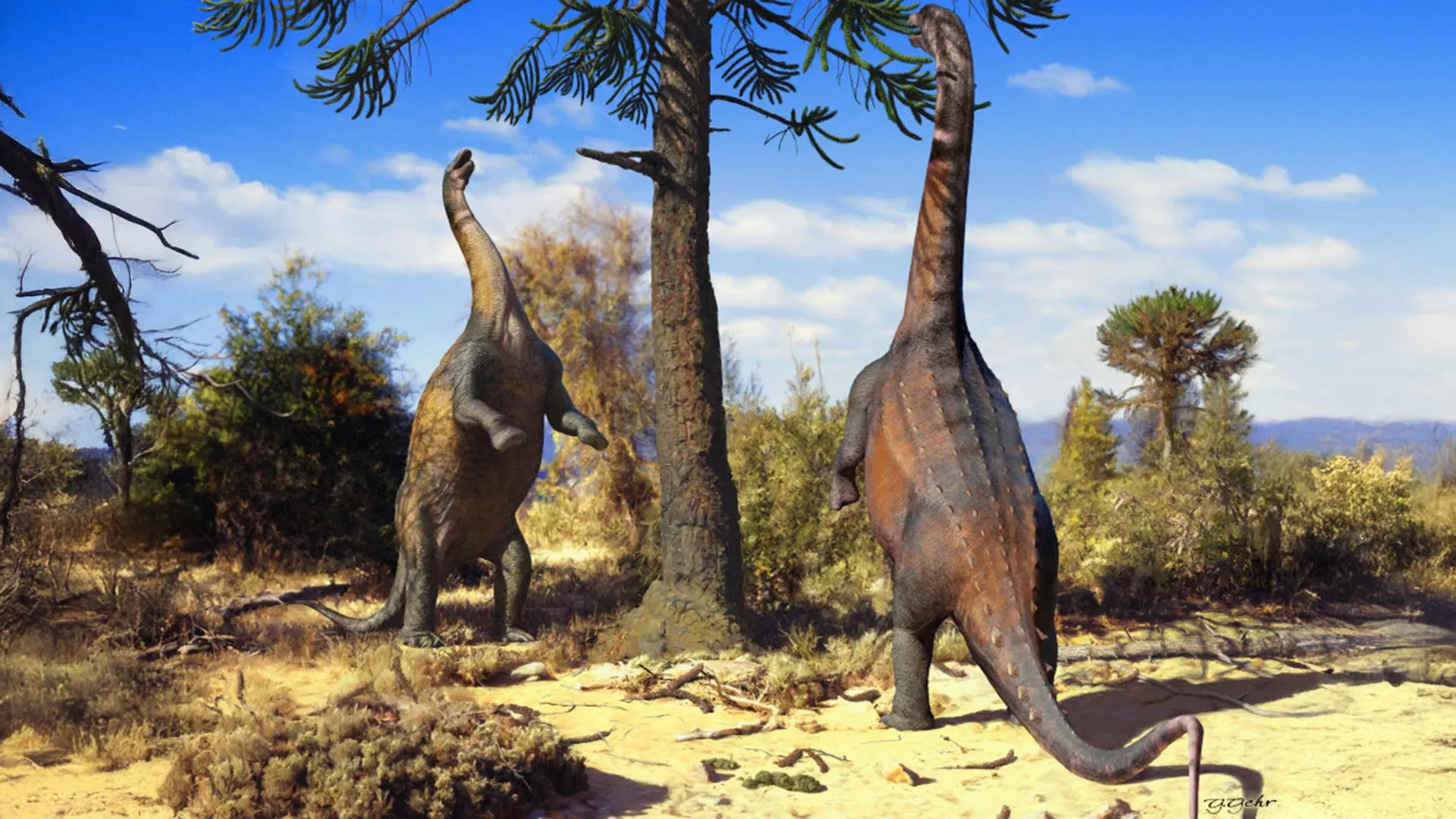
Some long-necked dinosaurs may have been far more capable of standing upright than their enormous bodies suggest. New research employing sophisticated engineering simulations on fossilized bones indicates that certain South American sauropods, even with their immense size, possessed a remarkable ability to balance on their hind legs, particularly during their youth. This newfound understanding challenges previous assumptions about the biomechanical limitations of these colossal herbivores and offers fresh insights into their behavior and survival strategies during the Late Cretaceous period, approximately 66 million years ago.
The focus of this groundbreaking study is on two distinct sauropod species: Uberabatitan from Brazil and Neuquensaurus from Argentina. While not reaching the gargantuan proportions of some of their more famous sauropod relatives, these dinosaurs were still substantial, comparable in size to modern-day elephants. Adult Uberabatitan individuals, in particular, are estimated to have reached lengths of up to 26 meters, solidifying their status as the largest known dinosaurs unearthed in Brazil. The findings, published in the esteemed journal Palaeontology, are the result of a collaborative effort involving an international team of scientists from Brazil, Germany, and Argentina, with significant support from the São Paulo Research Foundation (FAPESP).
Engineering Dinosaur Bones: A Novel Approach to Biomechanics
Traditionally, understanding how extinct animals moved and supported their weight has relied heavily on anatomical comparisons and inferred muscle mass. However, this new research ventures into uncharted territory by applying computational engineering techniques, specifically finite element analysis (FEA), to dinosaur femurs. FEA is a powerful numerical method widely utilized by engineers to simulate the behavior of structures under various loads and stresses. By dissecting digital reconstructions of fossilized bones into millions of tiny elements, researchers can meticulously calculate how each component responds to forces, offering a detailed picture of stress distribution.
The primary objective of this engineering-centric approach was to quantify the forces exerted on the femur, or thigh bone, when these dinosaurs shifted their weight onto their hind legs. This analysis aimed to determine the biomechanical feasibility and strain experienced during bipedal locomotion.
"Smaller sauropods like these had a bone and muscle structure that allowed them to stand more easily and for longer on their two hind legs," explains Julian Silva Júnior, a postdoctoral researcher at the School of Engineering of São Paulo State University (FEIS-UNESP) in Ilha Solteira, Brazil, and the study’s lead author. "Larger ones were probably also able to stand, but for a shorter time and with less comfort, since the position caused a lot of stress on the femur." Silva Júnior conducted this pivotal research during an internship at the University of Tübingen in Germany, supported by a FAPESP scholarship.
The research team meticulously created digital reconstructions of the femurs from seven different sauropod species. This selection represented a diverse range of evolutionary branches, body sizes, and anatomical features, drawing from fossil specimens housed in natural history museums across the globe. The careful selection ensured a comprehensive comparative analysis, allowing the researchers to draw broader conclusions about sauropod bipedalism.
Simulating the Stresses of Standing: Extrinsic and Intrinsic Forces
The finite element analysis was employed to conduct two distinct simulations. The first simulation focused on the "extrinsic scenario," which modeled the forces acting on the femur from an external source. This primarily involved the pull of gravity and the sheer body weight of the dinosaur as it balanced on its hind limbs. The second simulation delved into the "intrinsic scenario," analyzing the forces generated by the dinosaur’s own muscles as they contracted and exerted pressure on the femur to maintain an upright posture.
"Using this technique, we performed two simulations," Silva Júnior elaborates. "One dealt with the extrinsic scenario, simulating the force coming from outside to inside. In this case, gravity and the animal’s own weight on the femur when the dinosaur was standing on its hind legs. In the other, we analyzed the intrinsic scenario, the force that the muscles would exert on the femur."
By integrating the results of both simulations, the scientists were able to calculate the total stress experienced by the femur in each of the studied sauropod species. This combined analysis provided a robust estimation of the biomechanical challenges associated with bipedal standing.
South American Giants Show Remarkable Resilience
The results of these simulations revealed a striking pattern: the lowest stress levels on the femur were observed in the two South American sauropods, Uberabatitan ribeiroi and Neuquensaurus australis. The specimen of Uberabatitan ribeiroi examined was a juvenile, named after the Brazilian municipality of Uberaba where it was discovered, and coincidentally, Silva Júnior’s hometown. Neuquensaurus australis, found near the Neuquén River in Argentina, also contributed to this significant finding. Both species roamed the Earth during the Late Cretaceous period, approximately 66 million years ago, a time of significant ecological change leading up to the K-Pg extinction event.
The researchers attributed the superior stress-dissipating capabilities of these two species to the remarkable robustness of their femurs. Their thigh bones were notably thicker and sturdier than those of many other sauropods, allowing them to effectively spread and manage the significant forces generated during bipedal standing.
"They had more robust femurs and could dissipate stress better," states the paleontologist. "The bigger ones had very large muscles and even giant femurs, but not enough to support their weight. That doesn’t mean they couldn’t stand up, but they probably chose the best time to do so, because it must have been an uncomfortable position."
Age and Size as Determinants of Bipedal Capability
A crucial element of the study’s findings is the apparent correlation between age and the ability to stand upright. The simulations strongly suggest that younger, smaller individuals of these species were significantly more adept at supporting themselves on their hind legs for extended periods. As they grew and their body mass increased, the strain on their femurs would have amplified considerably.
While larger sauropods might still have possessed the physical capability to rise onto their hind legs, the simulations indicate that they could not maintain this posture as comfortably or for as long as their younger counterparts. The immense weight of adult sauropods would have placed them under considerable stress, making prolonged bipedalism a potentially taxing endeavor.
This principle also likely applied to adult Uberabatitan individuals. Although the juvenile Uberabatitan specimen in the study demonstrated excellent bipedal capabilities, fully grown adults would have carried substantially more mass. This increased weight would have subjected their femurs to stress levels more akin to those experienced by other giant sauropods, potentially limiting their ability to stand upright for extended durations.
The Multifaceted Advantages of Bipedalism in Sauropods
The capacity for sauropods to stand on their hind legs, even for short periods, would have conferred several significant evolutionary advantages. As herbivores, reaching high-lying vegetation would have been a primary benefit. By extending their necks and rising onto their hind legs, they could access foliage that was out of reach for shorter herbivores, expanding their dietary options and potentially reducing competition.
Reproductive strategies may also have been influenced by bipedalism. For male sauropods, standing upright could have facilitated mounting females during mating. Furthermore, visual displays, where individuals appeared larger and more imposing, could have played a crucial role in courtship rituals and attracting mates.
In terms of defense, an upright posture would have been a formidable deterrent. By lifting their massive bodies and extending their necks, sauropods could have presented a much larger and more intimidating silhouette to potential predators. This enhanced visual presence could have been enough to dissuade an attack from less determined carnivores. When combined with the tail acting as a third point of support, creating a tripod stance, these dinosaurs would have presented a stable and imposing figure.
Limitations and Future Directions in Biomechanical Research
Despite the remarkable insights gained from this FEA study, the researchers acknowledge certain limitations inherent in their models. Crucially, the simulations did not explicitly account for the role of cartilage, the flexible connective tissue that cushions joints and plays a vital role in absorbing and distributing stress. The absence of this crucial element means that the calculated stress levels might be slightly higher than what was experienced in reality.
Furthermore, the models did not incorporate the stabilizing contribution of the tail when the dinosaur adopted a tripodal stance. The tail would have provided significant support, potentially reducing the load on the hind limbs and pelvis.
Given that cartilage was not analyzed in any of the seven examined specimens, the researchers made a simplifying assumption that it would have played a similar functional role across all species. This means that the study is particularly effective for comparative purposes, allowing for a robust comparison of stress distribution among different sauropod species, rather than providing precise, absolute stress values for each individual animal.
"The tool we use is very efficient for comparisons, even if the answer isn’t exact for each one," Silva Júnior concludes. "By comparing representatives from different lineages, we can get a fairly accurate picture of how these animals behaved millions of years ago."
This innovative application of engineering principles to paleontology opens exciting avenues for future research. By refining these models to include more anatomical structures and considering a wider range of fossil specimens, scientists can continue to unravel the complex biomechanics of these magnificent extinct creatures, painting an ever-clearer picture of their lives and behaviors millions of years in the past. The findings underscore the fact that even the most colossal of Earth’s former inhabitants may have possessed a more dynamic and agile existence than previously imagined.