The American real estate market is undergoing a fundamental transformation as environmental concerns and public health risks reshape the priorities of prospective homeowners. According to a comprehensive new study released by Redfin and conducted by Ipsos in May 2026, the modern house hunter is no longer primarily driven by the allure of status-symbol luxuries like home theaters or wine cellars. Instead, a new "essentials" list has emerged, topped by high-end air and water filtration systems—features that define the growing "clean home" movement.
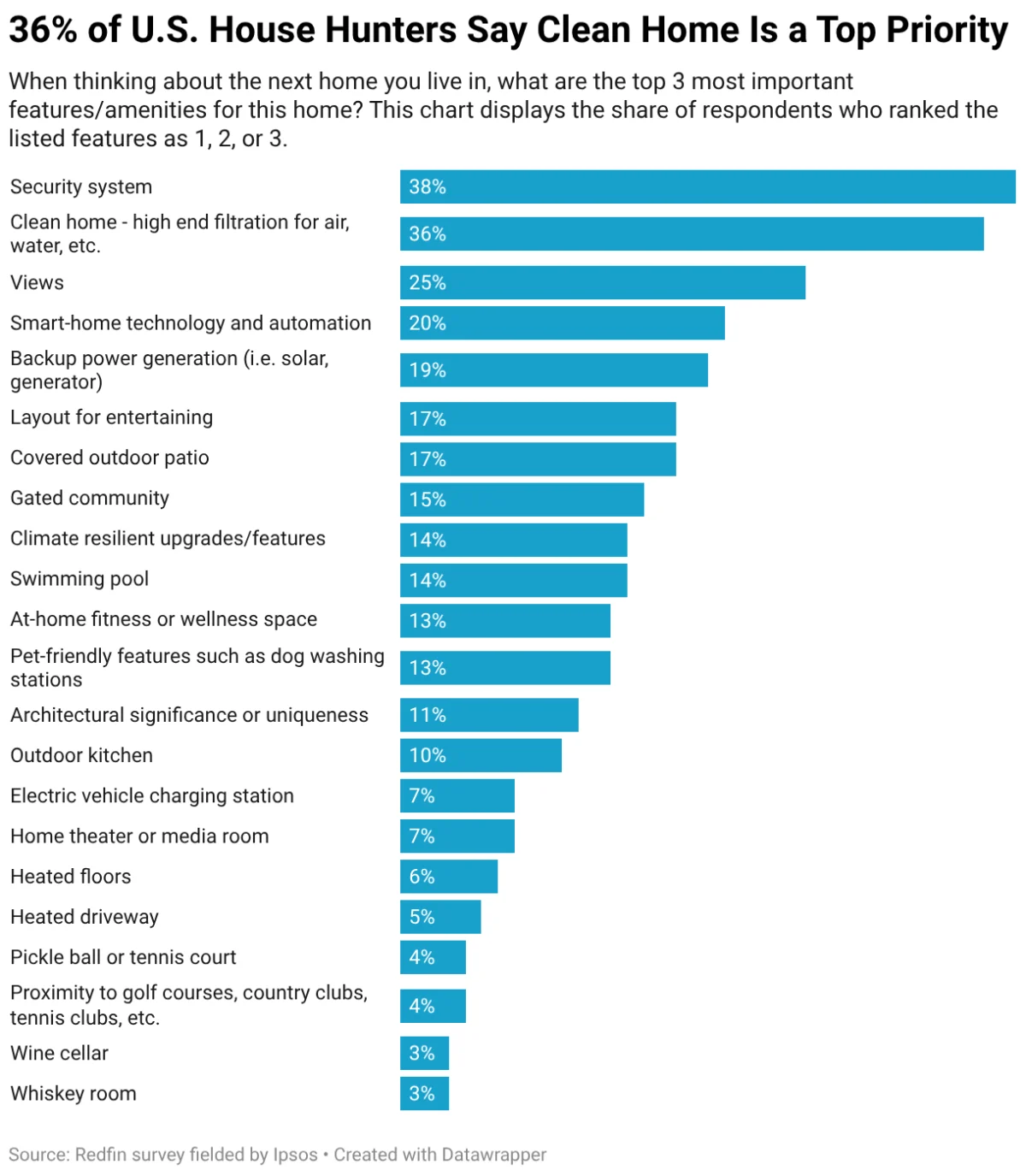
The survey, which gathered data from 4,000 U.S. residents and focused on approximately 1,000 active house hunters planning to move within the next year, reveals that 36% of respondents rank "clean home" features as one of their top three most important considerations. This figure places advanced filtration systems on equal footing with home security systems, which were cited by 38% of respondents. Together, these two categories represent a significant shift toward "defensive" homeownership, where the primary function of a dwelling is to act as a fortress against external environmental and societal threats.
The Hierarchy of Modern Home Amenities
For decades, the standard for a "dream home" was defined by aesthetic appeal and recreational extras. However, the 2026 data suggests those priorities have been inverted. While 36% of buyers demand clean air and water, only 7% prioritize home theaters, 10% look for outdoor kitchens, and a mere 4% seek out tennis or pickleball courts. This disparity highlights a growing pragmatism among Americans who are increasingly focused on the biological and environmental safety of their living spaces.
Following clean homes and security systems, "views" remain a significant draw, with 25% of buyers ranking them in their top three. Smart-home technology and automation (20%) and backup power generation (19%)—including solar panels and integrated generators—round out the top five priorities. The inclusion of backup power in the top five further reinforces the trend of self-sufficiency, as buyers prepare for potential grid instabilities caused by extreme weather events.
Climate-resilient upgrades, such as reinforced roofing, flood barriers, and fire-resistant siding, were cited as a top priority by 14% of respondents. While this is lower than the demand for air filtration, it still outranks traditional luxury features, suggesting that the "wellness and resilience" sector of the real estate market is now outperforming the "luxury and leisure" sector.
The Catalyst: A Summer of Environmental Crisis
The timing of the report’s release coincides with a period of intense environmental stress in the United States. In July 2026, massive wildfire smoke plumes originating from hundreds of active blazes in Canada blanketed the eastern half of the U.S., creating a public health emergency. This event served as a visceral reminder that environmental hazards are no longer localized issues; they are mobile and pervasive.
By July 17, 2026, more than 100 million people across eighteen states and the District of Columbia were under air quality alerts. Major metropolitan areas in Minnesota, Ohio, Illinois, Indiana, and Michigan recorded some of the worst air quality metrics in the nation’s history. Even regions typically insulated from wildfire effects, such as New York and New England, experienced "unhealthy" to "hazardous" air conditions.
This recurring phenomenon has fundamentally altered the consumer psyche. While the Redfin survey was conducted in May—prior to the peak of the July smoke events—the results indicate that the anticipation of such events was already baked into buyer behavior. The "clean home" is no longer a niche preference for the immunocompromised or the ultra-wealthy; it has become a baseline requirement for the middle-class American family.
Economic Implications and Expert Analysis
Redfin Chief Economist Daryl Fairweather notes that the shift toward high-end filtration is a direct response to the "new normal" of the American climate. "As wildfire smoke becomes more common, filtered indoor air is becoming a must-have rather than a nice-to-have," Fairweather stated. She suggests that this trend will eventually influence the very architecture of new developments.
"Homebuyers are already looking for homes that can protect their families during smoke events. In the near future, I expect buyers searching for single-family homes will also be looking for larger homes with versatile indoor space, where they can entertain themselves when smoke forces them inside," Fairweather added.
This "indoor-centric" lifestyle could also reshape the condominium market. In urban centers where outdoor space is limited, prospective buyers are likely to prioritize buildings that offer high-grade HVAC systems and extensive indoor amenities, such as air-purified gyms and event rooms, allowing for a high quality of life even when outdoor conditions are hazardous.
Generational Divides in Home Preferences
The demand for clean and secure homes is particularly pronounced among younger generations, who are statistically more likely to view climate change as a direct threat to their long-term health and financial stability.
Gen Z and Millennials: The Health-Conscious Cohorts
For Gen Z (born roughly between 1997 and 2012), the "clean home" is a top-tier priority, with 40% ranking it in their top three. This generation also places the highest value on security systems (42%). Millennials follow closely, with 37% prioritizing filtration systems—tying with security as their number one concern. For these groups, the home is a sanctuary that must provide a controlled environment.
Younger buyers are also more interested in smart-home technology (21% for both groups) and backup power generation (20% for Millennials). These cohorts are the most active in addressing climate change through personal action, and their home-buying choices reflect a desire to mitigate their environmental footprint while protecting themselves from its consequences.
Gen X and Baby Boomers: Security and Scenery
Gen X respondents showed a slightly different profile, prioritizing security systems (32%) and clean homes (25%), but also showing a strong interest in layouts for entertaining (24%) and swimming pools (23%). For Gen X, the home remains a social hub, though the need for protection is still evident.
Baby Boomers represent the most significant outlier in the data. For this generation, "views" are the absolute priority, with 47% ranking them in the top three. This is nearly double the rate of any other generation. However, even Boomers are not immune to the "clean home" trend; 35% cited filtration systems as a top priority, ranking it third behind security systems (40%).
The Decline of Traditional Status Symbols
The 2026 data reveals a startling decline in the perceived value of features that were once the hallmarks of luxury real estate. Wine cellars (3%), whiskey rooms (3%), and electric vehicle (EV) charging stations (7%) all ranked near the bottom of the list. Even the "pickleball craze" appears to have a limited impact on home-buying priorities, with only 4% of respondents seeking dedicated courts.
This shift suggests that "luxury" is being redefined. In the 20th century, luxury was defined by excess and exclusivity. In the mid-2020s, luxury is increasingly defined by "purity"—clean air, pure water, and uninterrupted power. A home with a state-of-the-art HEPA filtration system and a Tesla Powerwall is now seen as more "luxurious" and desirable than one with a gilded dining room or a specialized wine storage facility.
Chronology of the Shift (2020–2026)
To understand the 2026 data, one must look at the timeline of events that led to this psychological pivot in the American market:
- 2020-2022: The COVID-19 pandemic heightens global awareness of indoor air quality and ventilation. "Aerosol transmission" becomes a household term, and homeowners begin investing in portable HEPA filters.
- 2023: A massive Canadian wildfire season sends smoke into the U.S. Northeast and Midwest, turning skies orange in New York City and triggering the first major wave of "air quality anxiety" among the general public.
- 2024-2025: Insurance companies begin pulling out of high-risk climate zones (California, Florida), forcing homeowners to consider "resilience" as a financial necessity rather than an optional upgrade.
- May 2026: Redfin’s survey captures a market that has fully internalized these risks, with 36% of buyers prioritizing filtration.
- July 2026: A repeat of the wildfire smoke emergency reinforces the survey’s findings, solidifying the "clean home" as a permanent fixture of the real estate landscape.
Methodology and Statistical Validity
The data presented in this report is derived from a rigorous methodology. The survey was fielded to 4,000 U.S. residents, providing a broad cross-section of the population. The specific focus on the 1,000 respondents planning to move within the next 12 months ensures that the data reflects the current intentions of active market participants rather than theoretical preferences.
The credibility interval for the results is +/-3.9 percentage points, making the tie between "clean homes" (36%) and "security systems" (38%) statistically significant. Respondents were asked to select exactly three options from a list of 22 features, forcing them to make difficult trade-offs that reveal their true priorities.
Future Implications for the Real Estate Industry
The "clean home" trend is likely to have long-lasting effects on the construction and renovation industries. Homebuilders who once focused on granite countertops and open floor plans as selling points may need to pivot toward "whole-house" filtration and medical-grade air purification systems.
Furthermore, the valuation of homes may begin to factor in "Environmental Health Scores." Just as "Walk Scores" and "School Ratings" influence property values today, the quality of a home’s built-in filtration and its resilience to climate events could become a standard metric in real estate appraisals. For sellers, an investment in a high-end water filtration system or a solar backup array may now offer a higher return on investment (ROI) than a kitchen remodel or a bathroom upgrade.
In a world where the outdoor environment is increasingly unpredictable, the American home is evolving into a life-support system. The 2026 Redfin survey serves as a definitive marker of this evolution, signaling the end of the "amenity era" and the beginning of the "resilience era."