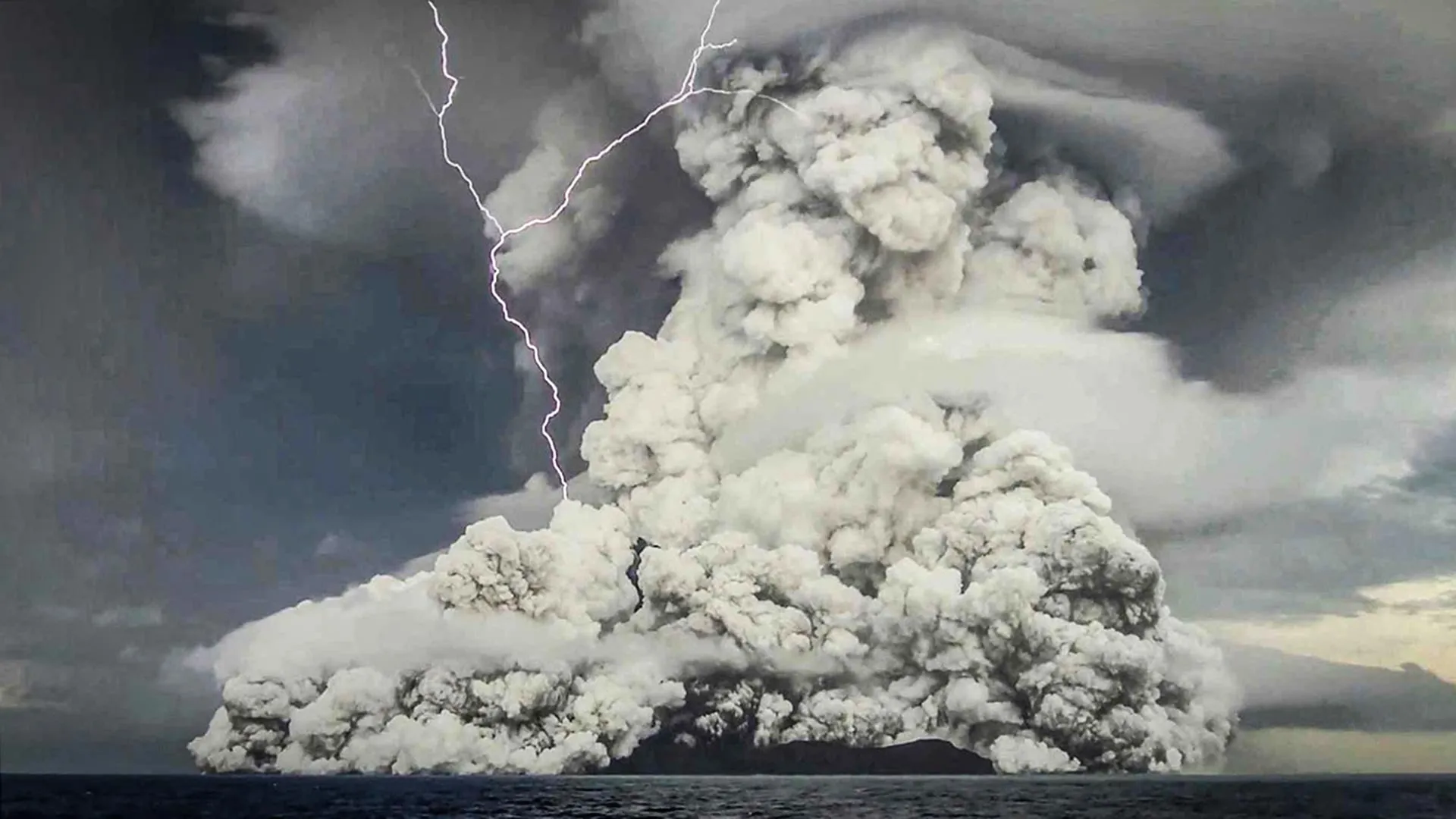
When the submarine volcano Hunga Tonga-Hunga Ha’apai erupted in the South Pacific in January 2022, it unleashed one of the most violent geological events of the modern era. The explosion sent a shockwave around the globe and injected an unprecedented amount of water vapor—enough to fill 58,000 Olympic-sized swimming pools—into the stratosphere. However, as the dust settles on the physical wreckage of the event, atmospheric scientists have uncovered an unexpected silver lining: the massive volcanic cloud appears to have acted as a chemical reactor, actively scrubbing methane, a potent greenhouse gas, from the atmosphere.
This discovery, recently published in the journal Nature Communications, challenges conventional wisdom regarding volcanic emissions. While volcanoes are traditionally viewed as sources of atmospheric pollutants, this study suggests that under specific conditions, the interplay between volcanic ash, seawater, and solar radiation can initiate a self-cleansing chemical process that neutralizes methane molecules.
A Chronology of the Event and Discovery
The eruption began in earnest on January 15, 2022, following a period of heightened activity. The cataclysmic blast reached the stratosphere, the second layer of Earth’s atmosphere, carrying with it a cocktail of volcanic ash and salty seawater. As the plume drifted across the Pacific and toward South America, it remained in the focus of the European Space Agency’s Sentinel-5P satellite.
Researchers monitoring the data from the satellite’s TROPOMI (TROPOspheric Monitoring Instrument) noticed a highly anomalous chemical signature: a record-high concentration of formaldehyde. In atmospheric chemistry, formaldehyde serves as a fleeting "fingerprint." It is a transient byproduct created during the oxidation of methane. Because formaldehyde has a short atmospheric lifespan—lasting only a few hours—its sustained presence within the drifting plume indicated that a continuous, large-scale chemical reaction was destroying methane for at least 10 days as the cloud moved across the ocean.
The Chemistry of Iron Salt Aerosols
The process responsible for this phenomenon involves a sophisticated sequence of chemical reactions that experts are only beginning to fully characterize. The foundation for this discovery was laid in 2023, when researchers identified that mineral dust from the Sahara, when mixed with sea salt from breaking waves, forms "iron salt aerosols."
When sunlight hits these microscopic particles, it triggers the release of chlorine atoms. Chlorine is exceptionally reactive; it functions as an oxidant, attacking methane molecules and breaking them down into simpler components. The Hunga Tonga eruption effectively replicated this process on a massive scale. Because the volcano was submerged, the eruption acted as a high-pressure pump, blasting vast quantities of saltwater into the stratosphere, where it mixed with pulverized volcanic ash.
The resulting aerosol mixture, irradiated by intense sunlight at high altitudes, created a localized "factory" for chlorine atoms. This chemistry, previously observed only in the lower troposphere, was found to be highly effective in the stratospheric conditions of the volcanic plume, offering a new pathway for methane removal that scientists had not previously factored into global climate models.
Quantifying the Methane Budget
The implications for the global methane budget are significant. The methane budget is the accounting framework used by climatologists to track sources—such as cattle, wetlands, and fossil fuel extraction—against sinks, the processes that remove methane from the air.
According to the study’s calculations, the Hunga Tonga eruption released approximately 300 gigagrams (Gg) of methane. To put this in perspective, that volume is comparable to the annual methane output of over two million cows. However, the plume also demonstrated a remarkable removal rate, scrubbing roughly 900 megagrams (Mg) of methane per day. This suggests that the "cleaning" effect was substantial enough to offset a significant portion of the volcanic emissions.
Professor Matthew Johnson of the University of Copenhagen, a co-author of the study, emphasized that this finding necessitates a recalibration of atmospheric data. "We now know that atmospheric dust, including that from volcanic eruptions, impacts the methane budget," Johnson noted. "Because this variable has not been fully accounted for in previous estimates, there is a clear need to refine the data models that define how methane circulates and is sequestered in the atmosphere."
The Urgent Need for Methane Mitigation
Methane is a critical target in the fight against climate change. While it is less abundant in the atmosphere than carbon dioxide, it is roughly 80 times more potent at trapping heat over a 20-year period. Its atmospheric lifetime is relatively short—approximately 10 years—meaning that any reduction in methane levels provides a nearly immediate "emergency brake" on global warming.
While carbon dioxide remains the primary driver of long-term climate change, methane reduction offers a way to mitigate the risk of hitting dangerous warming tipping points in the near term. The discovery that natural processes can accelerate methane breakdown has sparked interest in the burgeoning field of atmospheric methane removal.
Technological Implications and Future Research
The study has prompted discussions about whether human intervention could replicate this natural chemistry. If engineers could safely generate iron salt aerosols to mirror the effect observed in the Tonga plume, it might be possible to stimulate methane removal on a global scale.
However, experts urge caution. Dr. Jos de Laat, a senior researcher at the Royal Netherlands Meteorological Institute, highlighted the difficulty of measuring such interventions. "How do you prove that methane has been removed from the atmosphere at scale?" he asked. The study provides a partial answer: by utilizing satellite instruments like TROPOMI, scientists have a proven method for monitoring the chemical signatures of methane destruction from space, allowing for verifiable data collection that could support future climate mitigation strategies.
The researchers stress that any attempt to manipulate atmospheric chemistry would require exhaustive safety analysis. The goal is not to find a "silver bullet" to replace the need for decarbonization, but rather to identify additional tools to manage the climate crisis. As Dr. Maarten van Herpen, lead author of the study, noted, "It is known that volcanoes emit methane, but until now, it was not known that volcanic ash is also capable of partially cleaning up this pollution."
A New Chapter in Atmospheric Science
The success of this study relied on the meticulous work of an international team, including researchers from the Royal Belgian Institute for Space Aeronomy and the Spanish National Research Council (CSIC). Their ability to extract signal from noise—specifically, correcting TROPOMI data for the extreme altitude of the plume and the interference of sulfur dioxide—was vital to the study’s credibility.
As the scientific community continues to analyze the aftermath of the Hunga Tonga eruption, the event stands as a stark reminder of the complexity of Earth’s atmosphere. It has provided a unique, large-scale laboratory that may eventually lead to a better understanding of how nature manages greenhouse gases, and how humanity might one day emulate those processes to protect the climate.
While the path toward deliberate atmospheric methane removal remains theoretical and fraught with technical challenges, the "Tonga Blueprint" has shifted the paradigm. It has moved the conversation from whether such a mechanism could exist to how it might be harnessed, verified, and safely integrated into the broader strategy of global climate stabilization. For now, the researchers are focused on further refining their satellite-based observation methods, ensuring that the next time a major event occurs, they are ready to capture every detail of the chemistry unfolding in the skies.