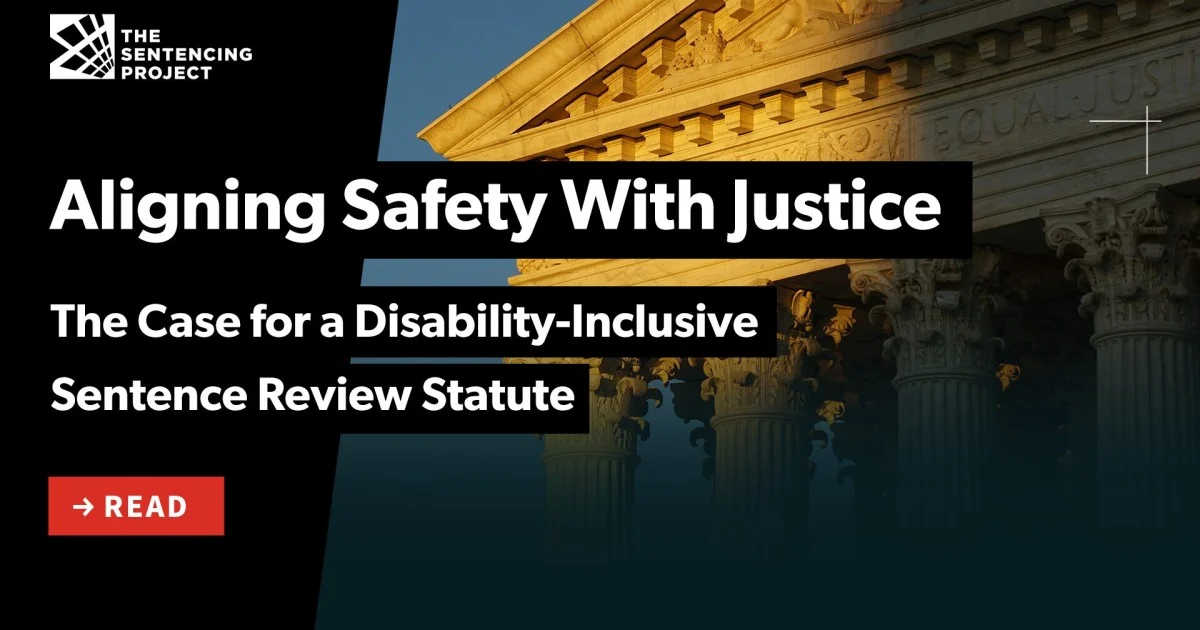
The United States criminal legal system is currently facing a critical reckoning regarding the treatment of incarcerated individuals with physical, cognitive, and social disabilities. Data from The Sentencing Project reveals a stark reality: individuals with impairments are significantly overrepresented in jails and prisons, comprising 38% of the incarcerated population compared to only 15% of the general public. In response to these disparities, the organization has unveiled a proposal for "disability second look" statutes—legislative frameworks designed to provide a pathway for sentence review for those whose disabilities played a role in their offense, their legal proceedings, or their experiences within the correctional system.
The Scope of the Disability Crisis in Prisons
The disparity between the general population and the incarcerated population regarding disability status is profound. Incarcerated individuals are approximately 2.5 times more likely to report at least one impairment. These disabilities often act as compounding factors that exacerbate the harshness of the legal system.
Historically, the intersection of disability and criminal justice has been poorly managed. Disabilities—ranging from neurodivergence and intellectual disabilities to chronic physical impairments—can influence an individual’s behavior, their ability to communicate with legal counsel, and their capacity to navigate the complexities of a courtroom. Research indicates that while people with disabilities do not commit crimes at higher rates than their non-disabled counterparts, they are significantly more likely to be arrested, prosecuted, and convicted. Once incarcerated, these individuals often face a "double jeopardy": they are frequently excluded from essential rehabilitative programming, vocational training, and reentry services due to a lack of accessible facilities or reasonable accommodations, further hindering their potential for parole or early release.
Chronology of Advocacy and Systemic Failure
The push for second look legislation is not new, but its application to the disability community represents a significant evolution in criminal justice reform. For decades, advocates have highlighted that the "tough on crime" era, which peaked in the 1980s and 1990s, failed to account for the specific vulnerabilities of defendants.
In recent years, fifteen states, the District of Columbia, and the federal government have enacted various forms of "second look" laws. These statutes allow courts to review long-term sentences for specific populations, such as those who were juveniles at the time of their offense, veterans suffering from trauma, or survivors of domestic violence. Despite the success of these programs in reducing recidivism and correcting sentencing errors, individuals with disabilities have been notably absent from these policy protections.
The current proposal by The Sentencing Project seeks to close this gap, arguing that the moral and legal rationale for reviewing sentences for youth or veterans applies equally to those whose culpability was mitigated by a disability.
The Proposed Model Statute
The proposed model statute is comprehensive, outlining five distinct criteria under which an incarcerated person could petition for a second look. These criteria acknowledge that a disability may have contributed to:
- The nature of the offense itself.
- The individual’s behavior or misperceptions before, during, or after their arrest.
- An inability to effectively exercise due process rights, such as communication barriers with defense counsel or confusion during trial proceedings.
- Struggles while incarcerated, including disciplinary actions for infractions that were manifestations of a disability, or the acquisition of new disabilities while in custody.
- Tangible obstacles that prevent the development of a viable reentry plan.
By formalizing these criteria, the legislation aims to provide a judicial mechanism to rectify sentences that were imposed without a full understanding of the defendant’s cognitive or physical reality.
Data-Driven Rationale for Sentencing Reform
Beyond the humanitarian arguments, there is a strong empirical case for re-evaluating long-term sentences for this population. Criminological research consistently shows that the risk of re-offending declines significantly with age, a phenomenon often referred to as the "age-crime curve." Data suggests that after roughly seven years without a new arrest, the risk of recidivism for a person with a criminal record becomes virtually indistinguishable from that of a person with no criminal history at all.
Critics of the current system point out that by keeping individuals with disabilities incarcerated long after their risk to public safety has diminished, the state incurs massive financial costs without providing any public benefit. Furthermore, the exclusion of these individuals from programming—often justified by prison administrators as a lack of resources—creates a feedback loop. Because they cannot complete programs, they are denied parole; because they are denied parole, they remain in a system ill-equipped to support them, often resulting in declining health and further disability.
The Necessity of Professional Training
A central pillar of the proposed reform is the call for mandatory training for stakeholders within the justice system. The Sentencing Project argues that legislation alone is insufficient if judges, prosecutors, defense attorneys, and law enforcement officers lack the specialized knowledge to identify and accommodate disabilities.
Such training would focus on the requirements of the Americans with Disabilities Act (ADA) and other federal mandates, ensuring that legal professionals understand how to provide reasonable accommodations during interrogations, trials, and sentencing hearings. Without this training, the legal system remains blind to the realities of disability, perpetuating a cycle of wrongful convictions and disproportionate sentencing.
Broader Implications and Official Perspectives
The implications of these proposed statutes are far-reaching. If adopted, states would be forced to conduct a massive audit of their existing prison populations to identify individuals eligible for review. This process would likely involve mental health professionals, public defenders, and judicial officers working in tandem to evaluate cases that have been settled for years, if not decades.
While official responses from legislative bodies have been mixed, there is a growing bipartisan interest in "second look" policies. Conservative proponents often cite the fiscal burden of housing an aging and disabled prison population, while progressive advocates focus on human rights and the need for a more equitable application of the law.
In Pennsylvania, for instance, the recent legal debates surrounding felony murder cases—where over 1,100 people face unresolved sentencing questions—have highlighted the instability of the current system. These cases, often involving defendants who did not intend for a loss of life, underscore the urgent need for judicial tools that allow for the re-examination of sentences that may no longer align with modern standards of justice.
Conclusion: A Path Toward Equity
The move to include disability as a qualifying factor for second look legislation is a necessary step toward addressing the systemic failures that have defined the American criminal legal system for decades. By shifting the focus from purely punitive measures to a more nuanced understanding of culpability and rehabilitation, these proposals offer a roadmap for reform.
The ultimate success of these initiatives will depend on the willingness of state legislatures to confront the uncomfortable reality of how the system treats its most vulnerable members. As research continues to validate the idea that long-term incarceration does not always equate to public safety, the argument for reviewing the cases of those with disabilities gains significant weight. The proposed model statute from The Sentencing Project serves not just as a legal blueprint, but as a challenge to the judiciary to ensure that the promise of equal protection under the law extends to every citizen, regardless of their physical or cognitive capacity.
As the legal community continues to grapple with the complexities of sentencing, the disability-specific approach provides a clear, actionable pathway for reform. By integrating mandatory training with a robust process for sentence review, jurisdictions have the opportunity to transform their legal systems from ones that historically marginalized the disabled to ones that recognize and account for the diversity of human functioning. This shift would represent a profound change in the American approach to justice, moving away from a rigid, one-size-fits-all model toward one that is both more compassionate and more effective at fostering genuine rehabilitation.