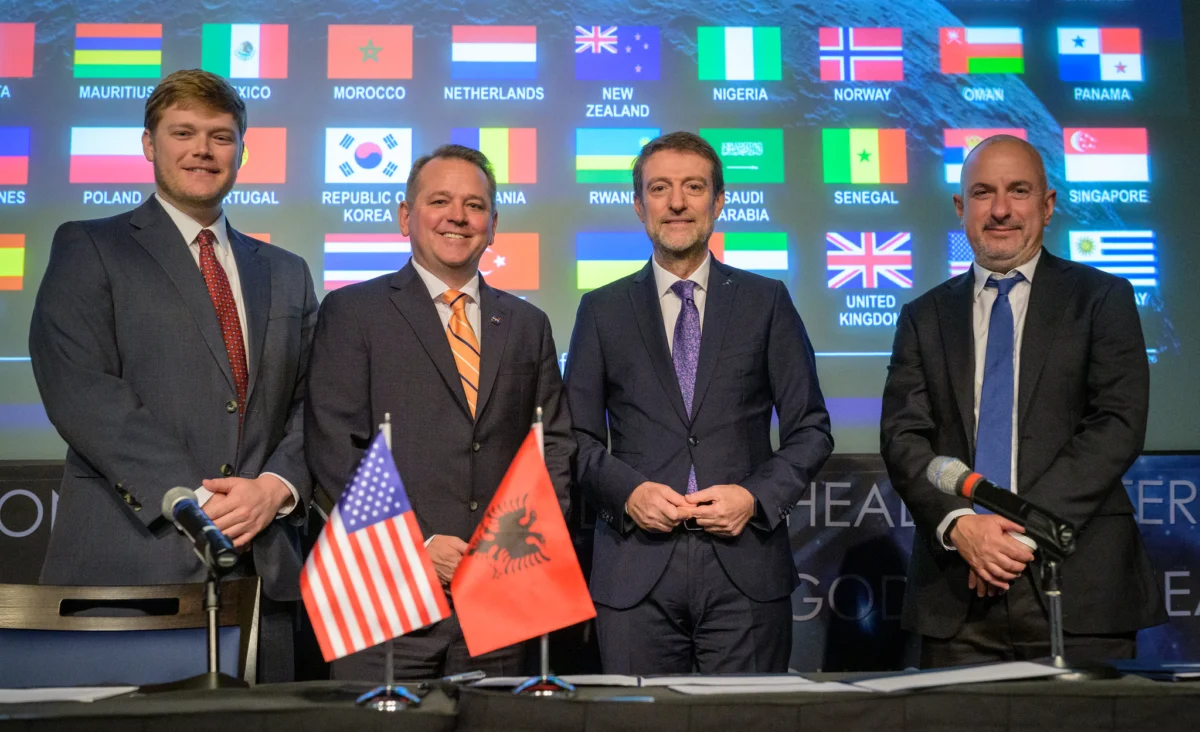
In a landmark ceremony held at the National Aeronautics and Space Administration (NASA) headquarters in Washington, D.C., the Republic of Albania officially joined the Artemis Accords, marking a pivotal expansion in the nation’s international diplomatic and scientific profile. By becoming the 73rd signatory to this multilateral framework, Albania has formally aligned itself with a coalition of nations dedicated to the peaceful, transparent, and sustainable exploration of the lunar surface, Mars, and the broader solar system. The signing ceremony, which underscored the century-long diplomatic relationship between Tirana and Washington, serves as a significant milestone in Albania’s burgeoning aerospace ambitions and its integration into the global space economy.
The Artemis Accords, established in 2020 by NASA and the U.S. Department of State in coordination with seven founding international partners, represent a set of non-binding principles designed to guide civil space exploration and use in the 21st century. As lunar activity increases—driven by a mix of national government programs and private commercial enterprises—the Accords provide a roadmap for avoiding conflict, ensuring interoperability, and protecting historical sites of scientific importance on the Moon.
The Diplomatic Significance of the Signing
The agreement was signed by Albania’s Minister for Europe and Foreign Affairs, Ferit Hoxha, in the presence of senior U.S. officials, including NASA Deputy Administrator Matt Anderson and the U.S. Deputy Assistant Secretary of State for Space and Environment, Connor Tomlinson. The ceremony also featured the attendance of the Ambassador of the Republic of Albania to the United States, Ervin Bushati, reinforcing the high-level commitment of both nations to this partnership.
"It is my privilege to welcome the Republic of Albania as the 73rd signatory of the Artemis Accords," NASA Deputy Administrator Matt Anderson stated during the event. "The relationship between our nations goes back more than a century. Today, we extend that partnership into space."
For Albania, the decision to sign the Accords is an affirmation of its foreign policy trajectory, which emphasizes adherence to international law and multilateral cooperation. Minister Hoxha noted that Albania views the exploration of space not as a solitary pursuit for individual nations, but as a collective endeavor that requires shared values and collaborative frameworks. By joining the Accords, Albania signals its intent to contribute to the "Golden Age of space exploration," a term frequently used by NASA officials to describe the current era of rapid technological advancement and international partnership in low-Earth orbit and beyond.
A Chronology of Albania’s Aerospace Ambitions
Albania’s journey into the space sector has accelerated significantly over the past several years. While the country is historically categorized as an emerging economy in the aerospace field, its recent actions demonstrate a clear strategic focus on leveraging space-based data for national development.
The most tangible evidence of this commitment occurred in January 2023, when Albania successfully launched two Earth-observation satellites, designated "Albania-1" and "Albania-2." The satellites were deployed via a SpaceX Falcon 9 rocket from NASA’s Kennedy Space Center in Florida. This mission was a collaborative effort that underscored the logistical and technical support provided by the United States to its allies. The satellites are intended to provide high-resolution imaging for environmental monitoring, agriculture, border management, and urban planning, marking a transformative leap in the country’s ability to utilize satellite data for evidence-based policymaking.
Prior to the satellite launch, Albania had already begun fostering a domestic culture of space-tech interest by participating in the NASA Space Apps Challenge. This annual hackathon, which takes place in over 150 countries, encourages students, coders, and scientists to use NASA’s open-source data to solve terrestrial problems. By hosting these events, the Albanian government has successfully engaged the younger generation, building a foundation of human capital that is essential for long-term participation in the space sector.
The Pillars of the Artemis Accords
To understand the weight of Albania’s decision, one must examine the fundamental principles of the Artemis Accords. The Accords are built upon the 1967 Outer Space Treaty, but they introduce practical guidelines for modern space operations. Key commitments include:
- Peaceful Purposes: Signatories commit to conducting all space activities for peaceful purposes, consistent with international law.
- Transparency: Nations agree to share information about their space policies and mission plans to prevent misunderstanding and conflict.
- Interoperability: To ensure safety and efficiency, nations agree to utilize open standards and compatible systems for their spacecraft and ground equipment.
- Emergency Assistance: Signatories commit to providing assistance to personnel in distress, reaffirming the humanitarian obligations established by international treaties.
- Registration of Space Objects: Participants agree to be open about their orbital parameters and to register their space objects to ensure transparency in space situational awareness.
- Scientific Data Sharing: Nations agree to make the scientific data resulting from their space missions publicly available, fostering a global repository of knowledge.
- Protection of Heritage: Signatories commit to protecting sites of historical or scientific significance on the Moon or other celestial bodies.
- Space Debris Mitigation: Nations pledge to plan for the mitigation of orbital debris, ensuring that space remains sustainable for future generations.
Economic and Technological Implications
The accession of Albania to the Accords is not merely a symbolic gesture; it carries meaningful economic and strategic implications. By committing to these standards, Albania aligns itself with the technical requirements necessary to engage in future commercial space ventures. As the global space economy moves toward a valuation of over $1 trillion by 2040, nations that adopt these transparent, "rules-based" frameworks are better positioned to attract foreign direct investment and partner with private aerospace companies.
For a nation like Albania, access to Earth-observation data is a critical tool for climate change adaptation. With the European Union and other international bodies increasingly focusing on environmental monitoring, Albania’s ability to integrate its satellite data into regional frameworks will likely enhance its standing in international climate negotiations. Furthermore, the collaboration with NASA provides a platform for Albanian academic and research institutions to participate in joint research projects, potentially leading to technological transfers that can bolster the domestic IT and telecommunications sectors.
Broader Geopolitical Context
The growth of the Artemis Accords coalition to 73 members reflects a significant shift in the global geopolitical landscape. As major powers compete for dominance in lunar exploration—specifically regarding the strategic location of the lunar south pole, which is believed to contain water ice—the United States has sought to build a broad consensus around norms of conduct.
Critics and observers often analyze the Accords as a diplomatic counterweight to the alternative space governance models proposed by other major spacefaring nations. By building a large, diverse coalition of democratic and cooperative states, the United States is effectively establishing a "normative bloc" that promotes transparency and sustainability. Albania’s inclusion is particularly relevant as it represents the growing role of Southeast European nations in the North Atlantic Treaty Organization (NATO) and other Western-aligned institutions, suggesting that the "space alliance" is increasingly mirroring the security and political alliances of the terrestrial world.
Future Prospects and Conclusion
Looking ahead, the partnership between Albania and NASA is expected to evolve through increased technical cooperation. Potential future developments could include enhanced training programs for Albanian scientists, increased access to NASA’s data portals, and potential participation in future educational outreach missions.
Minister Hoxha’s closing remarks at the ceremony captured the essence of the transition: "By taking this step, Albania affirms its commitment to peaceful, transparent, sustainable, and cooperative exploration of space. We do so as a country deeply committed to international law, multilateral cooperation, and the belief that humanity’s greatest achievements are realized not in isolation, but through partnerships."
As the world looks toward the first human return to the lunar surface in over half a century, the participation of countries like Albania demonstrates that space exploration is becoming a truly global endeavor. The Artemis Accords provide the structure for this expansion, ensuring that as humanity ventures further into the solar system, it does so with a shared set of values that prioritize safety, sustainability, and the advancement of all mankind. For Albania, the path forward is clear: by linking its national space strategy to the Artemis framework, the nation has positioned itself to play an active, recognized role in the next chapter of human exploration.