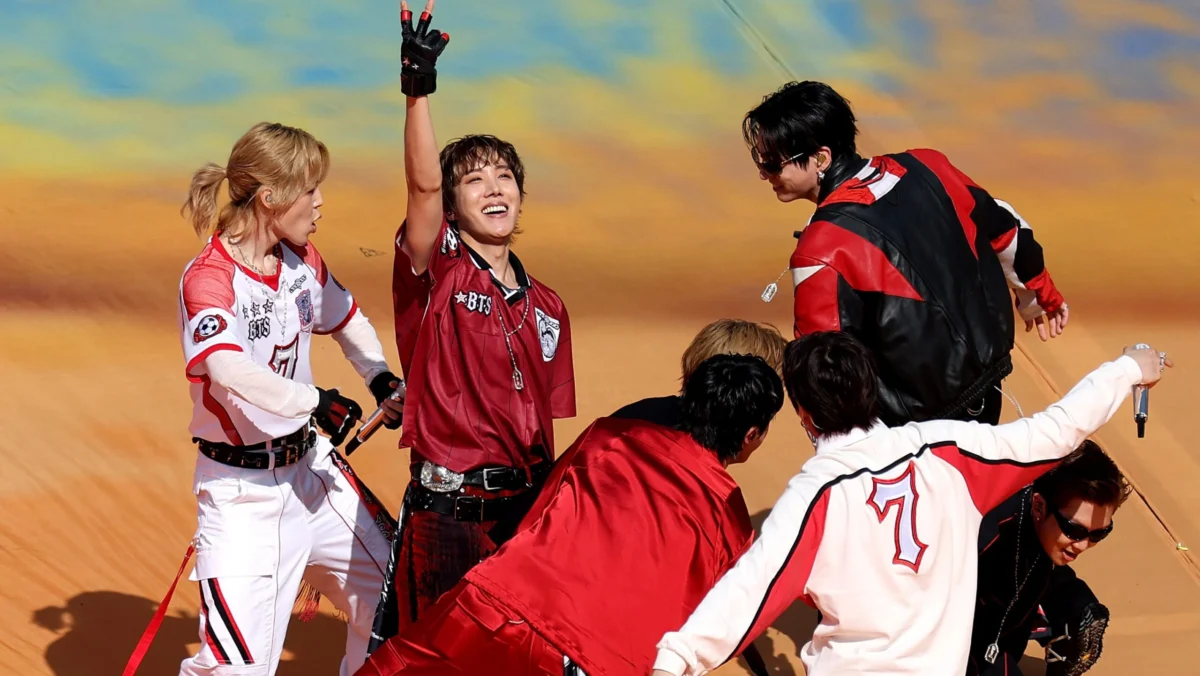
The 2026 FIFA World Cup reached a historic crescendo on Sunday as the global pop phenomenon BTS headlined the tournament’s first-ever halftime show, anchoring an 11-minute multi-artist spectacle during the final match between Spain and Argentina. Held at the New York New Jersey Stadium—widely recognized as MetLife Stadium—the performance marked a significant departure from traditional FIFA protocols, signaling a new era of entertainment integration for international football. The seven-member group, consisting of RM, Jin, Suga, J-Hope, Jimin, V, and Jung Kook, delivered an energetic rendition of their 2020 chart-topping single "Dynamite," adapted specifically for the global sporting stage.
The inclusion of a halftime show in the World Cup final represents a strategic shift by FIFA to mirror the high-production entertainment value of the American Super Bowl. Sunday’s event was not merely a solo concert but a "mega-mix" produced by the international advocacy organization Global Citizen, with programming curated by Coldplay frontman Chris Martin. The performance saw BTS sharing the stage with an eclectic lineup of global superstars, including Madonna, Justin Bieber, Shakira, and Burna Boy. Adding a layer of classical prestige and cultural whimsy, the show also featured the New York Philharmonic under the baton of Gustavo Dudamel, as well as appearances by The Muppets.
A Strategic Musical Evolution for FIFA
The 2026 World Cup, hosted across the United States, Canada, and Mexico, has been a tournament of firsts, but the introduction of a mid-game musical extravaganza stands as its most notable commercial evolution. By partnering with Global Citizen, FIFA aimed to blend athletic excellence with humanitarian advocacy. The halftime show served as the primary vehicle for the FIFA Global Citizen Education Fund, an ambitious initiative with a fundraising target of $100 million. To achieve this, a portion of every ticket sold throughout the tournament—totaling $1 per seat—was allocated to the fund, which focuses on providing educational resources to underserved communities worldwide.
The choice of BTS as a headlining act underscores the group’s unparalleled reach across international demographics. As the first K-pop act to perform at a World Cup final, their presence provided a bridge between the traditional football fan base and the massive, digitally savvy "ARMY" fandom. This intersection of audiences was evident in the stadium’s atmosphere, where the tension of the Spain-Argentina matchup briefly gave way to a celebration of global pop culture.
Performance Highlights and Choreography
The BTS segment of the show began with a high-energy introduction by the group’s youngest member, Jung Kook. Dressed in a striking red, black, and white ensemble featuring a customized motto jacket and sunglasses, Jung Kook took the lead following a choreographed nod to Norway’s "Viking Row" celebration—a gesture that resonated with the international crowd. As the familiar disco-pop beats of "Dynamite" began, the remaining six members—RM, Jin, Suga, J-Hope, Jimin, and V—joined him on the massive, multi-tiered stage.
To better align the performance with the spirit of the World Cup, the group modified the lyrics of their Grammy-nominated hit. V (Taehyung Kim) notably altered his lines to include football-centric references, singing, “King Kong, kick the ball,” and “Ding-dong, call me on my phone / Ice tea, and a game of football.” During the latter line, V engaged in a playful pantomime of a goal-scoring kick, drawing cheers from the 82,500 fans in attendance. The group’s synchronization, a hallmark of their global success, remained flawless despite the scale of the venue and the pressure of a live global broadcast estimated to have reached over one billion viewers.
A Collaborative Global Lineup
The halftime show was structured as a continuous flow of musical genres, reflecting the diversity of the competing nations and the host region. Madonna’s appearance reinforced her status as a pop matriarch, while Shakira—no stranger to the World Cup following her 2010 anthem "Waka Waka"—brought Latin American flair that resonated deeply with the Argentinian and Spanish supporters. Justin Bieber’s inclusion catered to the North American market, while Burna Boy represented the rising global dominance of Afrobeats.
In a moment of levity that bridged the gap between fiction and reality, actors Jason Sudeikis and Brendan Hunt appeared in character as Ted Lasso and Coach Beard from the hit series Ted Lasso. Their cameo served as a meta-commentary on the growth of "soccer" in the United States, a central theme of their television show. The integration of Gustavo Dudamel and the New York Philharmonic provided a sophisticated sonic backdrop, elevating the production beyond a standard pop concert.
The BTS Comeback and the Arirang Era
Sunday’s performance is a cornerstone of what industry analysts are calling a "massive comeback year" for BTS. Following a hiatus during which all seven members completed their mandatory military service in South Korea, the group officially reunited for full-ensemble activities in late 2025. Their return was solidified in March 2026 with the release of their studio album, Arirang. The album, named after a traditional Korean folk song that serves as an unofficial national anthem, was a thematic exploration of heritage, resilience, and the group’s journey through their military enlistment.
Since the release of Arirang, BTS has been on a relentless world tour, selling out stadiums across Asia, Europe, and the Americas. The group recently made a triumphant return to the American awards circuit, securing three trophies at the American Music Awards in May. Their appearance at the World Cup final acts as a prelude to their upcoming individual residency at MetLife Stadium, where they are scheduled to perform two sold-out headlining shows on August 1 and August 2.
Contextualizing the 2026 World Cup Final
The backdrop of this performance was a high-stakes final between two of football’s most storied nations. Spain, seeking to reclaim the glory of their 2010 victory, faced an Argentina side looking to maintain the momentum of their 2022 championship. The 2026 tournament was the largest in history, featuring 48 teams and matches played in 16 host cities across three countries. The decision to hold the final at MetLife Stadium in East Rutherford, New Jersey, placed the eyes of the world on the New York metropolitan area, making it a fitting stage for a performance of this magnitude.
Logistically, the halftime show required months of coordination between FIFA, the host city organizers, and Global Citizen. The transformation of a football pitch into a world-class concert stage and back again within a 15-minute window is a feat of engineering and stage management. For the 2026 final, the production utilized modular stage pieces that were deployed and retracted in under four minutes, ensuring the integrity of the playing surface was maintained for the second half of the game.
Broader Cultural and Economic Impact
The success of the inaugural FIFA halftime show is expected to have long-lasting implications for how major sporting events are marketed. By blending the world’s most popular sport with its most popular musical acts, FIFA has successfully tapped into new revenue streams and sponsorship opportunities. The involvement of Global Citizen also highlights a growing trend of "entertainment with a purpose," where major events are used to drive social change and charitable giving.
For BTS, the performance further cements their status as "Diplomatic Envoys" for South Korean culture. Their ability to command the stage at a World Cup final—an event traditionally dominated by Western pop stars—speaks to the shifting dynamics of the global entertainment industry. Financial analysts estimate that the "BTS effect" on the 2026 World Cup’s merchandise sales and digital engagement will be measured in the hundreds of millions of dollars.
Future Outlook
As the dust settles on the 2026 World Cup final, the focus for BTS shifts to the remainder of their "Arirang" World Tour. Following their upcoming MetLife Stadium dates in August, the group is slated to headline the iHeartRadio Music Festival in Las Vegas this September. Their schedule reflects a group at the peak of their powers, successfully navigating the transition from a boy band to a permanent fixture of the global cultural establishment.
The 2026 halftime show will likely be remembered as a pivot point for FIFA. While traditionalists may have initially balked at the introduction of a musical break in the middle of a World Cup final, the sheer scale and professional execution of the BTS-led performance have set a high bar for future tournaments. As the global community looks toward the 2030 World Cup, the precedent set at MetLife Stadium ensures that the intersection of sport and song will remain a central component of the "beautiful game."