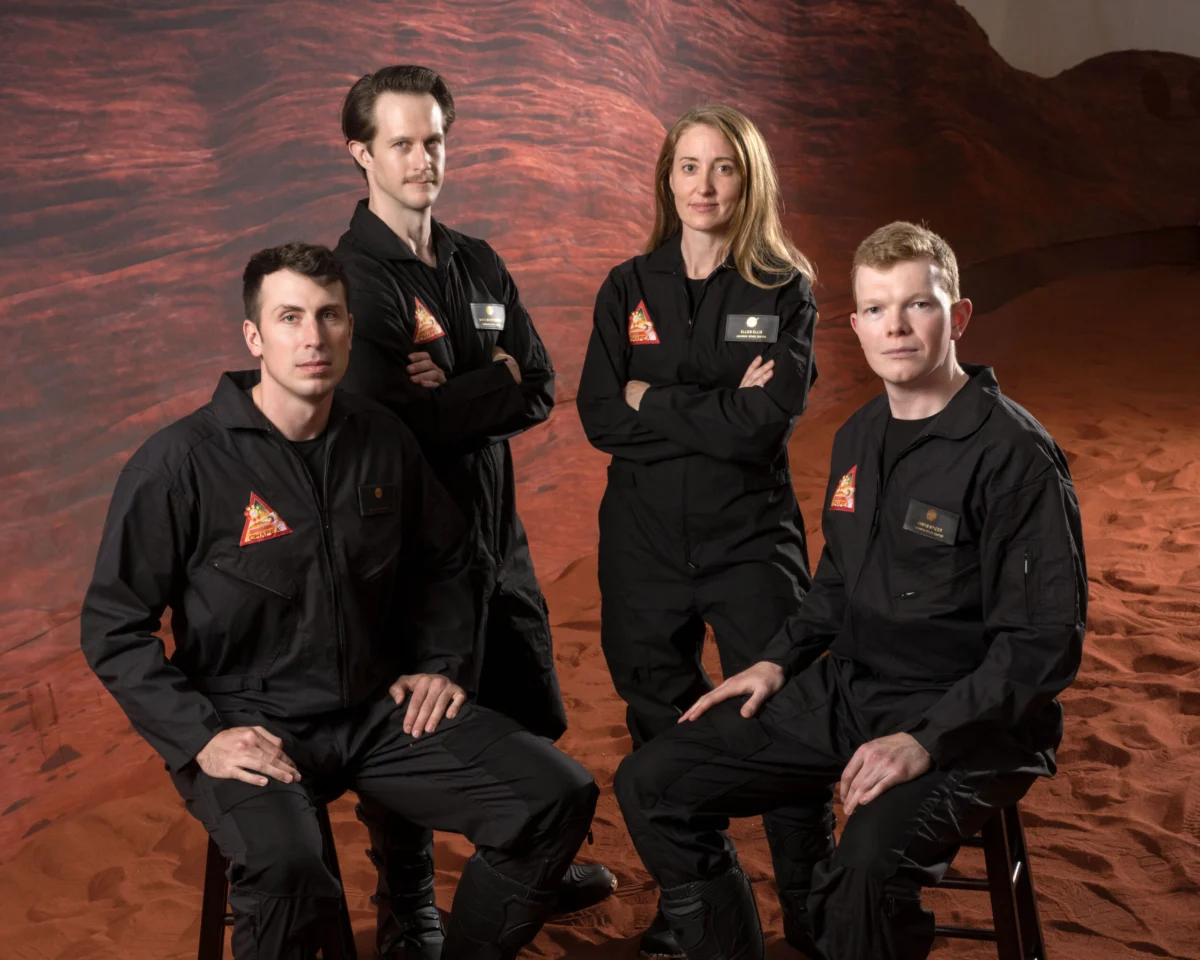
After spending 378 days in total isolation, four volunteers are set to emerge from the Crew Health and Performance Exploration Analog (CHAPEA) facility at NASA’s Johnson Space Center in Houston on Saturday, Oct. 31. This milestone marks the successful conclusion of the second CHAPEA mission, an ambitious long-duration simulation designed to mimic the rigors of life on the Red Planet. The exit ceremony, scheduled for 3 p.m. EDT, serves as more than just a homecoming; it represents a critical data point in humanity’s multi-decade quest to send astronauts to Mars.
The four crew members—Ross Elder, Ellen Ellis, James Spicer, and Matthew Montgomery—have spent over a year within the confines of a 1,700-square-foot, 3D-printed habitat. Throughout their stay, which began on Oct. 19, 2025, they were subjected to the unique stressors that future deep-space explorers will inevitably face, including significant communication delays, strict resource management, and the psychological weight of prolonged confinement.
Chronology of the CHAPEA Mission
The CHAPEA mission is part of a series of analog studies aimed at refining the protocols necessary for human exploration beyond low-Earth orbit. The current mission, designated as Mission 2, followed the inaugural CHAPEA test, which provided the first foundational insights into the viability of 3D-printed habitats.
From the moment the crew sealed the airlock on Oct. 19, 2025, their lives were dictated by a schedule that mirrored real-world Mars mission operations. The timeline of their residency included:
- Initial Integration: The first phase involved acclimation to the habitat’s life support systems and the establishment of daily operational routines.
- Operational Integration: The crew transitioned into full-scale mission profiles, conducting regular maintenance on habitat systems and managing the complexities of a closed-loop environment.
- Scientific Execution: The mid-mission phase saw the crew engage in intensive data collection, including the cultivation of crops within the facility and the execution of "Marswalks"—simulated extravehicular activities (EVAs) designed to test mobility and stamina in pressurized suits.
- The Final Stretch: The concluding months focused on the long-term impacts of isolation on team cohesion, cognitive performance, and physical health, culminating in the upcoming departure on Oct. 31.
The Engineering Behind the Habitat
The facility housing the CHAPEA crew is a marvel of modern construction and space-age engineering. The 1,700-square-foot habitat was constructed using specialized 3D-printing technology—a method NASA views as essential for future lunar and Martian base construction. By utilizing local resources (in-situ resource utilization) to print structures, NASA can reduce the mass of equipment that must be launched from Earth.
The facility includes private crew quarters, a workstation, a medical station, a common area, and food-growing stations. Every aspect of the environment is monitored to ensure the safety and productivity of the inhabitants. The stressors introduced by the research team were not merely inconveniences; they were carefully calibrated simulations of the "latency" inherent in deep-space communication. Signals sent to and from the habitat were delayed by up to 20 minutes each way, forcing the crew to rely on their own problem-solving skills rather than real-time guidance from Mission Control.
Scientific Objectives and Data Collection
NASA’s primary objective for the CHAPEA program is the mitigation of "human spaceflight risks." When humans travel to Mars, they will be millions of miles from the nearest hospital or rescue team. Therefore, the data gathered over these 378 days is invaluable.
Optimizing Nutritional and Resource Systems
One of the key focus areas for Mission 2 was the optimization of food system design. Feeding a crew for a three-year mission—the estimated duration of a round-trip to Mars—requires a highly efficient approach to calorie density, shelf-life, and nutritional variety. The crew’s success in growing plants and managing their food stores provides data on the viability of greenhouse operations in extraterrestrial environments.
Behavioral and Psychological Health
Perhaps the most significant aspect of the mission is the study of human performance under pressure. Living in a small group for over a year presents significant challenges to mental health and team dynamics. NASA flight doctors and psychologists have monitored the crew’s moods, sleep patterns, and interpersonal relationships. This information is critical for developing behavioral support practices that ensure crews remain mission-ready throughout the duration of a multi-year expedition.
Deep Space Network Efficiency
The mission also tested how crews manage communication bandwidth. With a limited connection to the Deep Space Network, the crew had to prioritize data transmission, deciding which scientific logs and personal communications were most urgent. These findings will dictate how NASA designs communication hardware for future Artemis missions to the Moon and beyond.
Official Responses and Media Engagement
The exit ceremony will feature remarks from Johnson Space Center Director Vanessa Wyche and NASA astronaut Jack Hathaway. Their participation underscores the agency’s commitment to the CHAPEA program as a cornerstone of the Artemis Generation’s future.
"The work being done inside the CHAPEA facility is not just about staying inside; it is about learning how to thrive in the harshest environments imaginable," said a spokesperson close to the mission. "The endurance shown by this crew provides the roadmap for how we will eventually sustain a human presence on the surface of Mars."
Media personnel have been invited to observe the final moments of the mission at the Johnson Space Center. Following the departure, subject matter experts will be available to discuss the broader implications of the data collected. The opportunity for virtual interviews with the crew in the days following their emergence will allow for a more personal look at the challenges and triumphs of their year-long isolation.
Broader Implications for Artemis and Beyond
The data derived from CHAPEA Mission 2 is expected to inform the development of the Moon Base architecture. By establishing a sustained human presence on the lunar surface, NASA intends to prove the technologies and operational protocols required for the subsequent leap to Mars.
The integration of 3D-printed habitats, efficient resource management, and remote medical support constitutes the "Mars Architecture." Without the empirical evidence provided by analog missions like CHAPEA, the risk profile for deep-space travel would remain unacceptably high. By identifying the limitations of current technology and human endurance, NASA is effectively "stress-testing" the future of space exploration.
Furthermore, the collaboration between different NASA divisions—including the Human Research Program and the Exploration Systems Development Mission Directorate—ensures that the insights gained are not confined to a single field of study. Engineers, biologists, and psychologists are working in tandem to synthesize these findings into a coherent strategy for deep-space sustainability.
Looking Toward the Future
As the clock ticks toward Oct. 31, the global scientific community watches with keen interest. The conclusion of this 378-day journey represents a pivotal moment in the history of human spaceflight. Once the crew steps outside the habitat, they will not only be reunited with their families but will also become the primary sources of knowledge that will guide the next generation of astronauts.
The CHAPEA program serves as a testament to the fact that exploration is a marathon, not a sprint. The challenges of isolation, resource scarcity, and the technical hurdles of living on another world are immense, but through simulation, preparation, and rigorous scientific analysis, the barrier to human expansion into the solar system is steadily being lowered.
For those interested in following the final hours of this historic mission, NASA will stream the departure live via the NASA Johnson YouTube channel and various social media platforms. Further information regarding the mission’s findings will be released in the coming months as researchers conclude their analysis of the data collected during the 378-day stay.
The legacy of this mission will undoubtedly be felt when the first humans set foot on the Martian surface. By successfully navigating the psychological and operational trials of the CHAPEA facility, these four volunteers have brought humanity one step closer to making Mars a destination, rather than just a point of light in the night sky.