In the United States, the constitutional requirements for federal office are clear and inclusive, yet the eligibility landscape for state and local government positions remains a complex, often exclusionary, patchwork of state statutes and local ordinances. While the U.S. Constitution imposes no categorical ban on individuals with felony convictions running for the presidency or seats in Congress, state and local jurisdictions have developed a wide array of restrictions that frequently bar formerly incarcerated individuals from representing their communities. This disparity creates a system where an individual might be legally qualified to lead the nation but disqualified from serving on a local school board or city council.
A recent analysis by The Sentencing Project highlights the precarious nature of these legal barriers, revealing that while formerly incarcerated individuals are increasingly being elected to office—from state legislatures in Nevada and Virginia to neighborhood commissions in the District of Columbia—many others remain sidelined by opaque and inconsistent eligibility rules.
The Historical and Legal Context of Candidacy
The legal principle governing federal candidacy was solidified by the Supreme Court in the 1995 case U.S. Term Limits, Inc. v. Thornton, which established that states cannot add qualifications for federal office beyond those explicitly listed in the Constitution. Consequently, incarceration does not serve as a legal bar to running for federal office. History provides notable examples of this, such as Congressman Matthew Lyon, who won reelection in 1798 while imprisoned for sedition, and socialist candidate Eugene V. Debs, who famously campaigned for president from a federal prison cell in 1920 under the moniker "Convict 9653."
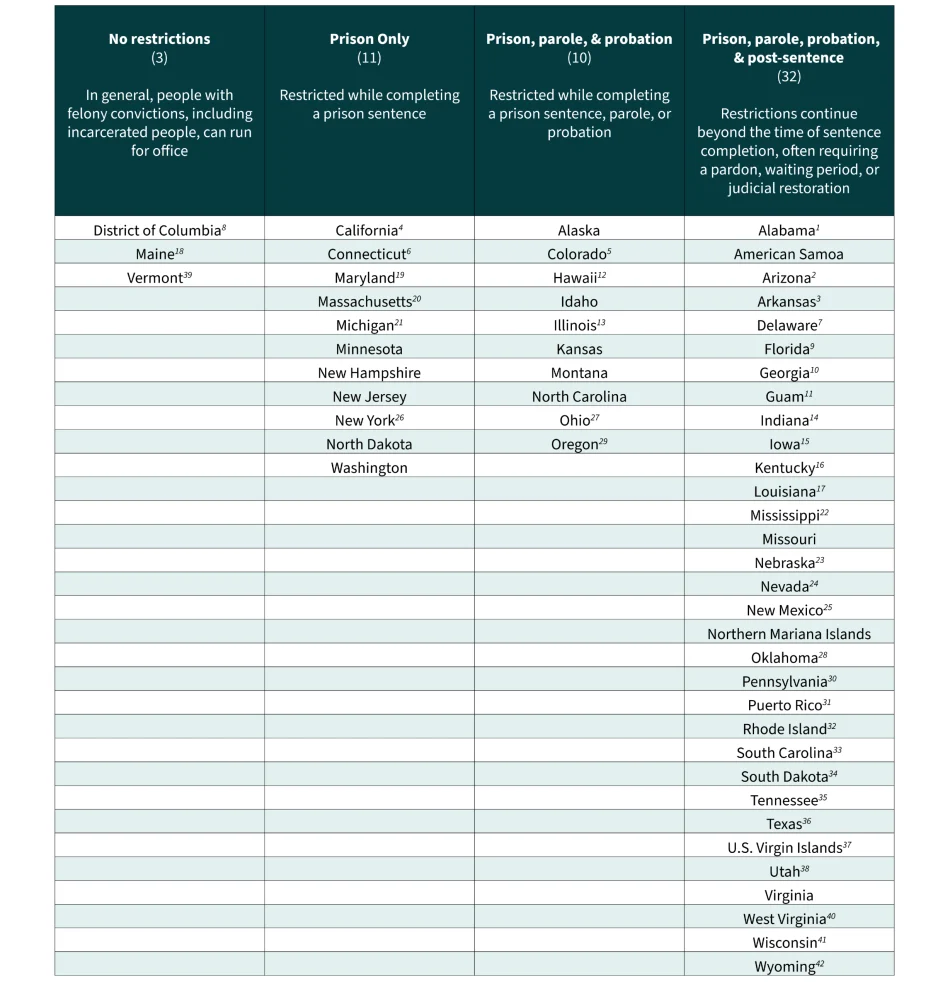
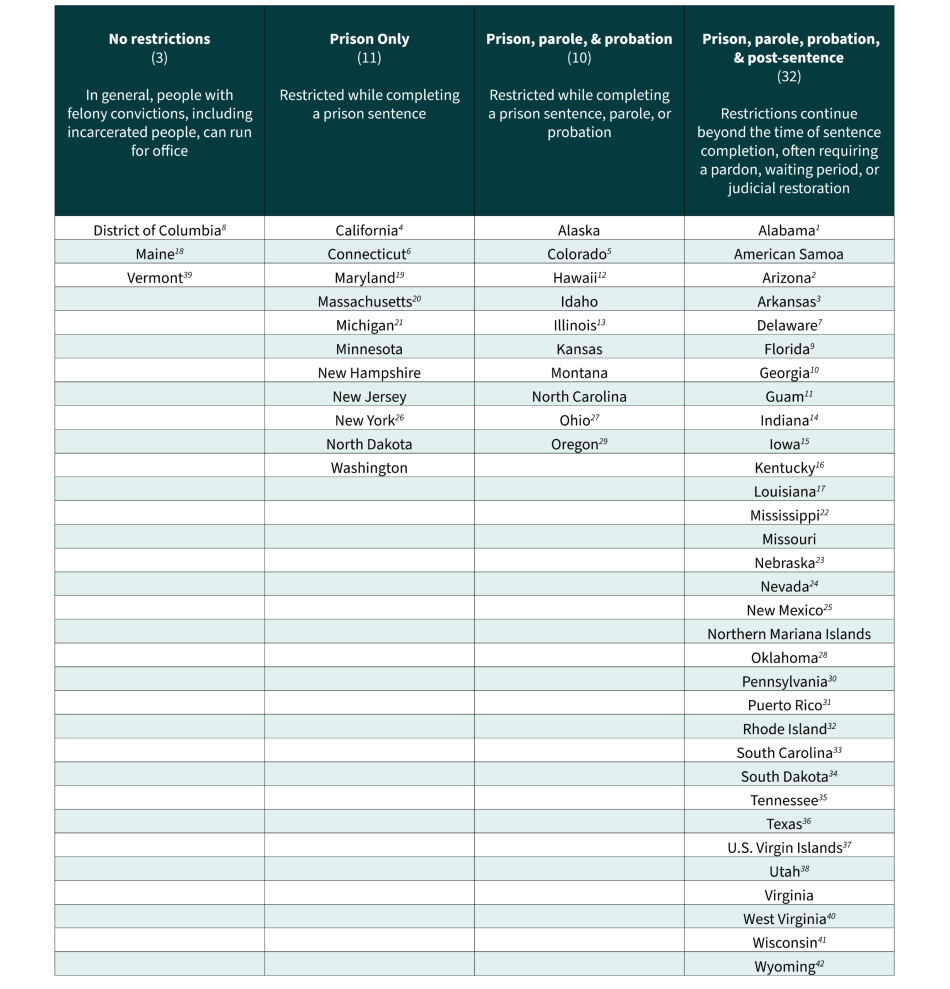
However, this federal standard does not extend to the state level. State constitutions and municipal charters hold the authority to determine their own eligibility parameters. This leads to scenarios where someone like Donald Trump, despite being eligible for federal office, would be barred from seeking a seat in a state legislature or a city council in various jurisdictions due to his felony convictions.
These restrictions often hinge on the definition of "completion of sentence." In some states, this means simple release from prison, while in others, it requires the full satisfaction of parole, probation, and the payment of all court-ordered fines, fees, and restitution. The ambiguity surrounding these requirements often serves as a functional barrier, as potential candidates may not be aware of whether they are legally eligible to appear on a ballot.
Profiles in Public Service: Voices from the Inside
The impact of these barriers is best understood through the experiences of those who have successfully challenged them. In the District of Columbia, Advisory Neighborhood Commissioner Harold Cunningham Jr. currently serves while incarcerated—a rarity in the modern American political landscape. Cunningham, who represents a district including the DC Jail, argues that his presence in office bridges a critical gap between the administration and the incarcerated population. "You cannot lock away your problems," Cunningham notes. "Having a position like this is the best thing that can happen in a prison. It brings the administration closer to the people in the jail."
Similarly, Nevada Assemblymember Jovan Jackson, the first formerly incarcerated member of the Nevada Assembly, has turned his experience with the criminal legal system into a platform for legislative reform. Since his election in 2024, Jackson has focused on dismantling structural barriers to housing, education, and employment for the justice-impacted. "I’m able to bring a voice to a population that went unheard for decades with mass incarceration," Jackson says, underscoring the value of lived experience in the policymaking process.
In Kentucky, Councilmember Brittanie Bogard’s path to office involved navigating the state’s pardon process. After receiving a full pardon from Governor Andy Beshear, Bogard was able to run for the Hopkinsville City Council. Her work since taking office has been instrumental in helping over 400 constituents secure their own expungements and pardons, demonstrating how justice-impacted officials can directly facilitate the reintegration of others.
Data and Disparities: The Patchwork of State Policy
The legal framework varies significantly by region. Research indicates that in 25 jurisdictions, the eligibility to run for office largely mirrors the eligibility to vote. However, in 31 jurisdictions, these rights are decoupled, with candidacy requirements being far more stringent than voting requirements.
For example, Missouri has taken steps to restore voting rights to individuals completing parole and probation, yet these same individuals remain ineligible to hold public office. This creates a civic irony: an individual is deemed trustworthy enough to participate in the democratic process by casting a vote, but remains deemed untrustworthy to represent their peers in a local government capacity.
Other states have implemented "moral turpitude" clauses or specific bars on individuals convicted of bribery, perjury, or the misuse of public funds. While these restrictions are intended to maintain the integrity of public institutions, they are often drafted so broadly that they capture non-violent offenses or long-past convictions, effectively creating a permanent political underclass. In states like Rhode Island, even a "no contest" plea can trigger a three-year ban from public office, highlighting how technical legal outcomes can have lasting impacts on an individual’s ability to engage in civil service.
Analysis: The Implications of Exclusion
The exclusion of people with felony convictions from public office has broader implications for representative democracy. When a significant portion of the population is legally barred from seeking office, the legislative body may fail to reflect the diversity of experiences within the community it serves. Proponents of reform argue that this exclusion perpetuates the cycle of marginalization, as those most affected by criminal justice policies are prevented from participating in the development of those policies.
Furthermore, the lack of clear, uniform guidance across states creates a "chilling effect." Many potential candidates may avoid running for office simply because they cannot afford the legal fees required to determine their eligibility or fear the risk of a post-election challenge to their candidacy. This uncertainty, according to The Sentencing Project, is a significant deterrent to civic engagement.
Recommendations for Reform
To address these disparities, experts suggest a three-pronged approach to policy reform:
-
Elimination of Candidacy Bans: Jurisdictions should move to abolish blanket bans on candidacy based on felony convictions. The prevailing view among reform advocates is that voters, rather than statutes, should determine whether a candidate’s past record disqualifies them from office. By allowing individuals to run, the system places the decision back in the hands of the electorate.
-
Alignment of Rights: Where immediate elimination of bans is not politically feasible, jurisdictions should align candidacy eligibility with voting eligibility. This would reduce public confusion and ensure that once an individual has paid their debt to society and regained their right to vote, they are also afforded the right to stand for election.
-
Clear Public Guidance: State and local election boards should be required to publish plain-language guides clarifying the criteria for running for office. This would provide necessary transparency and allow formerly incarcerated individuals to understand their rights without the burden of private legal counsel.
Looking Toward the Future
As the national conversation around criminal justice reform continues to evolve, the question of who is "fit" to hold office is becoming increasingly central. The success of officials like Jackson, Bogard, and Cunningham suggests that justice-impacted individuals can offer unique, high-value perspectives that traditional candidates might lack.
However, until states standardize their laws and reduce the arbitrary barriers to entry, the democratic process will remain uneven. The current landscape is one of transition; while some states are moving toward broader inclusion, others remain committed to rigid, historic restrictions. The path forward will likely require continued litigation, legislative advocacy, and a public reconsideration of what it means to be a representative in a society that has, for decades, relied on mass incarceration as a primary tool of public policy.
As of 2026, the movement to restore civil rights to the formerly incarcerated has gained momentum, but the specific right to seek office remains the final frontier in the effort to ensure full political reintegration for millions of Americans. Whether this shift will result in nationwide reform or remain a localized phenomenon will depend on the willingness of state legislatures to trust their voters to decide the character and qualifications of those who serve them.