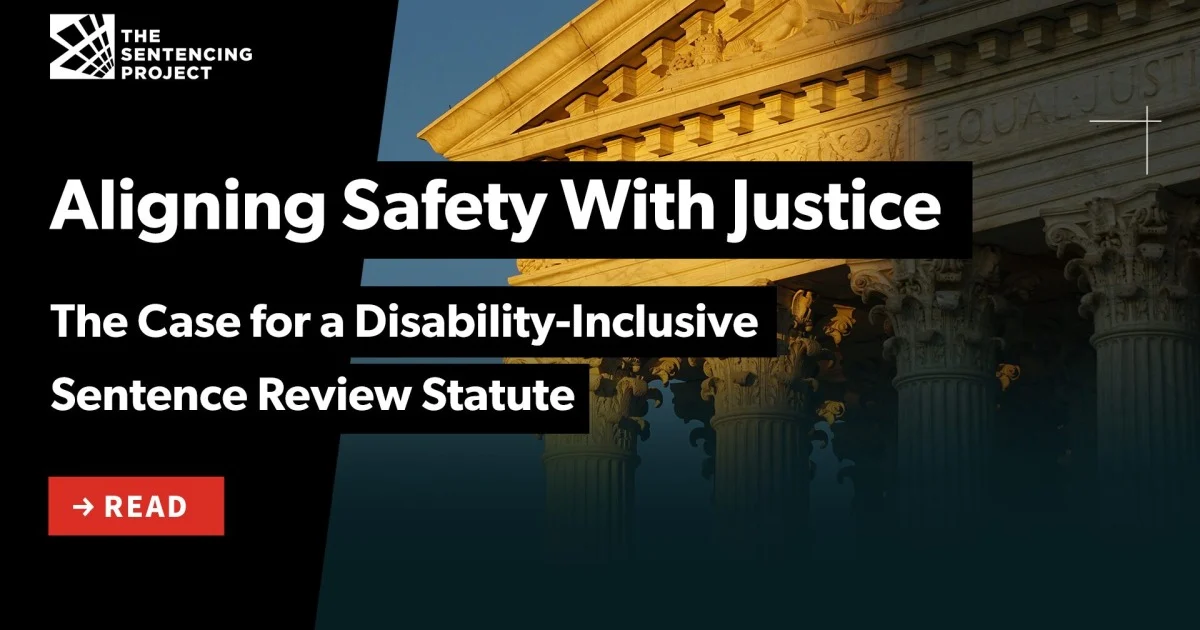
The American criminal legal system stands at a critical juncture as advocates and legal scholars push for legislative reform to address the profound overrepresentation of individuals with disabilities within jails and prisons. The Sentencing Project, a prominent research and advocacy group, has officially proposed the implementation of "disability second look" statutes. These proposed laws aim to provide a formal, legal mechanism for the judicial review of long-term sentences for individuals whose disabilities have fundamentally shaped their experiences within the justice system, from the point of arrest through their time served in correctional facilities.
The Scope of the Disability Gap in Carceral Settings
Current data reveals a stark reality: people with physical, cognitive, and social disabilities are disproportionately represented in the U.S. carceral population. According to research cited by The Sentencing Project, individuals in state and federal prisons are approximately 2.5 times more likely to report at least one impairment compared to the general adult population. Specifically, 38% of the incarcerated population identifies as having a disability, compared to 15% of the general public.
This discrepancy is not a result of higher criminality among the disabled population. Rather, systemic factors within the criminal legal apparatus often target, penalize, and disadvantage individuals with disabilities. From the initial police encounter to the final sentencing phase, the lack of appropriate accommodations and the failure of legal institutions to account for cognitive or physical limitations can lead to an erosion of due process.
Chronology of Systemic Failure and Emerging Reform
The push for "second look" legislation is a relatively modern development in the American legal landscape. While the concept of "second look" laws—which allow judges to review and potentially reduce sentences after a period of time—has gained traction in various jurisdictions, it has historically been applied to specific groups such as youth, veterans, and survivors of domestic violence.
In recent years, the recognition that certain personal characteristics reduce an individual’s culpability has led to the passage of second look laws in fifteen state legislatures, the District of Columbia, and at the federal level. Despite this progress, the specific needs of individuals with disabilities have been consistently overlooked. The current proposal by The Sentencing Project seeks to bridge this gap, arguing that a disability that influences the nature of an offense, hinders participation in one’s own legal defense, or prevents engagement in mandatory rehabilitation should be a primary factor in sentence review hearings.
A Model for Judicial Review
The proposed model statute outlines five specific areas where a disability may have influenced an individual’s trajectory within the system. Under this framework, an individual would be eligible for a second look if their disability contributed to:
- The nature of the offense itself.
- Their behavior or the misperception of their behavior by law enforcement before, during, or after their arrest.
- Their inability to access due process rights, including effective communication with counsel or understanding courtroom proceedings.
- Their struggle while incarcerated, such as receiving disciplinary infractions due to symptoms of their disability or being excluded from rehabilitative programming.
- The creation of insurmountable obstacles to developing viable reentry and parole plans.
The inclusion of these criteria is intended to mirror existing legal protections for other vulnerable cohorts. By treating disability as a mitigating factor, proponents argue that the justice system can align itself with contemporary standards of fairness and individualized justice.
The Role of Aging and Rehabilitation
A core argument supporting the enactment of these statutes is the correlation between age, the passage of time, and the significant decline in recidivism risk. Research consistently indicates that the propensity to commit crime decreases as individuals age. Furthermore, empirical studies suggest that for individuals with prior criminal records, the risk of re-arrest reaches a point of statistical insignificance—often cited as being indistinguishable from the general population—after roughly seven years without further contact with law enforcement.
For incarcerated individuals with disabilities, the lack of access to specialized programming often makes it difficult to demonstrate their "reformation." If an individual is excluded from vocational training, therapy, or education due to their disability, they are effectively trapped by a system that denies them the very tools required to earn a parole board’s recommendation for release. Providing a second look hearing would allow the judiciary to evaluate the person’s growth, maturation, and rehabilitation independent of the barriers they faced while institutionalized.
Mandatory Training as a Foundational Requirement
The Sentencing Project emphasizes that legislative change must be accompanied by structural institutional reform. The proposal includes a mandate for comprehensive training for judges, prosecutors, defense counsel, and law enforcement officers. This training would focus on the nuances of various disabilities and the legal obligations—under both federal and state statutes—to provide reasonable accommodations.
The necessity for this training is underscored by the recurring issue of misinterpretation. In many cases, symptoms of a mental or cognitive disability are perceived as defiance, non-compliance, or aggression, leading to unnecessary escalation during police encounters and more severe disciplinary actions within prison walls. By educating legal professionals, the proposal aims to reduce the likelihood of these misperceptions resulting in increased sentencing lengths.
Broader Implications for the Legal System
The broader implications of adopting disability-focused second look statutes are significant. First, it would force a re-evaluation of how the legal system defines "culpability." If a defendant’s physical or cognitive limitations prevented them from fully understanding the proceedings against them or participating in their defense, the legitimacy of the resulting sentence is inherently called into question.
Second, the proposal highlights the ongoing tension between punitive sentencing and the constitutional requirement to accommodate individuals with disabilities. Under the Americans with Disabilities Act (ADA) and other federal mandates, government agencies are required to provide equal access. The criminal legal system, however, has frequently operated as an exception to these requirements, often to the detriment of those with the most severe needs.
Third, the economic impact of such legislation warrants consideration. Long-term incarceration is a significant fiscal burden on states. Providing a mechanism for the release of individuals who no longer pose a public safety risk, particularly those whose continued incarceration is a result of systemic neglect of their disabilities, could alleviate the strain on state budgets while simultaneously correcting a moral failure.
Contextualizing the Need for Reform
The current legal environment is one of extreme volatility. In Pennsylvania, for example, the state is grappling with over 1,100 unresolved felony murder cases following a ruling that found mandatory life-without-parole sentences unconstitutional. This serves as a cautionary tale of what happens when the legal system relies on rigid, mandatory sentencing structures that fail to account for individual circumstances.
Reports on "felony murder" laws have further exposed how such sentencing schemes often catch individuals who neither caused nor intended a death, leading to decades of imprisonment for those who played a peripheral role. When these broad sentencing policies intersect with the presence of a disability, the result is often a life sentence for someone whose impairment played a role in the situation, yet who lacks any path to prove their rehabilitation.
Moving Toward a More Equitable Justice System
As the discourse on criminal justice reform continues to evolve, the focus on disability rights represents a necessary evolution in the movement toward a more humane and effective legal system. The arguments put forth by The Sentencing Project underscore that justice is not served when sentencing is blind to the human realities of those appearing before the court.
By codifying second look statutes that recognize the impact of disability, lawmakers have the opportunity to transform the criminal legal system into one that prioritizes evidence-based rehabilitation over indefinite punishment. As jurisdictions across the country continue to debate the future of sentencing, the integration of disability-aware policies may prove to be a defining factor in whether the system can truly achieve its stated goals of fairness, accountability, and public safety.
The road ahead will require not only the passage of new legislation but also a sustained commitment to funding the training and support services necessary to make these laws functional. For many individuals currently serving decades-long sentences, this proposal represents more than just a legal change; it represents a potential lifeline and a long-overdue acknowledgment of their humanity within a system that has, for too long, functioned in the shadows of their invisible challenges.