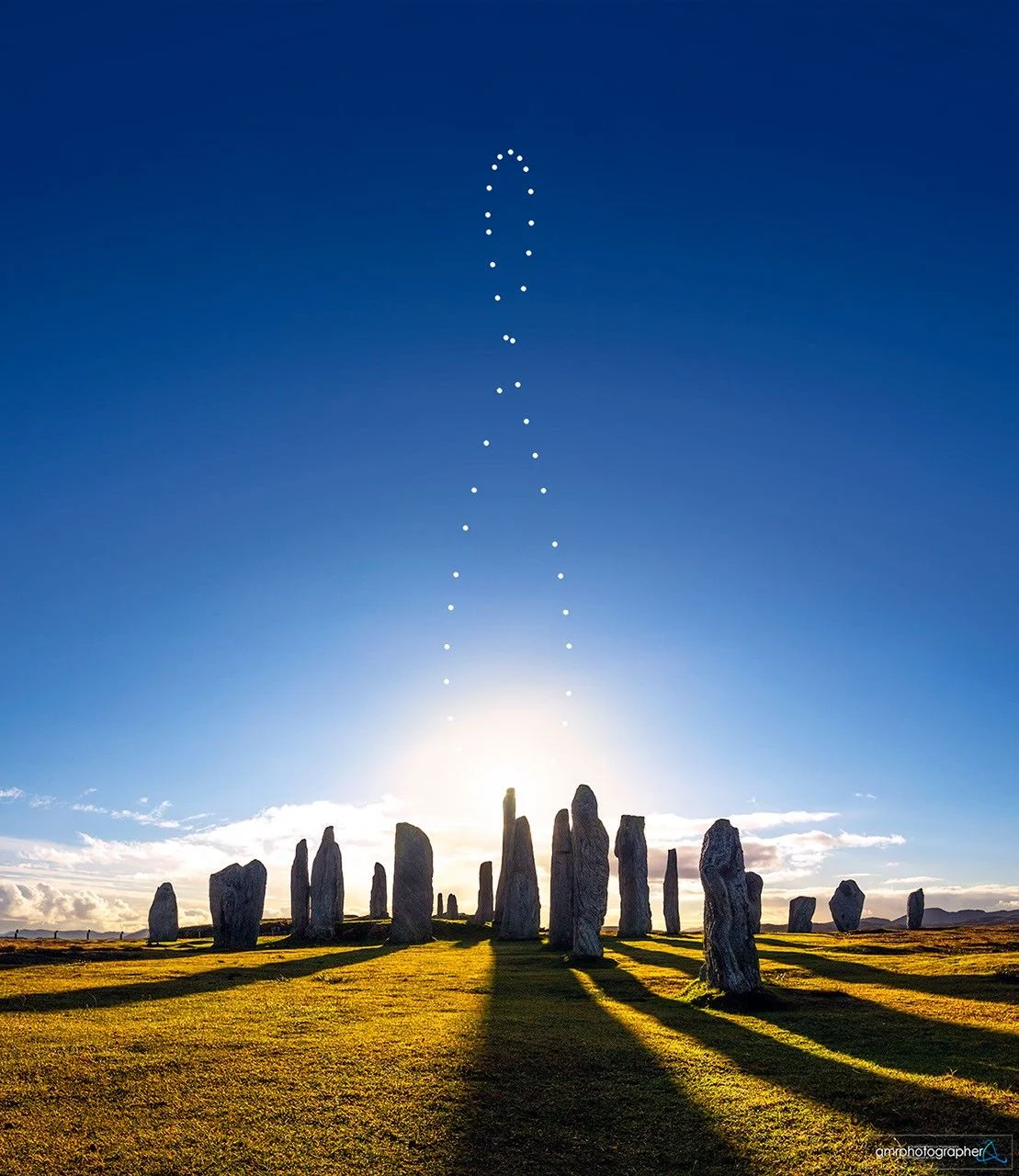
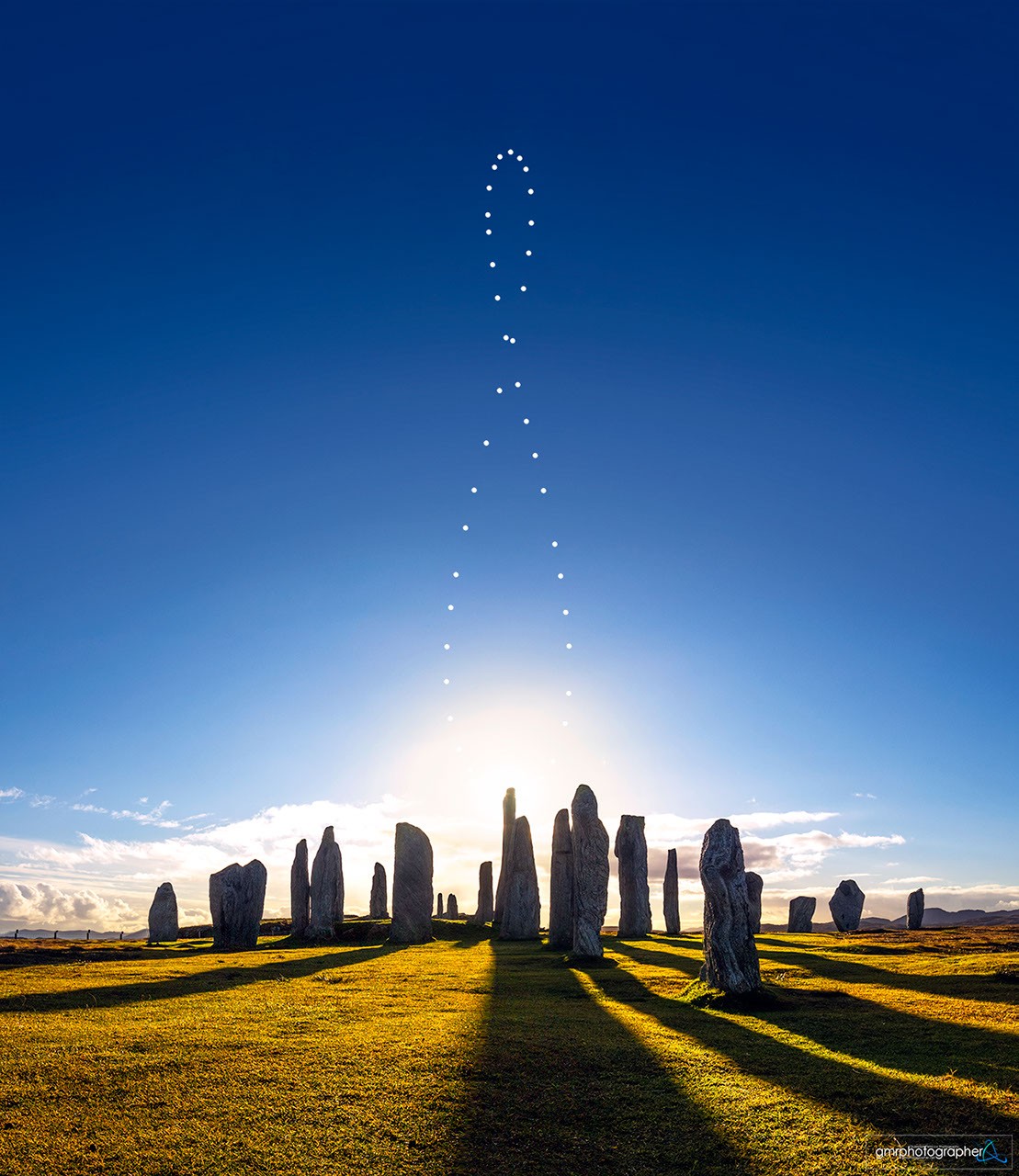
The phenomenon known as an analemma represents one of the most elegant intersections of celestial mechanics and human perspective, a concept brought into sharp relief by a composite image capturing the Sun’s position above the ancient Callanish Stones in Scotland. When an observer records the position of the Sun at the exact same time of day over the course of a full calendar year, the resulting pattern is not a simple line, but a precise, elongated figure-eight. This visual representation serves as a masterclass in planetary motion, illustrating how the Earth’s axial tilt and its elliptical orbit around the Sun dictate the rhythm of our seasons and the passage of time.
The Mechanics of the Figure-Eight
The primary driver behind the analemma’s shape is the Earth’s orbital dynamics. If Earth’s orbit were a perfect circle and its axis were not tilted, the Sun would appear in the same position in the sky at the same time every day. However, Earth follows an elliptical path, and its axis is tilted at an angle of approximately 23.5 degrees relative to its orbital plane.
This tilt causes the Sun’s declination—its apparent height above the celestial equator—to change as the Earth orbits. During the summer solstice, the Sun reaches its highest point in the sky for the Northern Hemisphere, while during the winter solstice, it reaches its lowest. Simultaneously, the variation in the speed of the Earth’s orbit, governed by Kepler’s second law, causes the Sun to appear to "lead" or "lag" against a perfect clock. This combination of north-south movement (the axial tilt) and east-west movement (the orbital eccentricity) produces the signature loop of the analemma.
Chronology and Composition: The Callanish Project
The featured composite, captured by astrophotographer Giuseppe Petricca, involved meticulous coordination. The images were taken over the course of a year from a fixed position near the village of Callanish, located on the Isle of Lewis in the Outer Hebrides, Scotland. By recording the Sun’s position at solar noon every few days, Petricca documented the gradual drift of the solar disc across the sky.
The choice of location—the Callanish Stones—adds a layer of historical intrigue to this modern scientific documentation. Erected during the Bronze Age, roughly around 2700 BC, the site consists of a central monolith surrounded by a stone circle and various alignments. While the exact astronomical intentions of the Neolithic builders remain a subject of academic debate, the proximity of the modern solar analemma to these ancient markers invites a comparison between the long-standing human fascination with the movement of the heavens and our current scientific understanding of the solar system.
Supporting Data: Astronomical Parameters
To understand the formation of the analemma, one must look at the specific variables that define the solar path:
- Axial Tilt (Obliquity): At approximately 23.44 degrees, this tilt is the primary cause of the seasonal variation in the Sun’s altitude. Without this, there would be no north-south component to the analemma.
- Orbital Eccentricity: Earth’s orbit is not a perfect circle but an ellipse with an eccentricity of about 0.0167. This causes the Earth to move faster at perihelion (closest approach to the Sun) and slower at aphelion (farthest distance), contributing to the east-west variation.
- The Equation of Time: This is the relationship between "apparent solar time" (indicated by a sundial) and "mean solar time" (the uniform time kept by clocks). The analemma is essentially a visual graph of the equation of time plotted against the Sun’s declination.
When plotted, the vertical axis represents the Sun’s declination, while the horizontal axis represents the equation of time. The intersection point of the loop, which occurs twice a year, does not correspond to the equinoxes in a simple, intuitive way, but rather to specific dates where the solar time and mean time align according to the orbital geometry.
Scientific Implications and Seasonal Transitions
The analemma is more than a curiosity for photographers; it is a vital tool for understanding the Earth’s climate cycles. As we approach the equinox—a moment defined by the Sun crossing the celestial equator—the length of day and night becomes nearly equal across the globe. This transition serves as a critical marker for the change in seasons, influencing everything from agricultural cycles to meteorological patterns.
In the context of the Callanish Stones, the alignment serves as a reminder of the continuity of human observation. While the Bronze Age inhabitants of the Outer Hebrides lacked the mathematical notation of Kepler or Newton, they clearly possessed an acute awareness of solar cycles. Modern analysis of such sites often focuses on whether they were used to track the solstice or equinox, highlighting a shared human drive to harmonize our calendars with the predictable, yet complex, motion of our planet.
Official Perspectives and Academic Context
Professional astronomers, including those at NASA’s Astronomy Picture of the Day (APOD) team, emphasize that these images provide a unique educational bridge. By presenting complex orbital data in a visually digestible format, institutions aim to foster public interest in celestial mechanics. The shift of the APOD main site to the NASA Science portal underscores a broader initiative to consolidate high-quality scientific imagery and explanations under a centralized, accessible infrastructure.
The collaboration between independent photographers like Petricca and established scientific bodies represents a growing trend in "citizen science." By utilizing high-precision equipment and rigorous methodology, amateur astronomers contribute valuable visual data that reinforces fundamental physics, while simultaneously documenting the cultural heritage sites that have defined human history for millennia.
Broader Impact: The Legacy of Observation
The study of the analemma serves as a reminder that the "stationary" Earth is, in fact, in constant, complex motion. The figure-eight pattern is a testament to the fact that time is not a static construct but a variable derived from our position in the solar system.
As we look toward the upcoming equinox, the global scientific community continues to study these cycles to better refine our understanding of climate and orbital stability. The persistence of the Callanish Stones—a site that has survived nearly five millennia of changing political, cultural, and environmental landscapes—stands in stark contrast to the fleeting nature of the solar position captured in the analemma. Yet, both the stones and the solar path speak to the same fundamental truth: the universe operates on a scale of time and distance that dwarfs human civilization, yet remains accessible to those who take the time to observe and document it.
In the final analysis, the image of the Sun tracing its path above ancient stone monoliths is a bridge between two eras. It confirms that while our tools have changed—from simple stone alignments to high-resolution digital sensors—the fundamental questions regarding our place in the cosmos remain constant. The analemma provides not just a pretty picture, but a rigorous, factual account of our journey around the Sun, captured one day at a time. As the seasons shift and the equinox approaches, the figure-eight remains a silent, swirling testament to the clockwork of the solar system, a constant presence in a world that is always in motion.