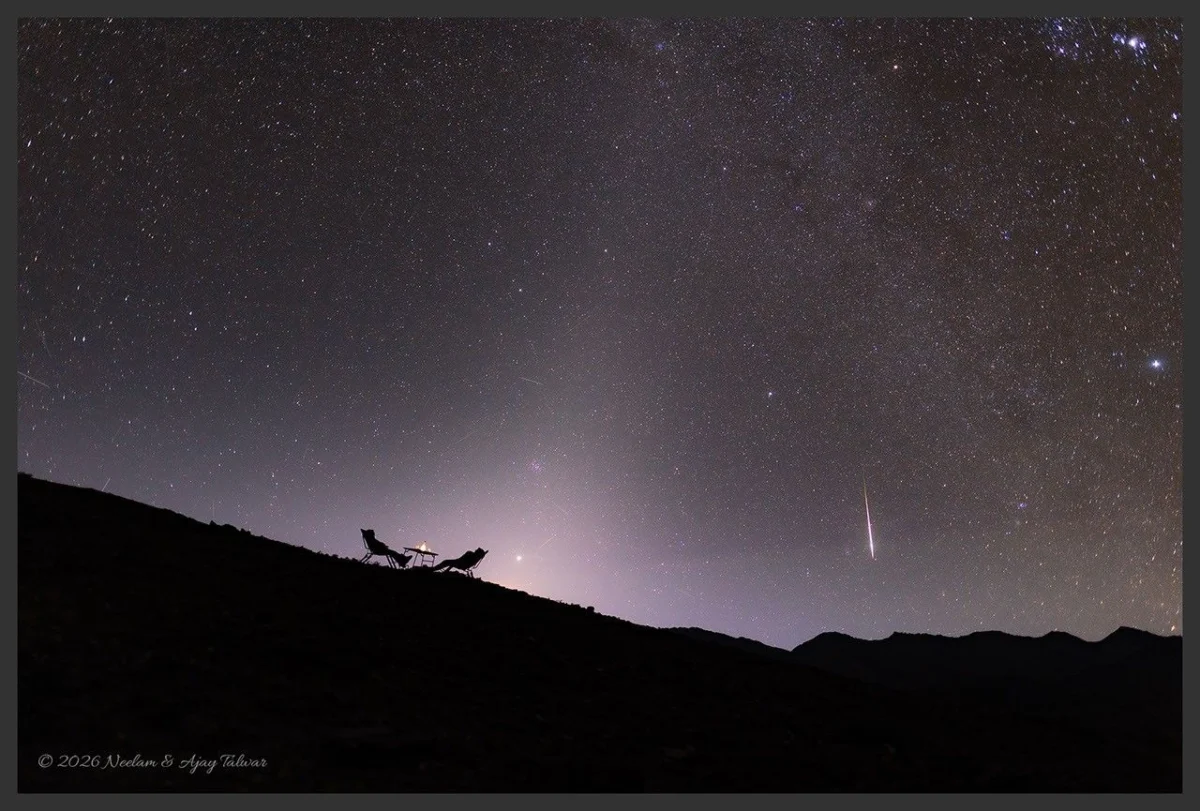
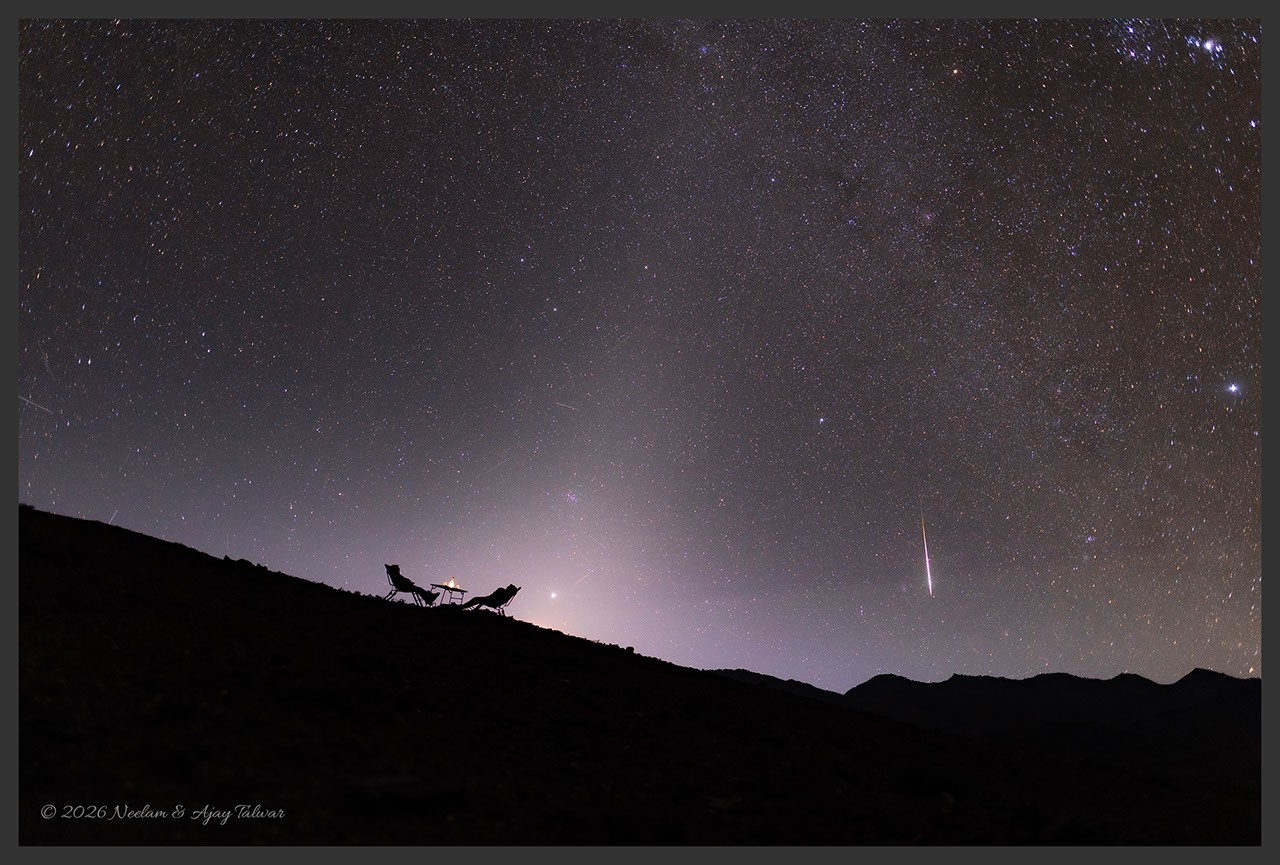
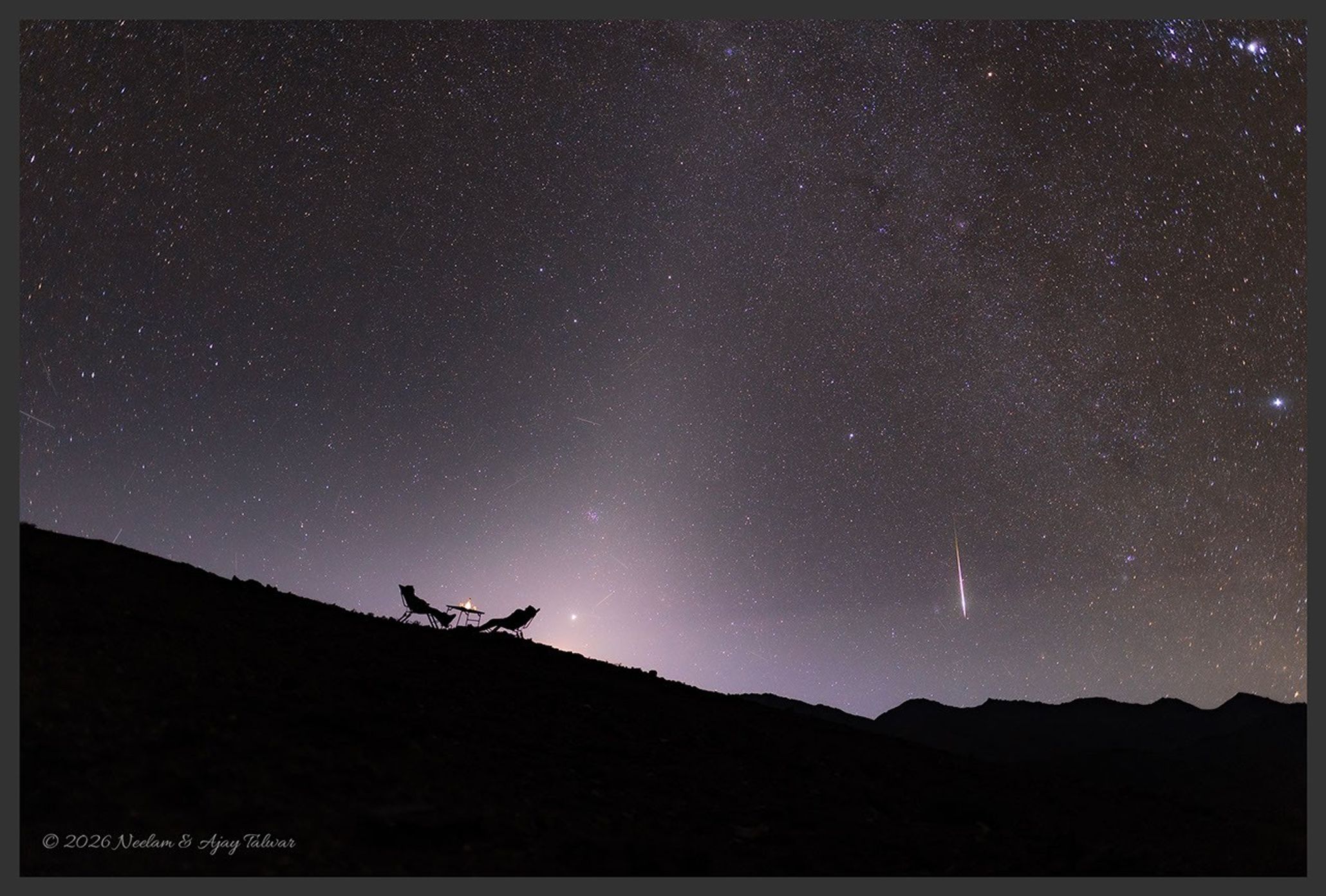
The Hanle Dark Sky Reserve, situated at an elevation of approximately 4,500 meters in the high-altitude desert of Ladakh, India, recently provided the backdrop for a remarkable astronomical observation. During a September star party, photographers and astronomers captured a vivid display of zodiacal light—a faint, triangular glow that extends upward from the horizon along the ecliptic plane. This phenomenon, often colloquially referred to as a "false dawn" or "false dusk," was documented in high-resolution detail, revealing not only the diffuse light of interplanetary dust but also the prominent positioning of Jupiter, the open star cluster M44, and the planet Mars against the backdrop of the Himalayan night sky.
The Phenomenon of the Zodiacal Light
Zodiacal light is a consequence of sunlight scattering off billions of microscopic dust particles that populate the inner solar system. These particles are remnants of cometary activity and asteroid collisions, forming a vast, flat disk that aligns with the orbital plane of the planets. When viewed from Earth under exceptionally dark, pristine conditions, this disk appears as a diffuse, glowing band.
The "false dawn" effect occurs because the dust disk is brightest near the sun. When the sun is well below the horizon, the scattered light remains visible, creating a luminous pyramid of illumination that can be mistaken for the early onset of twilight. The Hanle Dark Sky Reserve, being one of the few places on the planet with sufficiently low light pollution and thin, dry air, serves as an ideal laboratory for observing this subtle celestial display.
A High-Altitude Haven for Astronomy
The selection of the Hanle Dark Sky Reserve for such observations is not incidental. The reserve is located in the Changthang region, where the thin, dry atmosphere minimizes the scattering of light by water vapor and aerosols, which is critical for capturing the faint glow of the zodiacal band. The altitude of 4,500 meters places observers above a significant portion of the Earth’s dense atmosphere, providing a clarity that is difficult to replicate at sea level.
For the international astronomical community, the reserve represents a vital asset. As global light pollution continues to threaten the viability of ground-based observational astronomy, sites like Hanle are increasingly protected and prioritized. The September star party served as both a community engagement event and a serious research opportunity, allowing astrophotographers to document the seasonal orientation of the ecliptic, which in September favors a sharp, vertical alignment of the zodiacal light before dawn.
Chronology of the Observation
The capture of the zodiacal light during the September event followed a specific alignment of planetary bodies. As the sun descended, the zodiacal band became visible, stretching from the eastern horizon toward the zenith.
- Initial Observation: Observers identified the glow emerging as astronomical twilight reached its deepest point.
- Planetary Positioning: The planet Jupiter was noted as being immersed within the faint glow, serving as a bright anchor point near the horizon.
- Zenith Progression: As the gaze shifted upward, the open star cluster M44 (the Beehive Cluster) became visible, followed by the yellowish hue of Mars.
- Documentation: The imagery produced during this window was subsequently annotated to identify these specific celestial coordinates, providing a reference guide for the public and the scientific community.
Supporting Data and the Mars Dust Connection
Recent scientific inquiry into the origin of this interplanetary dust has challenged long-standing assumptions. For decades, it was widely believed that the dust was primarily contributed by short-period comets. However, data transmitted from the Juno spacecraft during its cruise to Jupiter has provided a compelling alternative hypothesis.
Juno’s star-tracking cameras, which were never intended to study interplanetary dust, recorded unexpected "hits" by microscopic particles. By analyzing the frequency and direction of these impacts, researchers determined that the dust population is highly concentrated near the orbit of Mars. This suggests that Mars is a major, if not the primary, source of the dust that backscatters sunlight to create the zodiacal light seen from Earth.
The implications of this discovery are profound for our understanding of solar system evolution. It suggests that the planetary environment is more dynamic than previously understood, with planets actively contributing to the debris field that populates the solar system. This "serendipitous" detection—a term used by researchers at NASA—highlights the importance of secondary mission data in expanding our fundamental knowledge of the cosmos.
Official Perspectives and Institutional Changes
This observational report coincides with a significant logistical transition for the Astronomy Picture of the Day (APOD) program. Managed by NASA and supported by the Michigan Technological University, the program serves as a bridge between professional research and the general public. As of the current term, the primary repository for APOD content is migrating from its long-standing home at apod.nasa.gov to the consolidated science.nasa.gov/apod platform.
This move is part of a broader initiative by NASA to modernize its digital infrastructure and improve the accessibility of scientific data. By migrating to a unified science portal, the agency aims to streamline the user experience and ensure that astronomical data remains readily available to educators, students, and enthusiasts. The inclusion of the Hanle images in this archive underscores the agency’s commitment to highlighting both global dark-sky sites and current research regarding interplanetary dynamics.
Broader Implications and Future Stargazing
The study of zodiacal light is more than an aesthetic pursuit; it is a gateway to understanding the debris disks surrounding other stars. By observing our own solar system’s dust, astronomers can create models that help interpret the light curves of exoplanetary systems. When a telescope observes a distant star, the presence of an exozodiacal dust disk can often mimic or mask the signals of orbiting exoplanets. Understanding the density, composition, and behavior of our own local dust is therefore essential for the next generation of space-based observatories.
Furthermore, the protection of sites like the Hanle Dark Sky Reserve ensures that humanity retains the ability to conduct such observations. As urbanization spreads, the "night" is becoming an endangered commodity. The collaboration between the Indian Institute of Astrophysics and local stakeholders to maintain the reserve is a model for environmental and scientific preservation.
Conclusion: A Window to the Solar System
The images captured in September 2026 serve as a testament to the intersection of human curiosity and technological capability. By viewing the zodiacal light, an observer is effectively looking at the "fossil record" of the solar system—the pulverized remains of ancient comets and the active contributions of the Red Planet.
As we continue to refine our models of the solar system, the "false dawn" remains a reminder that even the space between the planets is not truly empty. It is a crowded, active environment, and thanks to the clear skies of the Himalayas and the diligence of modern observers, the secrets of this interplanetary medium are slowly being brought to light. For those interested in the cosmos, the ongoing documentation of such events remains a cornerstone of amateur and professional astronomy alike, bridging the gap between the distant reaches of space and the observers here on Earth.