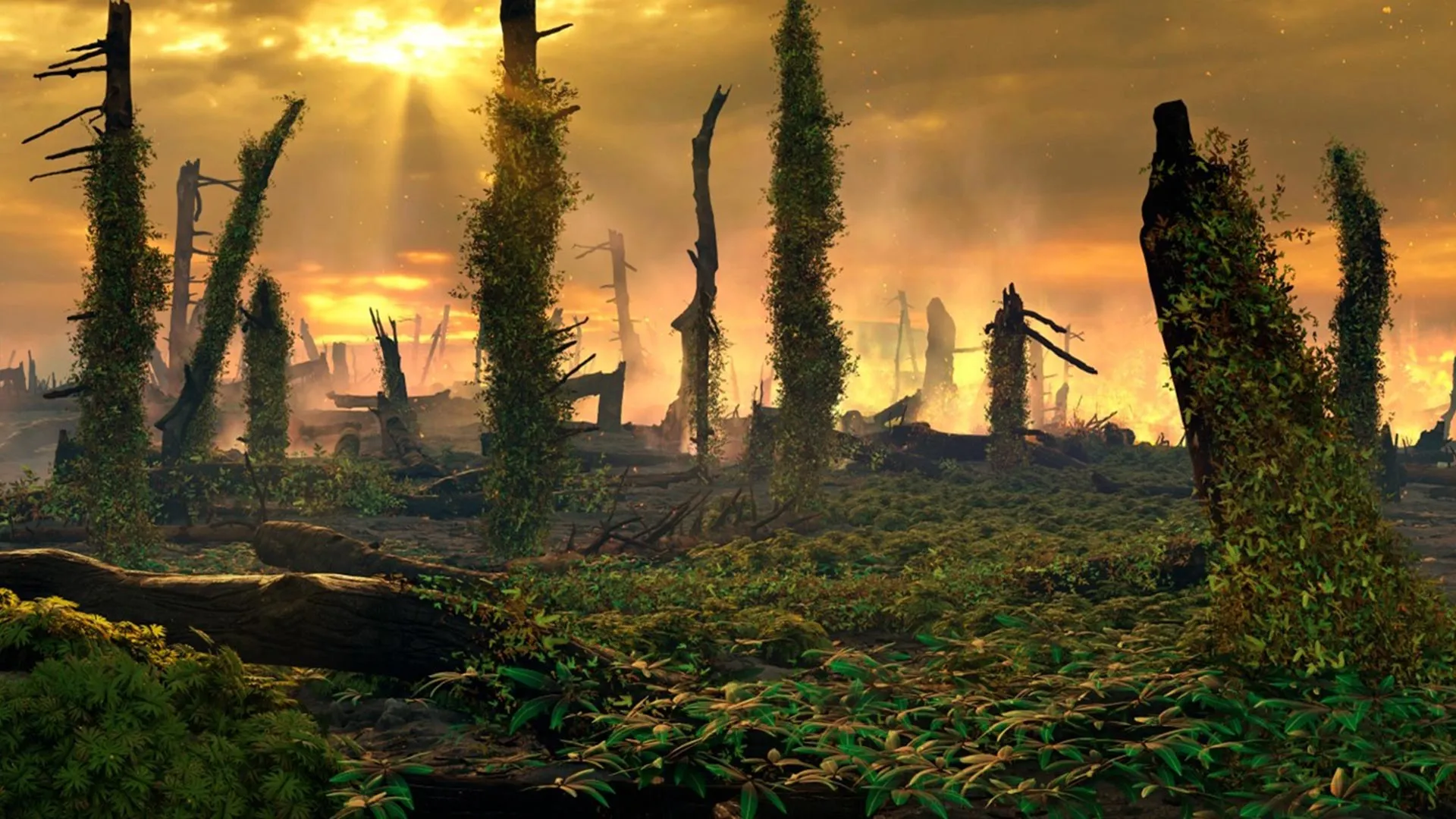
The dramatic upheaval of Earth’s ecosystems approximately 201 million years ago, known as the end-Triassic mass extinction, was a cataclysmic event directly linked to colossal volcanic eruptions. These fiery outbursts, occurring concurrently with the tectonic rifting that tore apart the supercontinent Pangea, spewed immense quantities of carbon dioxide (CO2) into the atmosphere. This surge in greenhouse gases triggered a significant global warming event, with temperatures estimated to have climbed between 5 to 10 degrees Celsius. The consequences for terrestrial life were devastating, leading to widespread ecological collapse.
The Reign of Ferns and the Rise of Fire
As the planet endured this unprecedented thermal stress, established forests, once the dominant vegetation, began to falter and die. Into these ravaged landscapes, a hardy and opportunistic species—ferns—proliferated with remarkable speed. These resilient plants quickly colonized vast tracts of land, particularly in what is now Northwest Europe, transforming the environment into expansive, savannah-like expanses. Emerging research from an international consortium, spearheaded by geologists at Utrecht University, indicates that these fern-dominated regions became highly susceptible to widespread and intense wildfires. Intriguingly, the ferns themselves may have provided a substantial portion of the fuel that sustained and propelled these infernos.
The groundbreaking findings of this study were published on July 21, 2026, in the prestigious scientific journal Nature Geoscience.
Unearthing Ancient Inferno: Reconstructing Wildfire Activity
To meticulously reconstruct the history of wildfires during this pivotal period in Earth’s history, the research team delved into exceptionally well-preserved sedimentary records. They analyzed material from four distinct drill cores, one of which was a recently extracted 640-meter-long core from the United Kingdom, offering an unprecedented glimpse into the deep past.
The scientists employed a multi-faceted approach to gauge ancient fire activity. Their methodology involved quantifying fossil charcoal, a direct indicator of burning, and polycyclic aromatic hydrocarbons (PAHs). PAHs are organic compounds produced during the incomplete combustion of organic matter, essentially the molecular signatures of wildfire smoke.
When these findings were cross-referenced with existing records of fossil pollen and spores, a compelling correlation emerged: a pronounced surge in wildfire activity coincided precisely with the main phase of the end-Triassic extinction. This period of intense fiery activity also aligned with a dramatic and widespread expansion of fern populations.
Advancing Fire Detection: The Palynomorph Darkness Index
While traditional indicators like charcoal and PAHs offer valuable insights, they are not without their limitations. The physical fragmentation of large charcoal pieces into smaller particles can artificially inflate the perceived extent of past fires. Furthermore, PAHs can be transported considerable distances from their source fires, and some of these organic molecules may not survive the geological processes of preservation, leading to an underestimation of their presence. Recognizing these inherent challenges, the researchers embarked on developing a novel and more robust method for tracking fires across geological time.
"The novelty of this study came from the analysis of color changes of organic microfossils," explains Dr. Bas van de Schootbrugge from Utrecht University, a senior author on the paper. "We used a simple and very low-cost technique that quantifies the ‘darkness’ of fossil pollen and spores, a so-called Palynomorph Darkness Index."
A Curious Phenomenon: The Geological Record of Color
Organic microfossils typically darken as they are buried deeper within the Earth’s crust. This gradual darkening is a consequence of increasing pressure and temperature, which progressively alter the organic material. Sediments that sink to greater depths are subjected to more intense heat, akin to cooking, causing the organic matter to become darker and more carbonized. In most geological contexts, greater burial depth equates to darker fossilized organic matter.
"But here we found a very different pattern," Dr. Van de Schootbrugge stated.
Contrary to typical geological observations, the oldest and deepest pollen and spores recovered from the cores remained relatively pale in color. However, fossils dating to the extinction interval exhibited a distinct and progressive darkening, eventually reaching an intensely dark brown hue. Following the cessation of the extinction period, the fossilized organic matter reverted to a pale yellow color, mirroring the appearance of older, less buried samples.
"We were quite puzzled by this phenomenon as it occurs in all 4 cores at exactly the same time, so it could not have been related to burial of the sediments as the four basins experienced very different geological histories," Dr. Van de Schootbrugge elaborated. This temporal synchronicity across geologically independent basins ruled out burial depth as the primary cause for the observed color changes.
The "Dark Zone": A Terrestrial Firestorm Revealed
The Palynomorph Darkness Index operates by measuring color variations using the standard RGB (Red, Green, Blue) spectrum. A digital camera integrated with a light microscope captures images of the fossilized pollen and spores. This color data is then processed to derive an average grayscale value, enabling precise quantification of darkness. This standardized approach allows for robust comparisons between samples from different stratigraphic layers within the same core, as well as across samples from cores collected at geographically distinct locations.
The research team meticulously performed over 15,000 measurements of pollen and spores from plant species that thrived before, during, and after the end-Triassic extinction event. They also conducted comparative analyses, examining the pollen of trees against the spores of ferns, to ascertain whether inherent biological differences between these plant groups might have contributed to the observed darkening.
"All plant groups show the same effect, which is a strong indication that it was the result of an outside force," Dr. Van de Schootbrugge confirmed.
When the scientists overlaid these colorimetric data with their findings on charcoal and PAH concentrations, a clear and compelling picture emerged. The unusual "Dark Zone," characterized by the progressively darkening microfossils, appeared to be a direct geological record of an extended and severe period of wildfire activity that coincided with the proliferation of ferns.
"The darkening overlaps exactly with the fern spike, the main extinction interval, and elevated abundance of charcoal and PAHs," the study authors concluded.
A Warming World and the Resurgence of Ferns
The rapid and dominant expansion of ferns during the peak of the end-Triassic extinction was likely a complex interplay of interconnected environmental pressures. These included the widespread deforestation caused by the extinction event itself, subsequent soil erosion, intense greenhouse warming, and the recurrent onslaught of wildfires.
Dr. Van de Schootbrugge highlighted the remarkable resilience of these ancient plants: "Ferns are truly remarkable plants that have withstood many crises throughout Earth history, and some species can adapt to some of the most extreme environments. They can be considered to be true disaster species."
Certain fern species possess an extraordinary ability to colonize disturbed ground, particularly in areas where other vegetation has been eradicated. Fire, paradoxically, can even accelerate this process. While the above-ground parts of ferns are consumed by flames, their robust root systems, often located beneath the surface, enable rapid regrowth. This regenerative capacity allows them to re-establish themselves and spread more quickly than many competing plant species, enabling them to capture and dominate even larger territories.
This ecological advantage may offer a compelling explanation for the protracted duration of the fern spike. Researchers estimate that this period of fern dominance persisted for at least 40,000 years, and potentially as long as 300,000 years.
Fueling the Flames: Ferns as an Ignition Source
"When the ferns dry out, the thick mats act as the ideal fuel to trigger massive wildfires," Dr. Van de Schootbrugge explained. The rapid proliferation of pioneer and "weeding" ferns, characterized by their fast growth and ability to colonize disturbed areas, created extensive fern savannahs. Some fern species may have even functioned as "fire ladders," facilitating the upward spread of flames across the landscape while simultaneously outcompeting and smothering other nascent vegetation.
"Ferns responded to and delivered the fuel that fanned the flames, triggering repeated massive wildfires. A truly hellish world," he described, painting a vivid picture of the ancient environment.
The cumulative effect of these processes likely created a destructive feedback loop. Climate warming and the loss of forests opened up the landscape, paving the way for fern colonization. These ferns, in turn, provided an abundant source of dry fuel for recurrent fires. Following these infernos, the ferns would rapidly regrow and expand once more, perpetuating the cycle.
"The lesson we can learn from this is that the combination of climate change, deforestation, and the spread of opportunistic species can provide all the ingredients for a perfect storm," Dr. Van de Schootbrugge concluded, drawing a stark parallel to contemporary environmental concerns.
Broader Implications and Future Research
The end-Triassic extinction event was one of the "Big Five" mass extinction events in Earth’s history, profoundly reshaping the planet’s biodiversity. It marked the end of the Triassic period and ushered in the Jurassic, a golden age for dinosaurs. The extinction wiped out a significant proportion of terrestrial and marine species, clearing ecological niches that would later be occupied by new life forms. Approximately 70-75% of all species went extinct during this period, including many large amphibians and most non-avian archosaurs.
This new research provides a critical piece of the puzzle, illuminating a previously underappreciated terrestrial feedback mechanism that likely exacerbated the extinction event. The study’s methodology, particularly the development and application of the Palynomorph Darkness Index, offers a powerful new tool for reconstructing ancient fire regimes and understanding past climate-vegetation interactions.
Scientists are now keen to explore whether similar fern-driven wildfire cycles played a significant role in other past extinction events or in periods of rapid climate change throughout Earth’s history. Further research could also investigate the specific physiological adaptations of these ancient ferns that allowed them to thrive in such harsh, fire-prone conditions, potentially offering insights into plant resilience in the face of environmental stress. The implications for understanding modern climate change and its cascading effects on ecosystems are profound, underscoring the interconnectedness of climate, vegetation, and fire in shaping the planet’s biological trajectory.