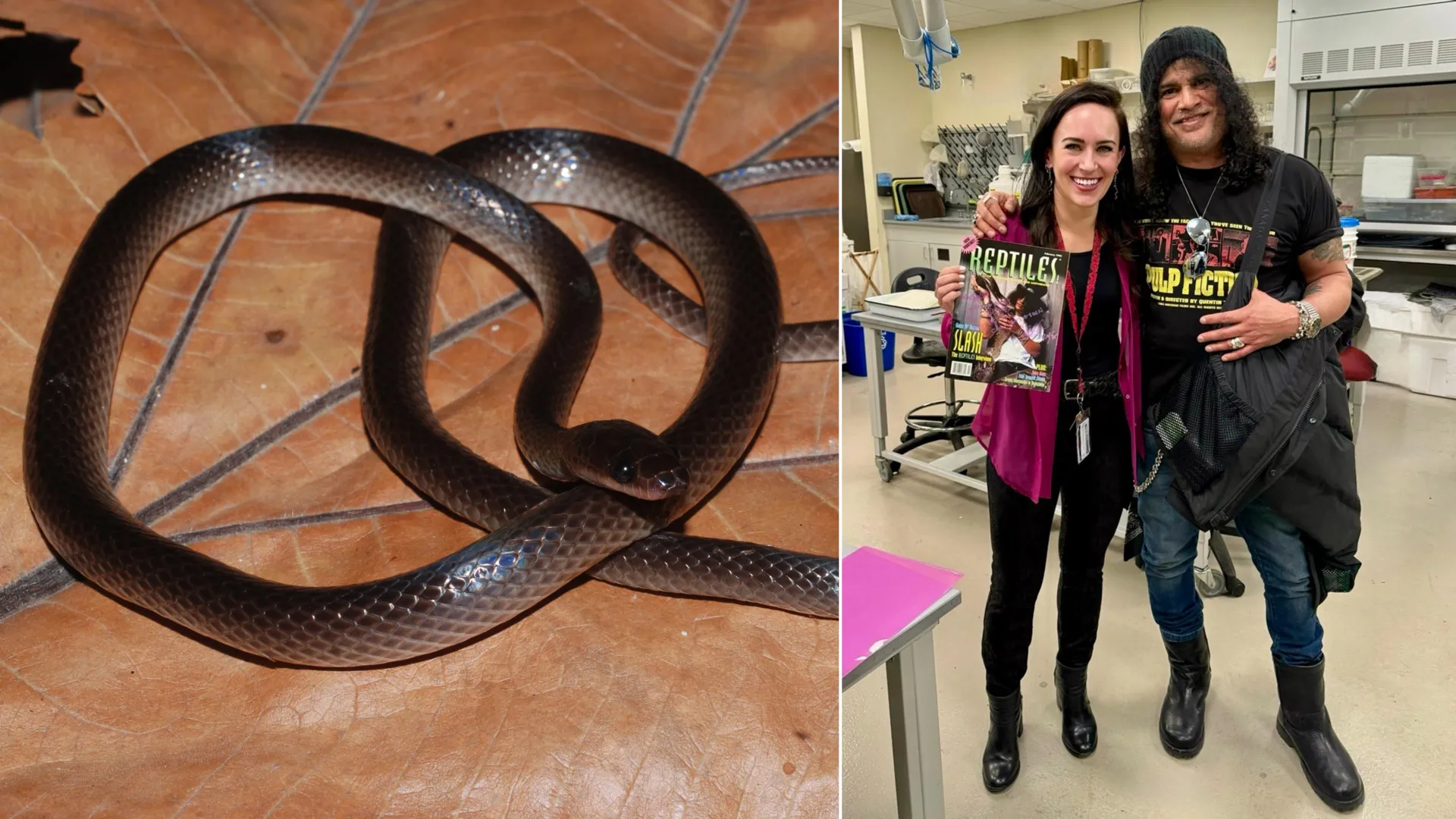
Saul Hudson, globally recognized by his stage name Slash, has solidified his legacy in music as the legendary lead guitarist of Guns N’ Roses. However, for decades, his influence has extended far beyond the stage and into the world of natural history. A lifelong enthusiast of reptiles, the musician has long been a vocal supporter of zoos, museums, and wildlife conservation. This long-standing passion has recently culminated in a unique scientific tribute: researchers have officially named a newly identified snake species from the dense forests of New Guinea Lielaphis slashi, or Slash’s groundsnake.
The formal designation, detailed in a study published in the peer-reviewed journal Zootaxa, marks a significant intersection between popular culture and taxonomic science. For Slash, the recognition is a profound, if unexpected, honor. “As a long-time herpetophile, I am extremely honored and humbled to have Lielaphis slashi from New Guinea named after me,” Slash stated in response to the news. “It is really exciting; I never would have imagined this moment would arrive.”
A Convergence of Music and Herpetology
The naming of Lielaphis slashi was spearheaded by Dr. Sara Ruane, the Field Museum’s Associate Curator of Herpetology and the study’s senior author. For Dr. Ruane, the decision to name the species after the musician was not merely a random choice but a reflection of a personal journey that bridged her dual interests in rock music and biological science.
“Guns N’ Roses has been one of my favorite bands since I was in first grade,” Dr. Ruane shared. By the time she reached the fifth grade, she had already solidified her career aspirations, telling her teacher that she intended to become a herpetologist—a scientist who specializes in the study of amphibians and reptiles. The connection deepened when she was twelve years old and encountered an issue of Reptiles Magazine featuring Slash on the cover, posing with his pet reticulated python.
Years later, as an established scientist with the authority to contribute to the nomenclature of newly discovered species, Dr. Ruane revisited that formative influence. Upon re-reading an interview with the guitarist, she noted his genuine advocacy for natural history museums and his childhood interest in searching for snakes in the wild. These shared values convinced her that Slash was the ideal namesake for a species that represented the hidden wonders of New Guinea’s biodiversity.
The Chronology of a Discovery
The journey to identifying Lielaphis slashi began nearly two decades ago. In 2006, during a nocturnal field expedition in the lush, biologically diverse forests of New Guinea, Dr. Chris Austin, a professor and curator of herpetology at the Louisiana State University Museum of Natural Science, encountered a specimen that did not match any known records.
New Guinea, the world’s second-largest island, remains one of the most enigmatic regions on the planet. Divided between Indonesia and Papua New Guinea, its rugged, tropical terrain contains an immense array of species that remain largely undocumented by the scientific community. Finding groundsnakes in this environment is a specialized endeavor; they are nocturnal creatures, typically emerging just after sunset at the bases of large trees to forage for food.
Dr. Austin, a co-author of the study, noted the inherent difficulties and dangers of such research. “When working at night in New Guinea, you need to be very careful, as there are several highly venomous species that look very similar to the non-venomous groundsnakes,” he explained.
Following the initial collection in 2006, the specimen remained in museum archives, awaiting the necessary genetic and morphological analysis. The project gained momentum in 2016 when Dr. Ruane, having completed her doctorate, began a collaboration with Dr. Austin at LSU. The two researchers focused their efforts on untangling the complex taxonomy of New Guinea’s poorly understood snake populations.
Genetic Analysis and Taxonomic Distinction
At first glance, the reddish-brown, 28-inch-long snake did not immediately present as a distinct species. The breakthrough occurred through the application of advanced laboratory techniques. Tianqi Huang, the study’s first author and a post-doctoral researcher at the Field Museum, utilized multiple cutting-edge genetic analyses to differentiate the specimen from its counterparts in the same genus.
“The combination of physical characteristics, like differences in numbers of scales when compared with other species, and the genetic evidence is what led us to realize that it is an entirely new species,” Huang noted. To confirm their findings, the team employed ecological modeling, which demonstrated that L. slashi occupies a specific ecological niche distinct from similar snakes in the genus. This rigorous, multi-faceted approach is standard in modern taxonomy, ensuring that new species are categorized based on evolutionary history rather than superficial appearance.
Ecological Context and Behavioral Traits
While the scientific community has successfully classified L. slashi, the creature remains shrouded in mystery. Observing snakes in the wild is notoriously difficult due to their evasive nature. However, the study of the snake’s anatomy offers insights into its lifestyle.
Unlike large constrictors that subdue prey through physical force, L. slashi belongs to a group of groundsnakes that possess specialized teeth in the back of their mouths. Researchers hypothesize that these teeth are adapted for grasping slippery-scaled lizards and the eggs of other reptiles. Contrary to the aggressive, "dangerous" persona often associated with Guns N’ Roses, the namesake snake is non-venomous and poses no threat to humans.
Broader Implications for Conservation
The identification of Lielaphis slashi serves as a poignant reminder of the fragility of New Guinea’s ecosystems. The region is currently facing significant environmental pressures, including the expansion of coffee farming and mining operations. These industrial activities threaten to destroy habitats before they are fully documented by the scientific community.
“That’s part of why describing the species that live there is important,” Dr. Ruane emphasized. “Every species should be recognized in order for us to better understand how ecosystems work, how everything fits into the environment. We can’t conserve animals or other living things that we don’t know about.”
The formal classification of L. slashi is a critical step in biodiversity mapping. By establishing a clear record of the species, scientists can better advocate for the protection of the specific forest zones the snake inhabits. The naming of the species—which serves to draw public attention to the field of herpetology—also highlights the role that cultural figures can play in promoting scientific literacy and conservation awareness.
Conclusion and Future Research
The team responsible for this discovery represents a global collaborative effort, including researchers from the Field Museum, Rutgers University, Louisiana State University, Slippery Rock University, the American Museum of Natural History, the Papua New Guinea National Museum and Art Gallery, the Virginia Museum of Natural History, and the University of Kentucky.
As climate change and human encroachment continue to alter global landscapes, the work performed by these scientists becomes increasingly urgent. Lielaphis slashi is just one of many species currently awaiting discovery and protection in the forests of New Guinea. For now, the legacy of the snake is tied to a man who, much like the scientists studying these remote habitats, has spent a lifetime driven by a profound curiosity for the natural world. This union of music history and taxonomic discovery ensures that while Slash continues to perform on global stages, a small, elusive creature in the New Guinea undergrowth will forever carry his name, serving as a testament to the importance of biodiversity and the ongoing quest to understand the living world.