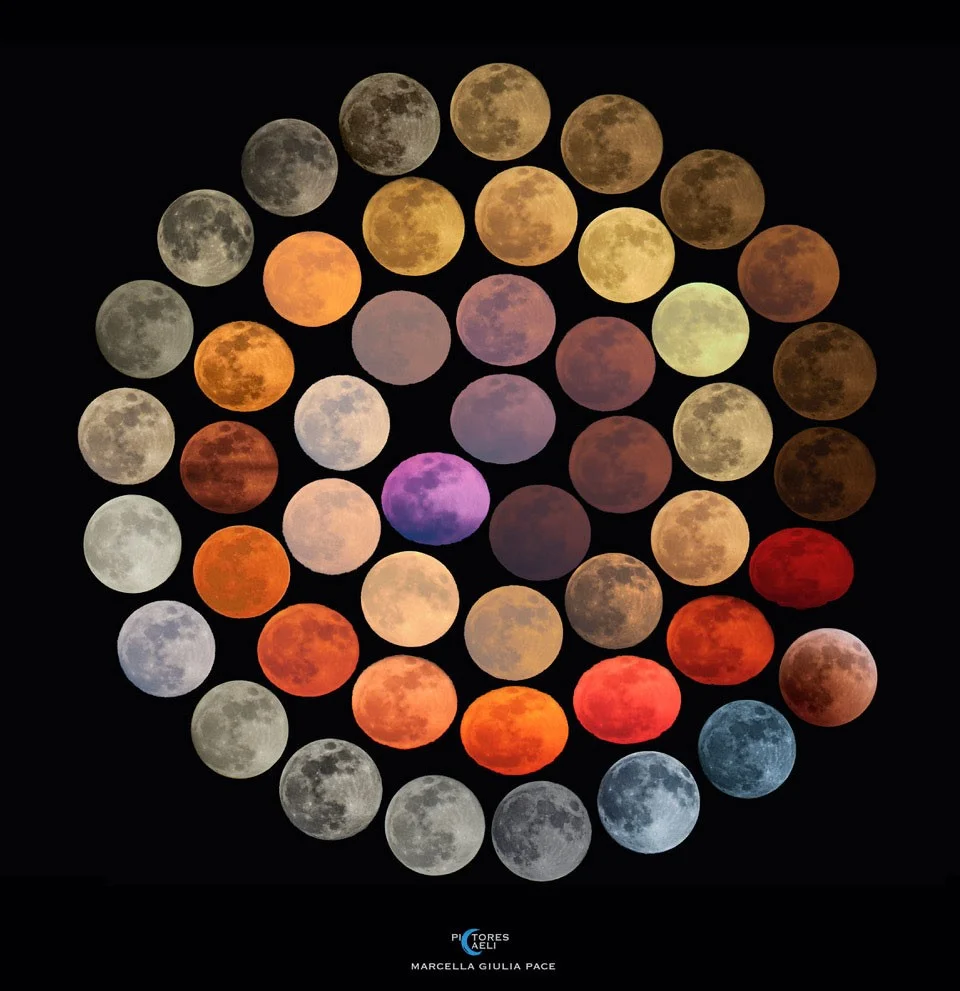
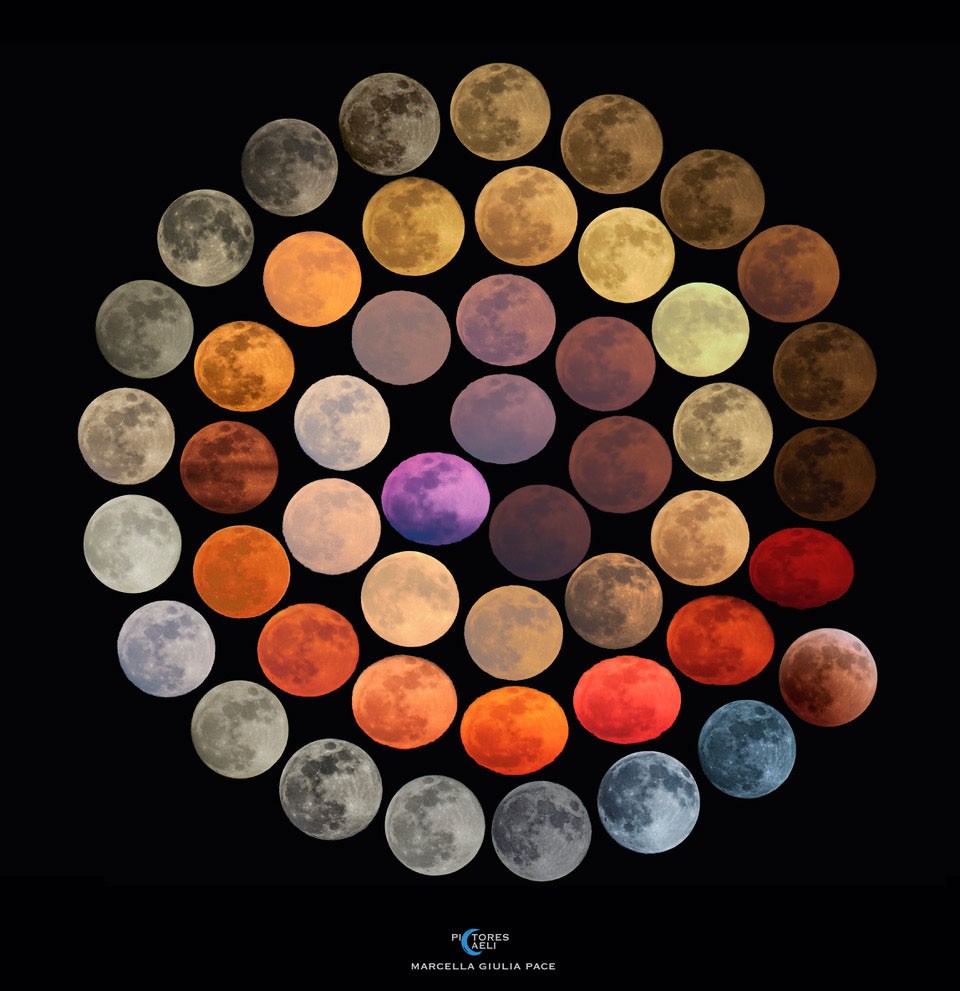
The Moon is fundamentally a monochromatic celestial body, a desolate landscape of basaltic plains and cratered highlands that reflects sunlight with a characteristic grey, albedo-rich glow. However, to the terrestrial observer, the Moon frequently presents a spectrum of colors that defy its true composition. A recent compilation by astrophotographer Marcella Giulia Pace, featured as NASA’s Astronomy Picture of the Day (APOD) for November 1, 2026, offers a definitive visual record of these optical phenomena. Captured over a ten-year span across various regions of Italy, the project documents how Earth’s atmosphere acts as a dynamic filter, refracting, scattering, and diffusing moonlight into a kaleidoscope of hues ranging from deep crimson to ethereal blue.
The Physics of Atmospheric Scattering
The apparent color of the Moon is governed by the principles of Rayleigh and Mie scattering, as well as the presence of atmospheric particulates. When the Moon is positioned high in the night sky, its light passes through a relatively thin column of the Earth’s atmosphere, reaching the observer with minimal alteration. In this state, the Moon appears in its natural, muted grey-brown tone.
However, as the Moon nears the horizon, its light must traverse a significantly longer path through the atmosphere. This increased distance exposes the lunar light to a higher concentration of gas molecules and aerosols. According to atmospheric scientists, shorter wavelengths—primarily blue and violet—are scattered more efficiently by these particles. By the time the light reaches the observer’s eye, the shorter wavelengths have been largely stripped away, leaving behind the longer, warmer wavelengths. This explains the familiar red, orange, and yellow tints observed during moonrise or moonset.
The phenomenon is often intensified by local atmospheric conditions. The presence of smoke, volcanic ash, or fine dust particles—often resulting from wildfires or industrial pollution—can exacerbate the scattering effect, leading to the deep, saturated reds that characterize a "Blood Moon" outside of eclipse events.
A Decade-Long Chronology of Observations
Marcella Giulia Pace’s documentation project serves as a longitudinal study of these optical events. Between 2016 and 2026, Pace utilized standardized imaging techniques to record the lunar disc from disparate locations, including coastal regions, urban centers, and high-altitude mountainous zones in Italy.
The collection serves as more than an aesthetic pursuit; it functions as a visual ledger of atmospheric variability. The timeline includes:
- 2016–2017: Initial documentation focusing on horizon-based color shifts during standard lunar cycles.
- July 2018: The capture of the total lunar eclipse, providing a stark contrast to non-eclipse atmospheric color shifts. During this event, the Moon entered the Earth’s umbra, and the only light reaching the lunar surface was sunlight refracted through the Earth’s atmosphere. This light, stripped of all but the longest wavelengths, bathed the Moon in a deep, coppery red.
- 2019–2026: Continued observation of anomalous color shifts, including instances of "blue moons"—a rare occurrence where larger dust particles, typically greater than 1 micron in size, scatter red light more effectively than blue, resulting in a blue-tinted lunar appearance.
Decoding the Purple Moon
While the mechanics of red and yellow lunar hues are well-understood by physicists, the emergence of a purple-tinted Moon remains a subject of observational curiosity. Pace’s collection includes images where the Moon exhibits a distinct violet or purple cast. Scientists suggest that this is likely a multi-factor optical phenomenon rather than a single atmospheric event.
It is hypothesized that a purple Moon occurs when a specific combination of atmospheric humidity, high-altitude aerosols, and low-angle refraction occurs simultaneously. The blue light, which is usually scattered away, may be partially preserved or amplified by specific scattering indices caused by water droplets or ice crystals in the upper troposphere, creating a visual blend with the underlying red shift.
Supporting Data and Scientific Context
The data provided by NASA and atmospheric research institutions reinforces the findings presented in the APOD feature. The "color" of the Moon is a function of the Earth’s optical depth. Astronomers define optical depth as a measure of how much light is absorbed or scattered as it travels through a medium.
Supporting research from the NASA Science Activation program notes that for every 10 degrees of altitude above the horizon, the air mass through which moonlight passes decreases significantly. At the horizon, an observer is looking through roughly 38 times the amount of atmosphere compared to looking directly overhead. This provides the necessary "laboratory" conditions for the color-shifting observed in the APOD collection.
Institutional Perspectives on Amateur Astrophotography
The inclusion of Pace’s work in the Astronomy Picture of the Day reflects a growing trend of professional institutions collaborating with citizen scientists and professional-grade astrophotographers. Experts from the Goddard Space Flight Center (GSFC) and the Michigan Technological University—who curate the APOD feed—regularly emphasize the importance of high-quality, long-term observational records.
"The documentation of celestial events by individuals like Marcella Giulia Pace provides researchers with a localized database of atmospheric conditions that might otherwise be overlooked," noted a spokesperson for the NASA Science Activation team. By standardizing the equipment and methodology over a decade, such projects provide a consistent baseline that helps educate the public on the complex relationship between the observer, the atmosphere, and the cosmos.
Broader Implications: Atmosphere as a Lens
The implications of these observations extend beyond mere curiosity. Atmospheric scientists use these natural color-shifting events to monitor the health and composition of the atmosphere. The prevalence of certain hues during moonrises can serve as a proxy for identifying increases in suspended particulates, whether from natural sources like forest fires or anthropogenic sources like industrial emissions.
Furthermore, these visual records serve as essential educational tools. By deconstructing the "myth" of the Moon’s color, these projects facilitate a broader understanding of optics. The public, often misinformed by folklore regarding the "Blue Moon" (which is traditionally a calendar-based term) or the "Blood Moon" (which is an eclipse-based term), can now engage with the scientific reality of light scattering.
Conclusion: The Observer’s Role
The APOD project concludes that while the Moon remains physically the same grey-brown rock regardless of its position in the sky, its appearance is a testament to the transparency and chemical composition of our own atmosphere. The spiral arrangement of images in Pace’s compilation effectively communicates the narrative of a changing sky—a reminder that every view of the night sky is filtered through the thin, fragile, and endlessly complex layer of gases that sustain life on Earth.
For enthusiasts and casual observers alike, the lesson is clear: the color of the Moon is not a property of the Moon itself, but a dialogue between the light of the stars and the composition of the Earth’s air. As technology continues to improve, the ability to document these phenomena with precision will only increase, allowing for a more nuanced understanding of the delicate optical balance that defines our view of the universe. The documentation of the 2018 total lunar eclipse and the decade of horizon-based shifts stands as a milestone in this ongoing observation, providing both a record of the past and a framework for future atmospheric studies.