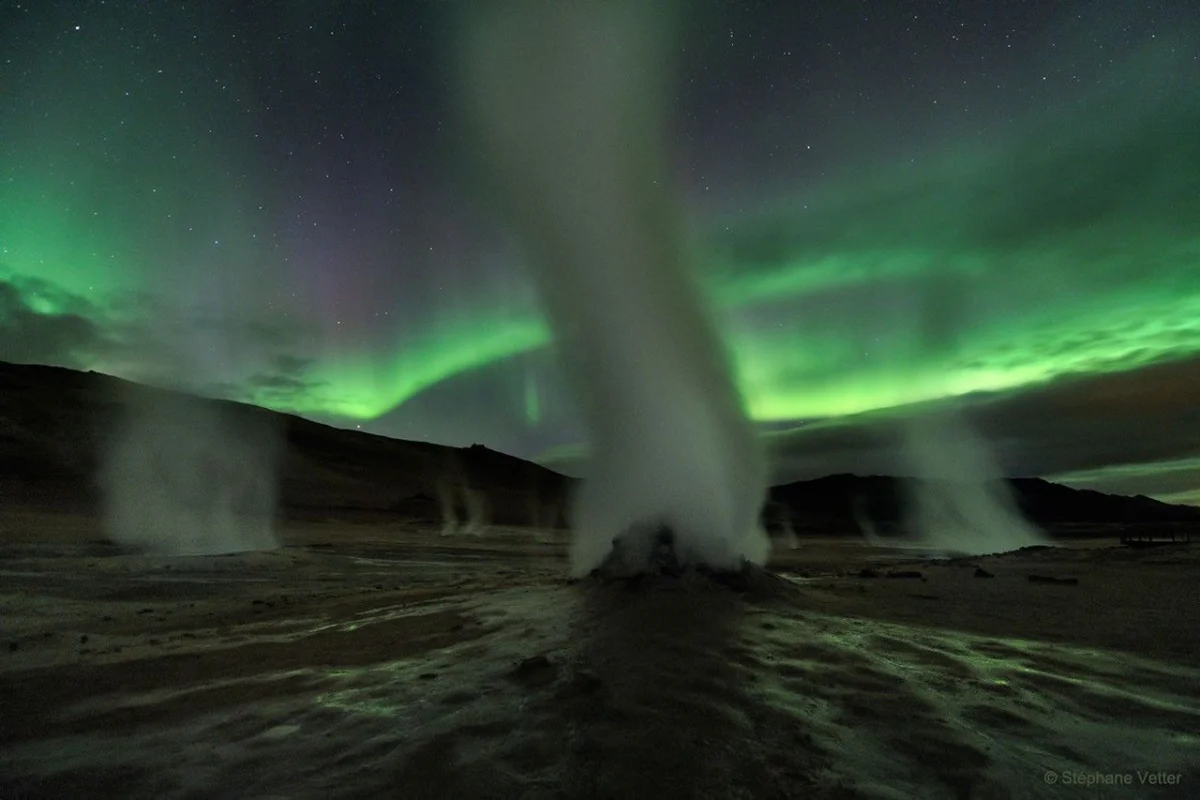
The intersection of terrestrial volcanic activity and solar-driven atmospheric phenomena has produced a hauntingly beautiful scene at Hverir, Iceland, capturing the imagination of space enthusiasts and geologists alike. As the Sun continues its journey through the high-activity phase of its current solar cycle, the Earth’s upper atmosphere has become a canvas for vibrant auroral displays, which, when viewed against the backdrop of Iceland’s otherworldly geothermal landscape, highlight the dynamic nature of our home planet. Photographed by Stéphane Vetter of Nuits sacrées, this image—featured as NASA’s Astronomy Picture of the Day—serves as a reminder that Earth is a living, breathing, and magnetically shielded planet subject to the whims of our nearest star.
The Science of the Hverir Display
Hverir, situated in the Krafla volcanic system of northeastern Iceland, is one of the most active geothermal fields in the region. The landscape is characterized by boiling mud pools, sulfurous fumaroles, and steaming vents that release gases from deep within the Earth’s crust. When these plumes of steam rise into the freezing night air, they create a dense, ethereal fog that clings to the rugged terrain.
On the night the photograph was captured, this earthly vapor collided with a celestial event: a geomagnetic storm. These storms occur when the Sun ejects clouds of charged particles—known as coronal mass ejections (CMEs)—or releases high-speed streams of solar wind. When these particles interact with the Earth’s magnetosphere, they are funneled toward the polar regions. Upon reaching the upper atmosphere, they strike oxygen and nitrogen atoms, exciting them and causing them to emit light. The result is the characteristic green, pink, and violet glow of the aurora borealis. At Hverir, the juxtaposition of the subterranean steam rising from the volcanic vents and the cascading ribbons of green light in the sky created a visual synthesis of internal planetary heat and external solar influence.
Solar Cycle 25: A Period of Increased Activity
The prominence of such auroral displays is directly linked to the current state of the Sun’s 11-year solar cycle. We are currently in the midst of Solar Cycle 25, which began in December 2019. Solar cycles are defined by the frequency and intensity of sunspots, solar flares, and coronal mass ejections. While initial predictions from the scientific community suggested a relatively modest cycle, observations from NASA and the National Oceanic and Atmospheric Administration (NOAA) have shown that the Sun’s activity has frequently exceeded those forecasts.
As the Sun approaches its "solar maximum"—the period of greatest activity—the likelihood of geomagnetic disturbances increases significantly. During these peaks, the Sun’s magnetic field becomes increasingly tangled, leading to more frequent disruptions that propagate through the solar system. For Earth, this means more frequent and more intense aurorae, often visible at lower latitudes than usual. The image captured at Hverir serves as a testament to this heightened solar climate, providing a visual record of the energy transfer from the Sun to the Earth’s protective magnetic envelope.
Chronology of Solar Influence
To understand the context of the Hverir photograph, one must look at the timeline of solar activity leading up to this event. Throughout 2026, solar observatories, including the Solar Dynamics Observatory (SDO) and the Deep Space Climate Observatory (DSCOVR), recorded a series of intense solar flares originating from active regions on the Sun’s surface.
- Early 2026: Increased sunspot counts suggested that the solar maximum was approaching rapidly.
- Mid-2026: A series of M-class and X-class solar flares resulted in multiple geomagnetic storms, causing significant aurora sightings across North America and Europe.
- October 2026: A sustained high-speed solar wind stream impacted Earth’s magnetosphere, creating a prolonged period of geomagnetic instability. It was during this window of optimal atmospheric conditions that the Hverir photograph was taken.
This timeline illustrates the transient nature of such events. Aurorae are not merely static decorations in the sky; they are the visual manifestation of a continuous, high-stakes interaction between the interplanetary medium and our planet’s biosphere.
The Intersection of Geothermal and Space Weather
The unique appeal of the Hverir image lies in its duality. It captures the "spooky" or "sinister" appearance of Earth, a theme often referenced during the Halloween season. However, from a scientific perspective, the image represents a bridge between two distinct fields of study: vulcanology and heliophysics.

The geothermal activity at Hverir is a direct consequence of the tectonic forces acting upon Iceland, which sits atop the Mid-Atlantic Ridge. This is a region where the Eurasian and North American plates are pulling apart, allowing magma to rise close to the surface. This heat powers the fumaroles. Meanwhile, the aurora is a product of forces originating 93 million miles away. When these two systems converge, they highlight the vulnerability and interconnectedness of our planet. The atmosphere acts as a shield against solar radiation, yet it is also the medium through which the most beautiful displays of solar-planetary interaction occur.
Implications for Modern Infrastructure
While the aurora borealis is a spectacle for photographers and tourists, the geomagnetic storms that create them carry significant implications for modern technology. Intense bursts of solar energy can induce electrical currents in long-distance power grids, potentially causing blackouts. Furthermore, they can disrupt satellite communications, GPS signals, and high-frequency radio transmissions.
Government agencies, including NASA’s Goddard Space Flight Center and the Space Weather Prediction Center (SWPC) under NOAA, maintain constant surveillance of these solar events. The data collected during the period surrounding the Hverir photograph provides valuable insights into how Earth’s magnetosphere responds to sustained solar pressure. By studying these events, scientists are better able to model the potential risks to the power grids and orbital assets that underpin the modern global economy.
Official Perspective and Educational Outreach
The dissemination of such images through the Astronomy Picture of the Day (APOD) program is part of a broader NASA initiative to foster public engagement with science. By pairing high-quality imagery with explanations from professional astronomers, the program aims to make complex astrophysical concepts accessible to a global audience.
"We look at these images not just as art, but as data," says a spokesperson for the NASA Science Activation program. "Every aurora capture, every steam vent, and every star trail provides a moment to teach the public about the mechanisms that govern our solar system. When we see the beauty of the aurora over a place like Hverir, we are seeing the direct impact of the Sun on our planet’s environment."
Looking Toward the Future
As the Sun moves toward the latter stages of its solar maximum, the scientific community anticipates that the frequency of these auroral events will persist before eventually tapering off as the Sun enters its solar minimum. For those located in high-latitude regions like Iceland, Norway, and Canada, the coming months will likely offer further opportunities to witness the dance of particles in the ionosphere.
The image from Hverir remains a poignant reminder of the cosmic theater in which Earth is a primary participant. As we look at the ghostly towers of steam rising against the backdrop of the northern lights, we are reminded that our planet is not an isolated sanctuary, but an active, integral part of a vast and energetic universe. Whether it is the internal heat of the Earth or the external fury of the Sun, the forces shaping our world are constant, powerful, and, occasionally, breathtakingly beautiful.
As the solar cycle continues to evolve, researchers expect to gather more comprehensive data on how these atmospheric interactions shift over time. The lessons learned from these "spooky" nights are helping to refine our understanding of space weather, ensuring that as our reliance on space-based technology grows, so too does our ability to predict and prepare for the next celestial storm.