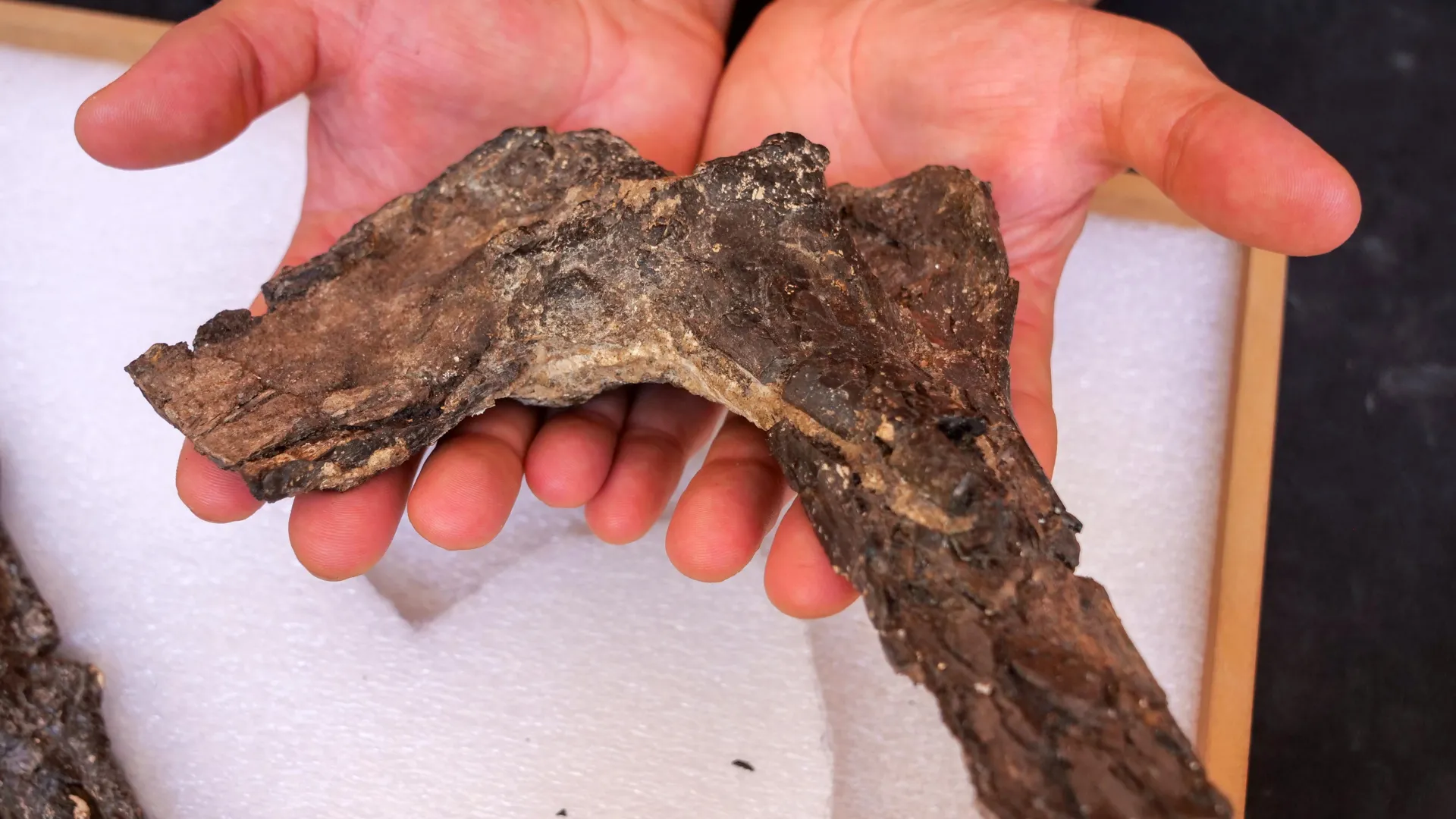
In a groundbreaking discovery that fundamentally alters our understanding of deep-time preservation, an international team of researchers has identified remarkably preserved traces of dinosaur blood within 115-million-year-old fossilized remains. The discovery, centered on the theropod dinosaur Aratasaurus museunacionali, unearthed in the Crato Formation of northeastern Brazil, marks the first definitive chemical confirmation of hemoglobin-derived molecules in such ancient vertebrate fossils. Published in the Proceedings of the National Academy of Sciences, the study suggests that biological molecules previously dismissed as too fragile to survive geological timescales can, under specific geochemical conditions, endure for over a hundred million years.
The research, spearheaded by Professor Kliti Grice of Curtin University’s WA-Organic and Isotope Geochemistry Centre, provides a high-resolution window into the physiological capabilities of extinct theropods. By utilizing advanced analytical techniques to examine the vascular canals of limb bones, scientists have bridged the gap between structural morphology and molecular biology, opening a new frontier in the study of prehistoric life.
The Chronology of Discovery and Analysis
The journey to this discovery began with the excavation of Aratasaurus museunacionali, a meat-eating theropod that inhabited the Gondwanan supercontinent during the Early Cretaceous period. While the fossil itself has been a subject of study for years, it was only through the application of modern geochemical protocols that the hidden remnants within the bone matrix were revealed.
The research process followed a rigorous timeline:
- Initial Excavation and Contextualization: The fossil specimen was recovered from the Araripe Basin in Brazil, a site renowned for its exceptional preservation of Cretaceous-era biota, including fish, insects, and plants.
- Microscopic Examination: Scientists utilized high-resolution scanning electron microscopy (SEM) to identify mineralized structures within the vascular canals of the dinosaur’s limb bones. These structures displayed morphologies consistent with red blood cells.
- Chemical Profiling: Leveraging mass spectrometry and specialized organic geochemistry techniques, the team targeted the chemical signatures of the iron-rich molecules associated with the mineralized cells.
- Verification: Researchers successfully confirmed the presence of heme—a vital component of hemoglobin—and identified specific amino acids associated with collagen, the foundational structural protein of bone and connective tissue.
This chronological approach allowed the team to move beyond mere visual observation, transitioning from “structures resembling cells” to the conclusive identification of biological chemical signatures.
The Role of Mineralization as a Biological Time Capsule
A critical aspect of the study is the explanation of how these delicate molecules avoided the inevitable decay of 115 million years. The preservation was facilitated by the presence of hausmannite, a manganese-oxide mineral. In the unique geochemical environment of the burial site—characterized by low oxygen levels and high microbial activity—the hausmannite acted as a stabilizing agent.
This mineral coating essentially created a natural “time capsule” around the red blood cells, shielding them from the oxidative processes that typically dismantle biological polymers. The rapid burial of the dinosaur in sediment, combined with the lack of oxygen, prevented the biological material from being completely scavenged or broken down by microbial decomposition. This specific sequence of events—mineral stabilization followed by long-term environmental isolation—is the primary reason this specimen has survived when millions of others have disintegrated.
Official Perspectives and Academic Impact
The findings have sent ripples through the paleontological community, challenging the dogma that biological molecules possess a finite “shelf life” that typically expires within a few million years. Professor Kliti Grice, the lead investigator and an Australian Research Council Laureate Fellow, emphasized the magnitude of this breakthrough.
“To detect intact heme-derived molecules in 115-million-year-old red blood cells is astonishing; this really is a landmark discovery,” Professor Grice stated. She noted that the implications extend far beyond the identification of a single fossil’s contents. "It not only extends the known fossil record of blood, but also offers a direct molecular window into the physiology of long-extinct animals so we may better understand them and the world they lived in."
Professor Martin Van Kranendonk, head of the School of Earth and Planetary Sciences at Curtin University, lauded the collaborative nature of the effort. The project involved a diverse array of global institutions, including the Japan Agency for Marine-Earth Science and Technology, the Brazilian National Museum, the Regional University of Cariri, and Johns Hopkins University. According to Van Kranendonk, the study exemplifies how multidisciplinary, international coordination can unlock secrets previously deemed inaccessible by science.
Rethinking the Limits of Paleontology
For decades, the standard assumption in paleontology was that proteins like hemoglobin were inherently unstable over "deep time." Most researchers argued that once an organism dies, enzymes and bacteria rapidly break down these complex organic molecules into simpler compounds, leaving only the mineralized bone structure behind.
This discovery systematically dismantles that assumption. If heme molecules can persist for 115 million years, it suggests that the fossil record is far richer in molecular data than previously estimated. This creates a paradigm shift in how fossils are processed. Where researchers once looked at bones as mere structural templates, they may now view them as potential repositories for the entire chemical history of the organism.
The implications for understanding evolution are significant. With access to these molecular markers, scientists can theoretically begin to reconstruct the metabolism, oxygen-transport efficiency, and thermal regulation of dinosaurs with a level of precision that was previously considered science fiction. By comparing these markers with modern-day descendants, such as birds, researchers can trace the evolution of physiological systems through the vast chasm of the Mesozoic Era.
Implications for Astrobiology and Life Beyond Earth
Perhaps the most provocative aspect of the research lies in its application to astrobiology. As NASA and other space agencies continue to explore the Martian surface and the icy moons of the outer solar system, the question of how to identify ancient life remains central.
The study of how biological molecules can survive in extreme environments on Earth provides a roadmap for detecting biosignatures on other planets. If terrestrial biological molecules can remain intact for over a century of millions of years under specific mineralogical conditions, then similar preservation mechanisms might exist on Mars or within the subsurface oceans of Enceladus or Europa.
Professor Van Kranendonk noted that these insights could force scientists to reconsider their criteria for searching for life beyond Earth. If we know the precise conditions that favor the long-term preservation of life’s chemical building blocks, we can refine the search patterns for robotic missions, focusing on geological sites that mimic the "time capsule" environment of the Araripe Basin.
Future Directions in Molecular Paleontology
The publication in the Proceedings of the National Academy of Sciences is expected to trigger a new wave of research projects aimed at re-examining existing museum collections. With the knowledge that ancient blood may be hiding in plain sight, laboratories worldwide are likely to begin re-testing fossil samples that were previously considered "empty" or purely mineralized.
The path forward will involve:
- Refined Analytical Protocols: Developing more sensitive mass spectrometry techniques to detect even smaller traces of biomolecules in older or less well-preserved specimens.
- Broader Surveys: Investigating other dinosaur species and unrelated fossils from similar geological formations to determine if the hausmannite-driven preservation is a unique anomaly or a recurring geological phenomenon.
- Cross-Disciplinary Integration: Combining paleontology, geochemistry, and microbiology to build a more comprehensive model of "taphonomy"—the study of how organisms decay and become fossilized.
In conclusion, the discovery of 115-million-year-old dinosaur blood is a monumental achievement that forces a complete re-evaluation of the durability of life’s fundamental molecules. By proving that biological history is not necessarily lost to the erosion of time, the team from Curtin University and their global partners have provided a new, high-definition lens through which we can view the prehistoric world. Whether this leads to a new understanding of dinosaur physiology or provides the key to identifying life on distant worlds, the research stands as a testament to the fact that the earth beneath our feet holds far more information than we have ever dared to imagine.