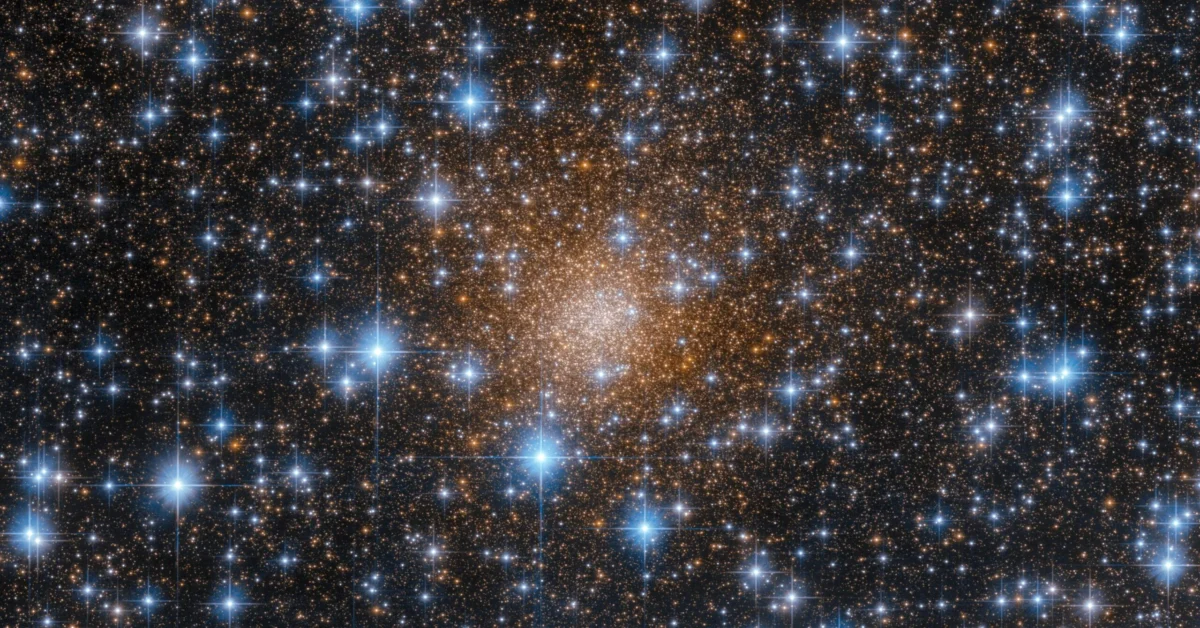
NASA’s iconic Hubble Space Telescope has unveiled a breathtaking new image of globular cluster NGC 6426, a celestial spectacle that evokes the vibrant burst of a sparkler against the dark canvas of the cosmos. This stunning release, timed to commemorate the United States’ upcoming 250th anniversary, underscores NASA’s enduring commitment to the spirit of exploration that has defined America’s journey into the universe. The image showcases a dense, spherical collection of stars, a testament to the profound scientific insights gleaned from decades of Hubble’s unwavering gaze upon the cosmos, and serves as a poignant reminder of the nation’s pioneering role in unraveling the universe’s mysteries.
NGC 6426, nestled within the sprawling outer halo of our own Milky Way galaxy, is more than just a beautiful arrangement of stars; it is a time capsule, offering a glimpse into the universe’s nascent stages. Globular clusters, like NGC 6426, are ancient, gravitationally bound congregations of stars, estimated to have formed as single, cohesive units from vast, collapsing clouds of gas billions of years ago. This shared origin imbues them with a remarkable uniformity in stellar age, and their inhabitants are among the oldest celestial bodies known. With an estimated age of approximately 13 billion years, NGC 6426 stands as one of the Milky Way’s most venerable globular clusters, a cosmic elder whose existence predates the universe’s current estimated age of 13.7 billion years by a mere fraction. This proximity to the universe’s birth makes such ancient clusters invaluable laboratories for understanding the conditions and processes that shaped the cosmos in its earliest epochs.
The striking visual representation of NGC 6426 in the Hubble image is not merely aesthetic; it is scientifically rich, with color serving as a crucial indicator of stellar properties. The vibrant blues in the image represent stars emitting light at shorter wavelengths, signifying higher temperatures. Conversely, the reds depict stars radiating at longer visible light wavelengths, as well as some near-infrared light, indicating cooler stellar temperatures. These color assignments are the result of sophisticated image processing techniques employed by NASA scientists, carefully calibrated to best represent the specific wavelengths of light captured by Hubble’s advanced filters during observation. The direct correlation between a star’s color and its temperature is a fundamental principle in astrophysics, allowing astronomers to infer crucial details about stellar evolution and composition simply by observing their emitted light.
A key characteristic of the stars within NGC 6426, as revealed by their spectral analysis, is their remarkably low metallicity. In astronomical terms, "metallicity" refers to the abundance of elements heavier than hydrogen and helium. The stars in this ancient cluster are predominantly composed of these primordial elements, a cosmic fingerprint that strongly resembles the chemical composition of the early universe. In the universe’s infancy, matter was almost exclusively hydrogen and helium, with heavier elements being scarce. These heavier elements were gradually synthesized through nuclear fusion within the cores of massive stars and subsequently dispersed into the interstellar medium through stellar explosions, or supernovae. The low metallicity of NGC 6426’s stars thus provides compelling evidence for their ancient origins, originating from a time when the universe was still in the process of forging its heavier constituents.
Further analysis of NGC 6426 has yielded even more intriguing discoveries: evidence of two distinct stellar populations within the cluster. This suggests a complex evolutionary history, where a subsequent generation of stars formed from material enriched by the explosive demise of earlier, more massive stars. When massive stars reach the end of their lives, they undergo supernova explosions, violent cosmic events that not only mark the end of a star but also act as cosmic forges, creating and scattering elements heavier than hydrogen and helium. These newly synthesized elements, dispersed throughout the galaxy, then serve as the raw materials for the formation of subsequent generations of stars and planets, a continuous cycle of cosmic creation and renewal. The presence of these two chemically distinct populations in NGC 6426 offers a tangible record of this enriching process, illustrating how the universe gradually built up its elemental diversity over eons.
The Hubble observations of NGC 6426 are part of a broader scientific initiative to study globular clusters residing in the Milky Way’s halo. The primary objectives of these studies are to accurately determine the ages of these ancient stellar congregations and, in doing so, to illuminate the intricate processes of galaxy formation and evolution. The Milky Way’s halo, a vast, roughly spherical region surrounding the galactic disk, is populated by some of the galaxy’s oldest stellar components, including globular clusters. Studying these objects provides crucial insights into the early assembly of our galaxy and the conditions under which it first began to coalesce.
Over its remarkable three-decade tenure in orbit, the Hubble Space Telescope has fundamentally reshaped humanity’s understanding of the universe. Its unparalleled resolution and sensitivity have enabled groundbreaking discoveries, from precisely measuring the expansion rate of the universe to imaging the most distant galaxies ever observed. Hubble’s legacy of exploration is not one that stands in isolation. Its observations are continuously amplified and complemented by an array of other cutting-edge NASA missions, each designed to probe different aspects of the cosmos. The James Webb Space Telescope, with its unparalleled infrared capabilities, delves deeper into the universe’s history, observing the first stars and galaxies to form after the Big Bang. The upcoming Nancy Grace Roman Space Telescope, slated for launch in late summer, promises to further expand our cosmic horizons with its wide-field survey capabilities, enabling the discovery of thousands of exoplanets and shedding light on dark energy. This synergistic approach, combining the strengths of multiple observatories, represents a powerful strategy for advancing our collective knowledge of the universe.
The United States’ commitment to space exploration, embodied by agencies like NASA, has a rich history that predates the nation’s 250th anniversary. The Space Act of 1958, which established NASA, marked a pivotal moment in the nation’s scientific endeavors, driven by the geopolitical landscape of the Cold War and the burgeoning Space Race. This early period saw rapid advancements in rocketry, satellite technology, and human spaceflight, culminating in the historic Apollo missions that landed humans on the Moon. Each mission, from the early Mercury and Gemini programs to the Skylab space station and the Space Shuttle era, built upon the knowledge and technological prowess of its predecessors. The Hubble Space Telescope, launched in 1990, represented a paradigm shift in observational astronomy, providing an unprecedented view of the universe from above Earth’s distorting atmosphere. Its continued operation and the stunning images it produces, like that of NGC 6426, serve as powerful symbols of this enduring legacy of scientific curiosity and technological innovation.
The celebration of America’s 250th anniversary, while a national milestone, resonates globally within the scientific community. The pursuit of knowledge about the cosmos is a shared human endeavor, and the discoveries made by NASA telescopes are freely shared, contributing to a global understanding of our place in the universe. The international collaboration inherent in many space missions, including contributions from agencies like the European Space Agency (ESA) to Hubble and the James Webb Space Telescope, further emphasizes this global aspect. The ongoing research into globular clusters like NGC 6426 is not just about understanding our own galaxy but about discerning universal principles of stellar and galactic evolution that apply across the cosmos.
The implications of studying ancient stellar populations like those in NGC 6426 are far-reaching. By understanding the conditions of the early universe, scientists can refine cosmological models, better comprehend the Big Bang theory, and investigate the processes that led to the formation of the first stars and galaxies. The study of low-metallicity stars also informs our understanding of planet formation. Early planetary systems would have formed from gas and dust with a much lower abundance of heavy elements, potentially influencing the types of planets that could form and their chemical compositions. This has direct relevance to the search for exoplanets and the potential for life beyond Earth, as it helps define the conditions under which habitable planets might arise.
Furthermore, the discovery of multiple stellar populations within a single globular cluster, as seen in NGC 6426, provides concrete evidence for the complex, multi-stage assembly of galaxies. It suggests that galaxies are not simply born fully formed but grow and evolve over billions of years through mergers and accretion of smaller structures, as well as through internal processes like star formation and supernova enrichment. This understanding of galactic evolution is fundamental to our comprehension of the cosmic web – the large-scale structure of the universe.
The ongoing commitment to space exploration, represented by NASA’s continued investment in observatories like Hubble and its successors, signifies a long-term vision for scientific discovery. The data gathered from these missions will continue to be analyzed for decades to come, yielding new insights and sparking further research. The legacy of exploration is not just about the images captured or the initial discoveries made, but about the enduring impact on scientific understanding and the inspiration it provides for future generations of scientists, engineers, and explorers. As the United States approaches its 250th anniversary, the shimmering stars of NGC 6426, captured by the tireless eye of the Hubble telescope, serve as a luminous reminder of a nation’s pioneering spirit and its profound contributions to humanity’s quest to understand the universe.
Media Contact:
Claire Andreoli
NASA’s Goddard Space Flight Center
Greenbelt, MD
[email protected]